
What This Calculator Does
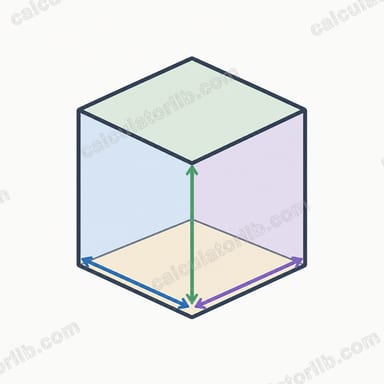
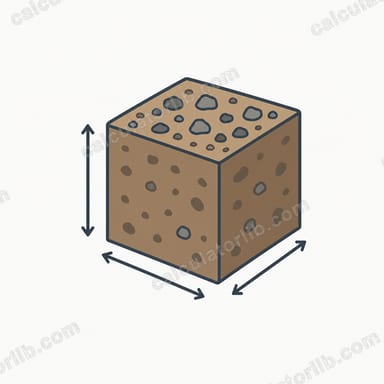
The Cubic Unit Cell Calculator computes the volume of a cubic unit cell and the theoretical density of a crystalline solid. Given the cube edge length a (in picometers), the number of atoms per unit cell n (1 for simple cubic, 2 for body-centered cubic, 4 for face-centered cubic), and the molar mass M, it returns both the cell volume and the predicted mass density. This is a universal physics/chemistry tool and applies everywhere — it does not depend on any country or jurisdiction.
How To Use It
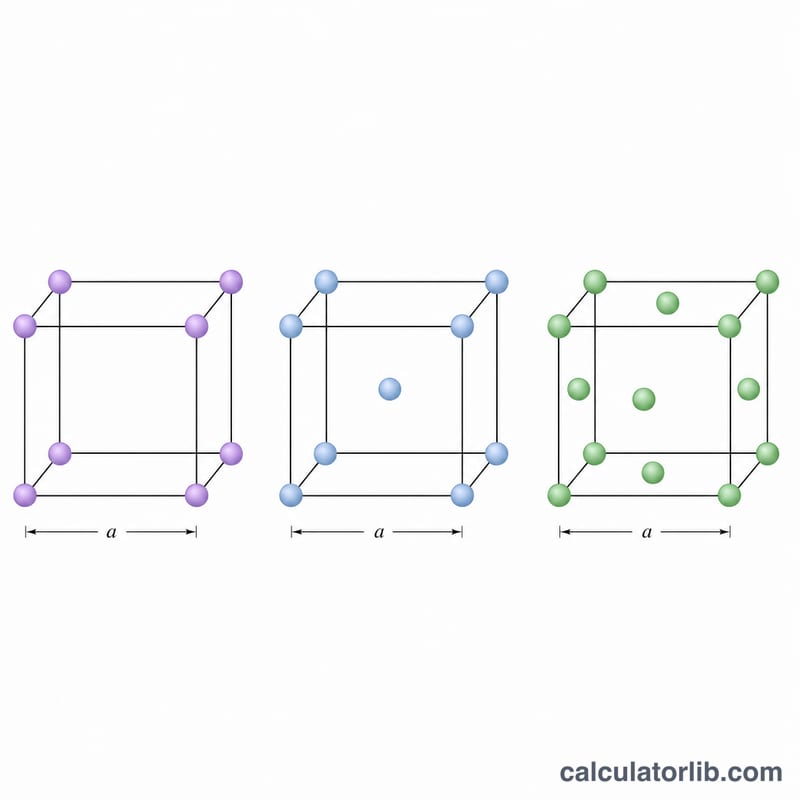
Enter the edge length in picometers, pick the lattice type (which sets atoms per cell), and type the molar mass in g/mol. The calculator returns the cell volume in pm³ and cm³, plus the theoretical density in g/cm³.
The Formula Explained
The cube volume is simply \(V = a^{3}\). For density we convert the edge to centimeters (1 pm = 1×10⁻¹⁰ cm), so the mass of n atoms — each contributing \(M/N_A\) grams — divided by the cell volume gives the following, with \(N_A = 6.02214076\times10^{23}\ \text{mol}^{-1}\).
$$\rho = \frac{n \cdot M}{N_A \cdot a^{3}}$$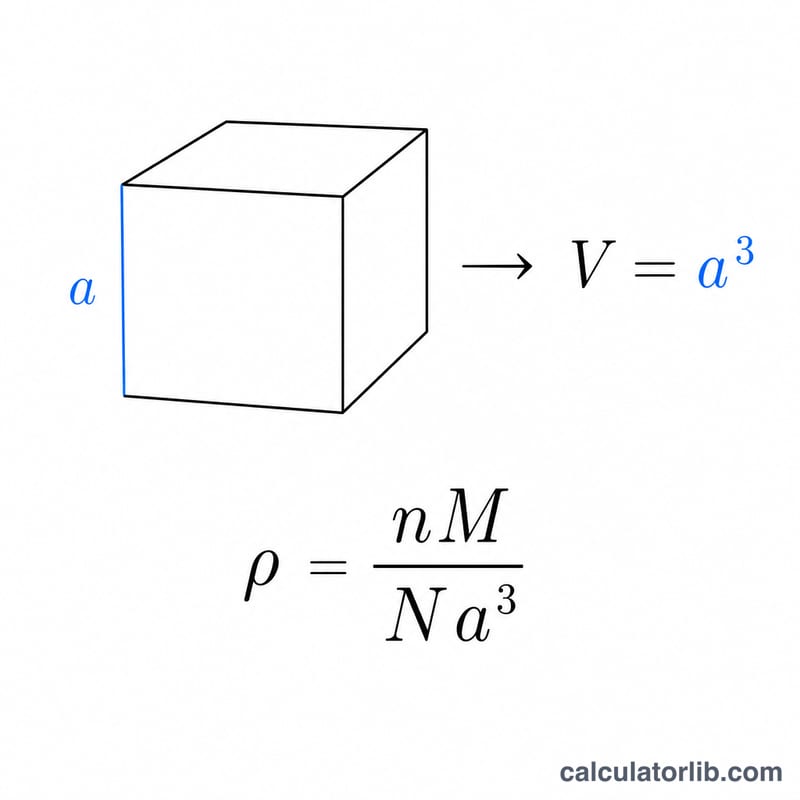
Worked Example
Copper is FCC with \(a = 361.5\) pm, \(n = 4\), \(M = 63.55\) g/mol. Volume = \(361.5^{3} \approx 4.7242\times10^{7}\) pm³. In cm: \(a = 3.615\times10^{-8}\) cm, so \(a^{3} \approx 4.7242\times10^{-23}\) cm³. Density:
$$\rho = \frac{4 \times 63.55}{6.02214\times10^{23} \times 4.7242\times10^{-23}} \approx 8.93\ \text{g/cm}^{3}$$— matching the measured density of copper.
FAQ
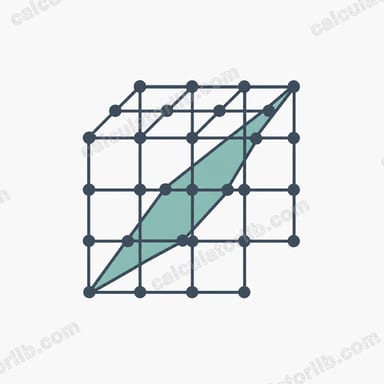
What is "atoms per unit cell"? It is the effective number of atoms wholly contained in one cell after sharing corners, edges, and faces: 1 (SC), 2 (BCC), 4 (FCC).
Why convert pm to cm? Density is conventionally g/cm³, so the edge must be in cm before cubing.
Can I use angstroms? Multiply angstroms by 100 to get picometers, then enter that value.