
What Is Dalton's Law of Partial Pressures?
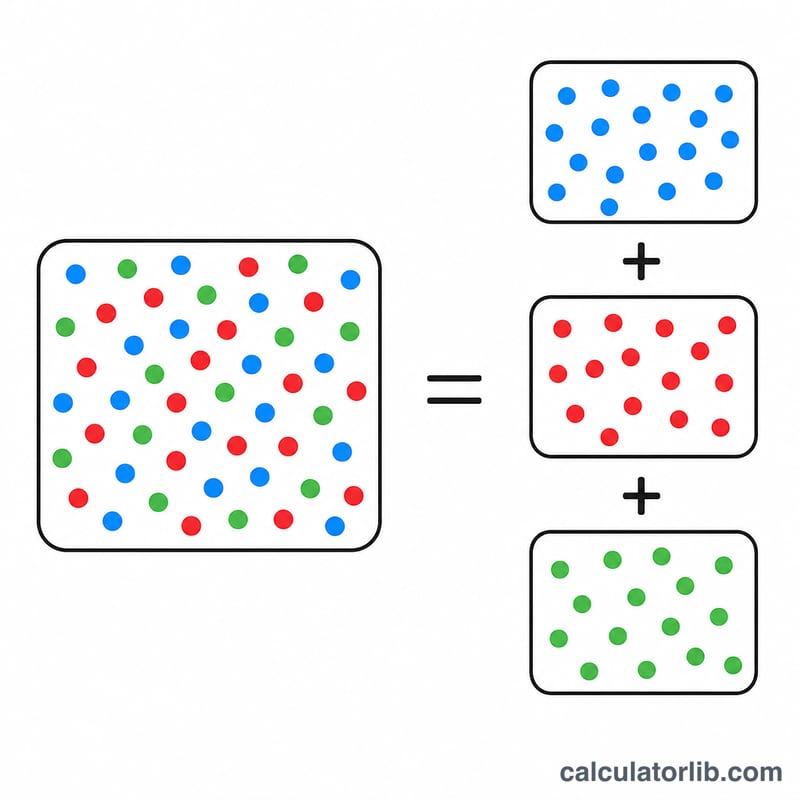
Dalton's Law states that in a mixture of non-reacting gases, the total pressure equals the sum of the partial pressures of each individual gas. A direct consequence is that the partial pressure of any single component is its mole fraction multiplied by the total pressure of the mixture. This calculator applies that relationship instantly to any pair of units, since the result comes out in whatever units you enter for total pressure (atm, kPa, mmHg, bar, psi).
How to Use This Calculator
Enter the mole fraction of the gas you care about — a dimensionless value between 0 and 1 — and the total pressure of the gas mixture. Press calculate to see the partial pressure of that gas along with the percentage of total pressure it contributes.
The Formula Explained
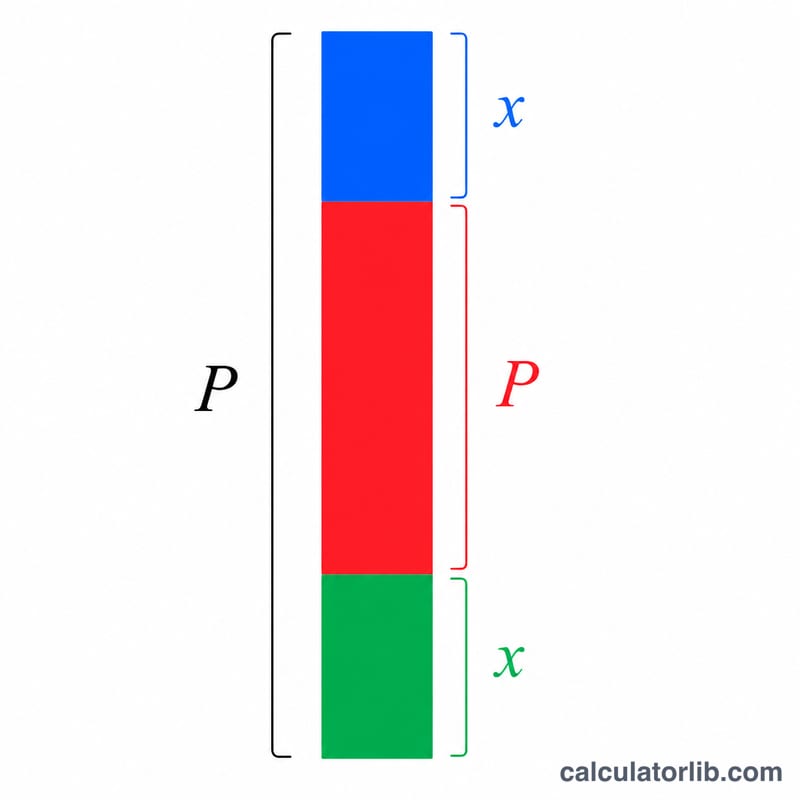
The governing equation is $$P_i = x_i \times P_{total}$$ where \(P_i\) is the partial pressure of component i, \(x_i\) is its mole fraction (moles of i divided by total moles), and \(P_{total}\) is the total pressure of the mixture. Because mole fractions of all components sum to 1, the partial pressures sum to the total pressure.
Worked Example
Air is roughly 21% oxygen by moles, so the mole fraction of oxygen is \(x = 0.21\). At a total atmospheric pressure of 1 atm, the partial pressure of oxygen is $$P_i = 0.21 \times 1 = 0.21 \text{ atm}$$ If instead the total pressure were 760 mmHg, oxygen's partial pressure would be \(0.21 \times 760 = 159.6\) mmHg.
FAQ
What units should I use? Any pressure unit works — the partial pressure comes out in the same unit you enter for total pressure.
Can the mole fraction be greater than 1? No. A mole fraction is always between 0 and 1, since it is a fraction of the total moles.
Does Dalton's Law work for all gases? It is most accurate for ideal gases and non-reacting mixtures at moderate pressures. Real gases at high pressure may deviate slightly.