
What Is a TDS Calculator?
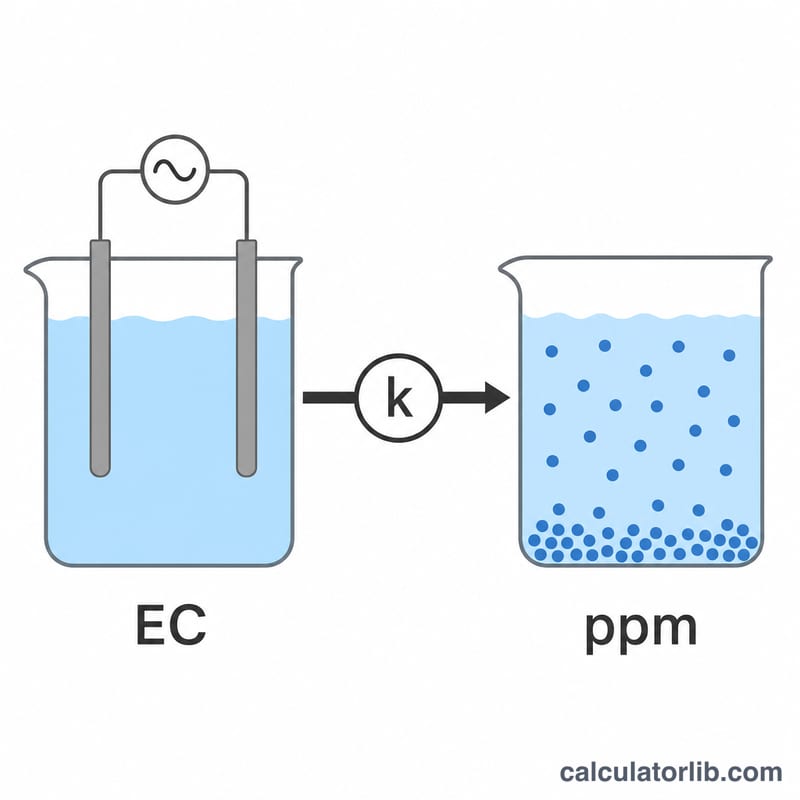
Total Dissolved Solids (TDS) measures the combined concentration of all dissolved inorganic and organic substances in water, expressed in parts per million (ppm) or milligrams per liter (mg/L). Since TDS is difficult to measure directly in the field, it is commonly estimated from a water sample's Electrical Conductivity (EC), which is measured in microsiemens per centimeter (µS/cm). This calculator converts EC to TDS using a simple conversion factor.
How to Use It
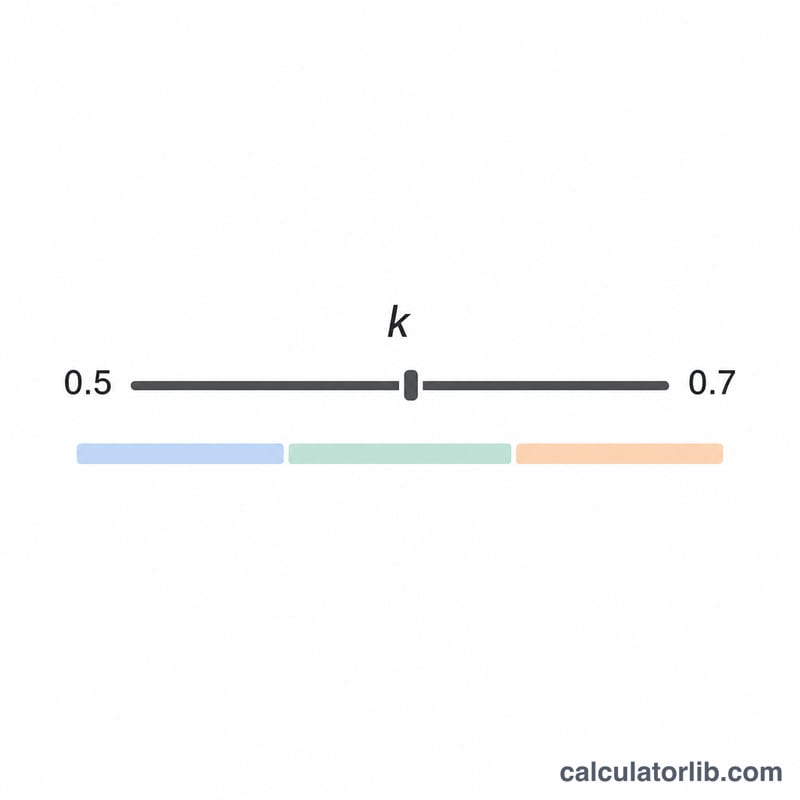
Enter your measured electrical conductivity in µS/cm and choose a conversion factor. Most TDS meters use a factor between 0.5 and 0.7: a factor of 0.5 (NaCl scale) is common in North America, while 0.64 (442 scale) and 0.7 (KCl scale) are used elsewhere. The calculator multiplies the two values to give TDS in ppm.
The Formula Explained
The relationship is linear: $$\text{TDS (ppm)} = \text{EC (µS/cm)} \times k$$ where \(k\) is the conversion factor. The factor accounts for the fact that different dissolved salts conduct electricity differently. Using the right factor for your water type improves accuracy, but any value in the 0.5–0.7 range gives a reasonable estimate.
Worked Example
Suppose a hydroponics reservoir reads 1,500 µS/cm and you use the common 0.5 factor. $$\text{TDS} = 1{,}500 \times 0.5 = 750 \text{ ppm}$$ If you switched to the 0.7 KCl factor, $$\text{TDS} = 1{,}500 \times 0.7 = 1{,}050 \text{ ppm}$$ — showing why the chosen factor matters when comparing readings.
FAQ
Which conversion factor should I use? Check your meter's documentation. If unknown, 0.5 is the most widely used default.
Is ppm the same as mg/L? For dilute water solutions, yes — \(1 \text{ ppm} \approx 1 \text{ mg/L}\).
Can I convert TDS back to EC? Yes: \(\text{EC} = \text{TDS} \div k\). Just divide your ppm value by the same factor.