What is the Plug-in Hybrid Economy Calculator?
A plug-in hybrid electric vehicle (PHEV) runs on battery power for shorter trips and switches to a gasoline engine for longer drives. This means your fuel budget has two separate components: electricity drawn from the grid and gasoline burned at the pump. This calculator combines both to estimate your true running cost over any period — a week, a month, or a year.
How to use it
Enter how many miles you drove in electric mode and how many in gas mode. Then add your vehicle's electric efficiency in miles per kWh, your electricity price per kWh, your gas efficiency in MPG, and your gas price per gallon. The calculator returns the total cost, a breakdown of electric vs gas spending, and your blended average cost per mile.
The formula explained
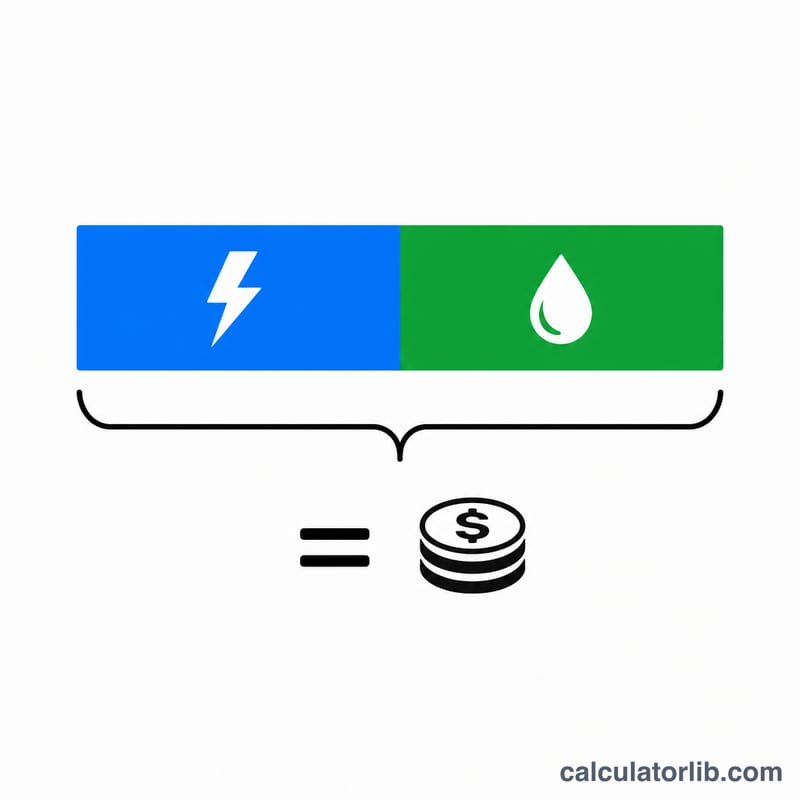
Electricity cost per mile equals price per kWh divided by miles per kWh. Gas cost per mile equals price per gallon divided by MPG. Multiply each by the miles driven in that mode and add them together:
$$\text{Cost} = \text{electric\_miles} \cdot \frac{\text{elec\_price}}{\text{efficiency}} + \text{gas\_miles} \cdot \frac{\text{gas\_price}}{\text{MPG}}$$
Worked example
Suppose you drive 800 electric miles and 400 gas miles. Your PHEV gets 3.5 mi/kWh at $0.15/kWh and 45 MPG at $3.50/gallon. Electric cost per mile = \(0.15 \div 3.5 = \$0.042857\), so electric cost = \(800 \times 0.042857 = \$34.29\). Gas cost per mile = \(3.50 \div 45 = \$0.077778\), so gas cost = \(400 \times 0.077778 = \$31.11\). Total = $65.40 for 1,200 miles, or about $0.0545 per mile.
Cost Comparison: Electric Share Scenarios
The table below compares the same 1,200-mile month at different electric shares of driving. Assumptions: 3.5 mi/kWh, $0.15/kWh electricity, 45 MPG in gas mode and $3.50/gal gasoline. That works out to about $0.0429 per electric mile ($0.15 ÷ 3.5) and about $0.0778 per gas mile ($3.50 ÷ 45). These are illustrative inputs, not a prediction for any specific vehicle or region.
| Electric share | Electric miles | Gas miles | Electric cost | Gas cost | Total cost | Blended cost per mile |
|---|---|---|---|---|---|---|
| 90% | 1,080 | 120 | $46.29 | $9.33 | $55.62 | $0.046 |
| 70% | 840 | 360 | $36.00 | $28.00 | $64.00 | $0.053 |
| 50% | 600 | 600 | $25.71 | $46.67 | $72.38 | $0.060 |
| 25% | 300 | 900 | $12.86 | $70.00 | $82.86 | $0.069 |
| 0% | 0 | 1,200 | $0.00 | $93.33 | $93.33 | $0.078 |
Example for the 70% row: \(840 \cdot \frac{0.15}{3.5} + 360 \cdot \frac{3.50}{45} = 36.00 + 28.00 = 64.00\). Moving from 0% to 90% electric driving cuts the monthly cost by about $37.71 under these assumptions. With cheaper gas or pricier electricity the gap narrows, and it can reverse if electricity is expensive enough.
Typical PHEV Efficiency and Price Ranges
The figures below are general ranges for typical plug-in hybrids. They are not guarantees, and individual vehicles, driving styles, temperatures and local prices differ.
| Input | Typical range | Notes |
|---|---|---|
| Electric efficiency | about 2.5–4 mi/kWh | Lower in cold weather, at highway speeds or with heavy cabin heating or cooling. Use kWh drawn from the wall, which includes charging losses. |
| Charge-depleting (all-electric) range | about 20–50 miles | Varies by battery size and conditions. |
| Gas-mode efficiency | about 35–50 MPG | Applies once the battery is depleted and the car runs as a regular hybrid. |
| US residential electricity price | roughly $0.12–$0.30/kWh | Depends heavily on region, utility and rate plan (time-of-use rates can be lower off-peak). |
| Gasoline price | varies | Changes with location, season and the market, so enter your current local price. |
Sources for checking your own numbers: the U.S. EPA and DOE fueleconomy.gov site lists rated electric and gas efficiency for specific PHEV models, and the U.S. Energy Information Administration (EIA) publishes average electricity and gasoline prices by state and region. The electricity and price ranges here are US-specific; other countries differ.
Key Terms: kWh, MPG, Charge-Depleting Mode
- PHEV (plug-in hybrid electric vehicle): a vehicle with both a gasoline engine and a battery that can be charged from the grid, allowing some driving on electricity alone.
- kWh (kilowatt-hour): a unit of energy equal to 1 kilowatt used for one hour. Electricity is billed per kWh.
- mi/kWh: miles driven per kWh of electricity. Higher is more efficient. Electric cost per mile = price per kWh ÷ mi/kWh.
- MPG (miles per gallon): miles driven per gallon of gasoline. Gas cost per mile = price per gallon ÷ MPG.
- Charge-depleting mode: the car uses stored battery energy (sometimes with occasional engine help) and the battery state of charge falls.
- Charge-sustaining mode: once the battery reaches its minimum level, the engine takes over and the car behaves like a conventional hybrid, holding the charge roughly steady.
- Blended cost per mile: total electricity plus gasoline cost divided by total miles driven, so it reflects your actual electric/gas split.
- MPGe (miles per gallon equivalent): an EPA metric that compares electric efficiency to gasoline using 33.7 kWh as the energy of one gallon: \(\text{MPGe} = \text{mi/kWh} \times 33.7\). For example, 3.5 mi/kWh ≈ 118 MPGe.
mi/kWh vs kWh/100 mi: these are reciprocals: \(\text{kWh/100 mi} = \frac{100}{\text{mi/kWh}}\). For example, 3.5 mi/kWh = \(100 \div 3.5 \approx 28.6\) kWh/100 mi. Higher mi/kWh is better, while lower kWh/100 mi is better.
FAQ
Why is electric driving usually cheaper? Electricity per mile is often a fraction of gasoline per mile because EV powertrains are far more efficient and electricity prices per unit of energy are typically lower.
What if I only drive electric? Set gas miles to zero and the calculator returns only your electricity cost.
Does this include charging losses? No. To account for charger inefficiency (typically 10-15%), reduce your stated mi/kWh figure slightly to reflect energy actually drawn from the wall.