What the TDEE to BMI goal weight calculator does
This tool answers two linked questions at once. First, it converts a target BMI into an exact goal weight for your height. Second, it uses your TDEE (Total Daily Energy Expenditure, the calories you burn on an average day) to work out the daily calorie deficit or surplus that moves you from your current weight to that goal weight within a timeframe you choose.
In short: pick the BMI you are aiming for, tell the calculator how many calories you burn, and it returns the weight you are heading toward plus a daily calorie budget to get there.
How to use it
Enter your height in centimetres and your current weight in kilograms. Add your TDEE in calories per day; if you do not know it, calculate it first with a TDEE calculator. Choose a target BMI (18.5 to 24.9 is the normal-weight range) and a timeframe in weeks. The result shows your goal weight, how many kilograms you need to lose or gain, the total energy involved, and the daily calorie deficit or surplus alongside a recommended daily intake.
The formula explained
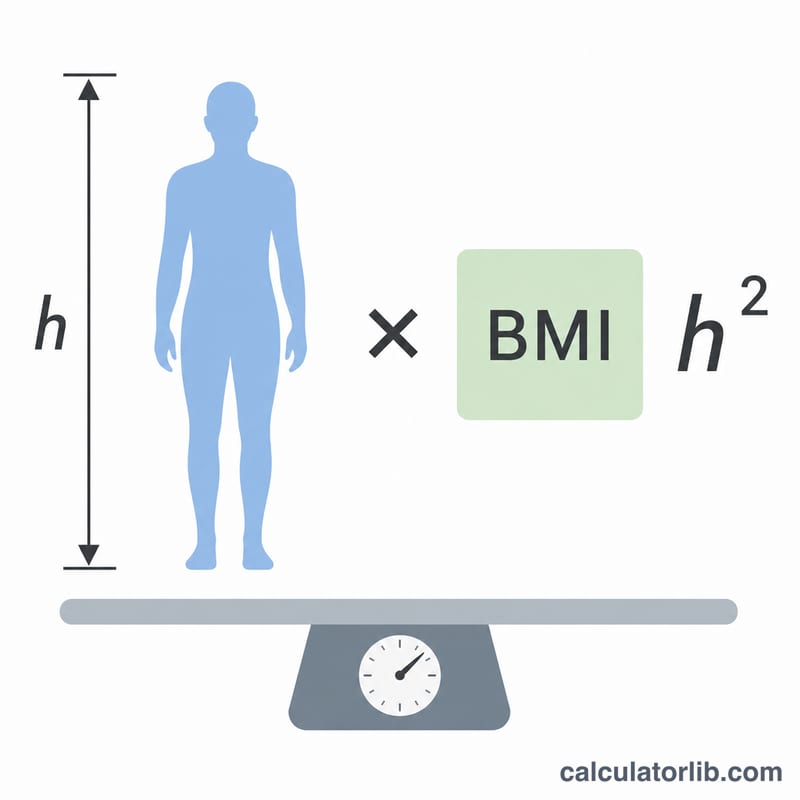
Goal weight comes straight from the BMI definition, rearranged to solve for weight:
$$ W_{goal} = \text{BMI}_{target} \times \left( \frac{h}{100} \right)^2 $$where h is height in centimetres. The daily calorie change uses the widely cited rule that one kilogram of body mass is worth about 7,700 kcal (equivalently 3,500 kcal per pound):
$$ \text{Daily change} = \frac{ |W_{now} - W_{goal}| \times 7700 }{ \text{weeks} \times 7 } $$Your recommended intake is then your TDEE minus that number to lose weight, or plus it to gain:
$$ \text{Target intake} = \text{TDEE} \pm \text{Daily change} $$Worked example
Suppose you are 175 cm tall, weigh 80 kg, have a TDEE of 2,500 kcal, and want to reach a BMI of 22 over 12 weeks. Goal weight is 22 multiplied by 1.75 squared, which is 22 times 3.0625, or about 67.4 kg. You therefore need to lose 12.63 kg. That is 12.63 times 7,700, roughly 97,200 kcal, spread over 84 days, a deficit of about 1,157 kcal per day. Subtracting that from your 2,500 kcal TDEE gives a target intake of about 1,343 kcal per day.
BMI Categories and Goal Weight by Height
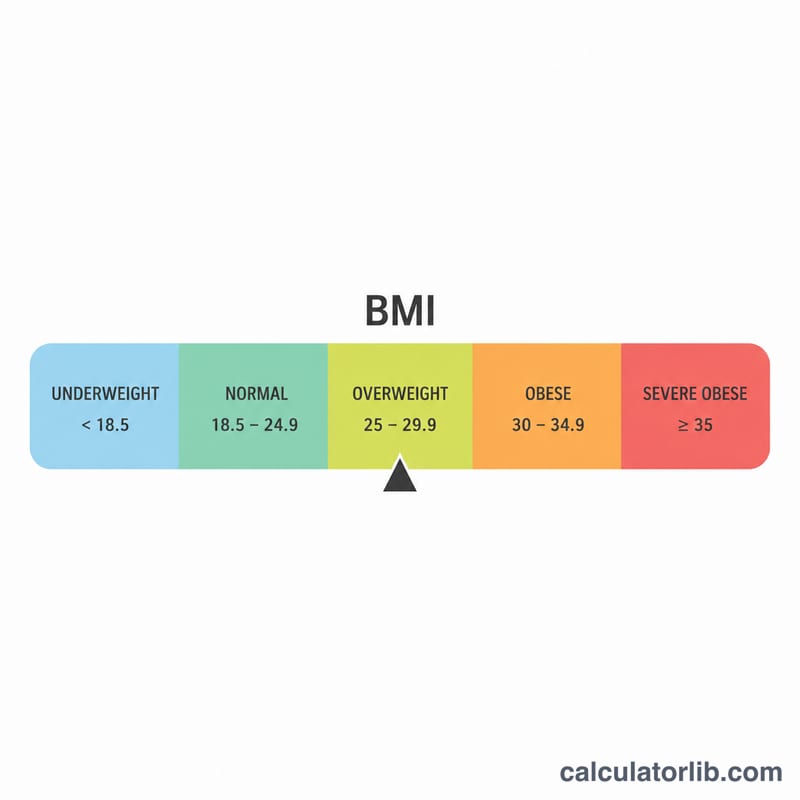
Body mass index is weight in kilograms divided by height in metres squared. The calculator reverses this: \(\text{Goal Weight (kg)} = \text{BMI} \times (\text{height in m})^2\). The categories below are the WHO adult BMI categories.
| Category (WHO, adults) | BMI (kg/m²) |
|---|---|
| Underweight | below 18.5 |
| Normal range | 18.5 – 24.9 |
| Overweight | 25 – 29.9 |
| Obesity class I | 30 – 34.9 |
| Obesity class II | 35 – 39.9 |
| Obesity class III | 40 and above |
Goal weights in kg (rounded to 0.1 kg) for several heights:
| Height | BMI 18.5 | BMI 22 | BMI 24.9 |
|---|---|---|---|
| 150 cm | 41.6 | 49.5 | 56.0 |
| 160 cm | 47.4 | 56.3 | 63.7 |
| 170 cm | 53.5 | 63.6 | 72.0 |
| 180 cm | 59.9 | 71.3 | 80.7 |
| 190 cm | 66.8 | 79.4 | 89.9 |
Example: at 170 cm and BMI 22, \(22 \times 1.70^2 = 22 \times 2.89 = 63.58\) kg.
Interpreting Your Result
The goal weight is simply the body weight that would produce your chosen BMI at your height. It is a reference point, not a prediction of what is healthy or ideal for you personally.
Limitations of BMI
- BMI does not distinguish muscle from fat, so a muscular person can have a high BMI with low body fat.
- It says nothing about where fat is stored (for example abdominal fat) or about fitness and metabolic health.
- The relationship between BMI and health risk varies with age, sex and ethnicity. The WHO categories above are the international standard for adults, but for Asian populations some health authorities suggest lower cut-offs for increased risk (commonly around 23 for overweight and 27.5 for high risk).
- BMI categories are for adults and do not apply in the same way to children, teenagers or pregnant women.
About the calorie math
The calculator uses the common approximation that about 7,700 kcal corresponds to 1 kg of body weight change. This is a rough rule: as you lose weight your energy needs usually fall and your metabolism adapts, so real-world changes differ from the straight-line estimate. Water balance also affects early changes on the scale.
Public health guidance commonly cites a gradual rate of about 0.5–1 kg per week as a sustainable pace. Very large daily deficits can push intake below commonly cited minimum levels (often quoted around 1,200 kcal/day for women and 1,500 kcal/day for men without medical supervision), which can make it harder to meet nutrient needs.
This is general information only, not personal or medical advice. Consult a doctor or registered dietitian before making major changes to your diet or weight.
Scenario Comparison: Timeframe vs Daily Calorie Change
Example: height 175 cm, current weight 80 kg, goal BMI 22, TDEE 2,500 kcal/day. The goal weight is \(22 \times 1.75^2 = 22 \times 3.0625 = 67.375\), about 67.4 kg, so about 12.63 kg must be lost. Total energy change is \(12.63 \times 7700 = 97{,}251\) kcal, and the daily deficit is \(\frac{ 12.63 \times 7700 }{ \text{weeks} \times 7 }\). For 16 weeks: \(\frac{97251}{112} \approx 868\) kcal/day.
| Timeframe | Daily deficit (kcal/day) | Target intake (kcal/day) | Weekly change (kg) |
|---|---|---|---|
| 8 weeks | 1,737 | 763 | 1.58 |
| 12 weeks | 1,158 | 1,342 | 1.05 |
| 16 weeks | 868 | 1,632 | 0.79 |
| 24 weeks | 579 | 1,921 | 0.53 |
| 36 weeks | 386 | 2,114 | 0.35 |
The 8-week plan implies a weekly loss above the commonly cited 0.5–1 kg range and an intake far below commonly cited minimum levels, so it is generally not considered appropriate without medical supervision. The 12-week plan is still slightly above that range. Longer timeframes such as 16–24 weeks fall closer to gradual-rate guidance. These figures are estimates based on the 7,700 kcal/kg approximation; actual results vary. This is general information, not personal advice.
Frequently asked questions
Do I need my TDEE to use this? You need it for the calorie part. Goal weight only depends on your height and target BMI, but the daily-calorie budget compares your intake against the energy you burn, which is exactly what TDEE measures.
How accurate is the 7,700 kcal per kilogram figure? It is a well-established approximation (often called the 3,500-calorie rule) and is fine for planning. In reality your metabolism adapts as you lose weight, so progress usually slows over time and you may need to reassess.
Is the recommended intake always safe? Not necessarily. Very aggressive timeframes can push intake below healthy limits. As a general guide, do not eat below about 1,200 kcal per day (women) or 1,500 kcal per day (men) without medical supervision; instead, extend the timeframe.