
What this calculator does
The Body Mass Index (BMI) is defined as weight in kilograms divided by the square of height in meters. This is a universal metric used worldwide. Normally you compute BMI from a known weight and height. This calculator works in reverse: you tell it a target BMI and a height, and it tells you the body weight that produces exactly that BMI. It also builds a height-versus-weight table so you can see, at the same BMI, how the ideal weight changes across a whole range of heights.
How to use it
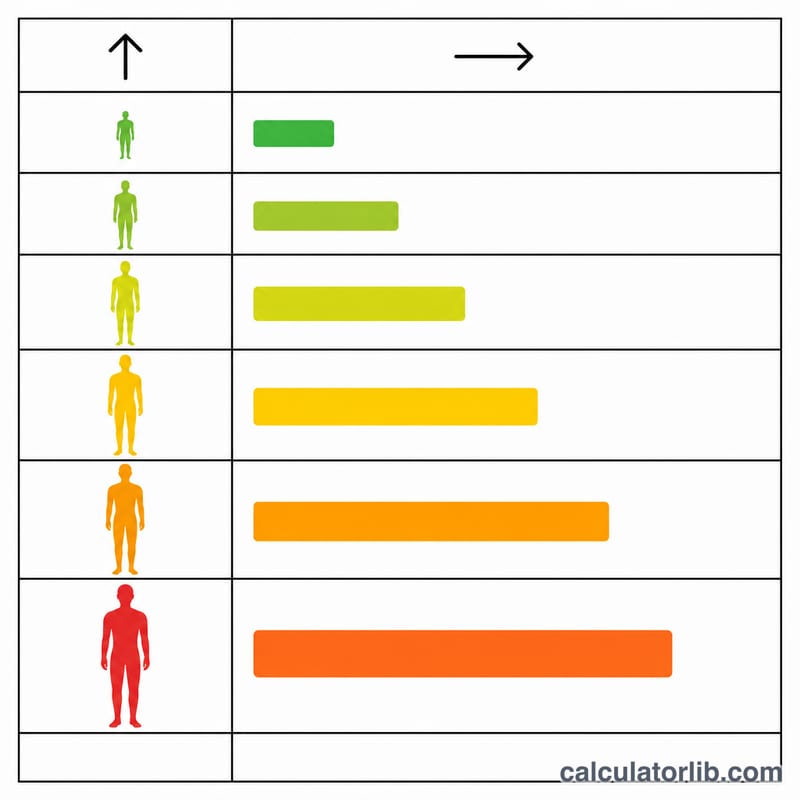
Enter four values: the BMI value you want to target (22 is a common reference, often described as the BMI at which a person is least likely to become ill), the initial height in centimeters, the increment by which each table row should grow, and the number of repetitions (rows) to generate. The hero box shows the weight for your starting height; the table lists the weight for every stepped height in both kilograms and pounds.
The formula explained
Starting from \(\text{BMI} = \text{weight} / \text{height}_m^2\), simple algebra gives \(\text{weight} = \text{BMI} \times \text{height}_m^2\). Because the calculator takes height in centimeters, it first divides by 100 to convert to meters. The relationship is exact and fully reversible, so the weight returned will reproduce your input BMI if you feed it back into a standard BMI calculator.
$$\text{Weight (kg)} = \text{BMI} \times \left(\frac{\text{Height (cm)} + i \cdot \text{Step (cm)}}{100}\right)^2$$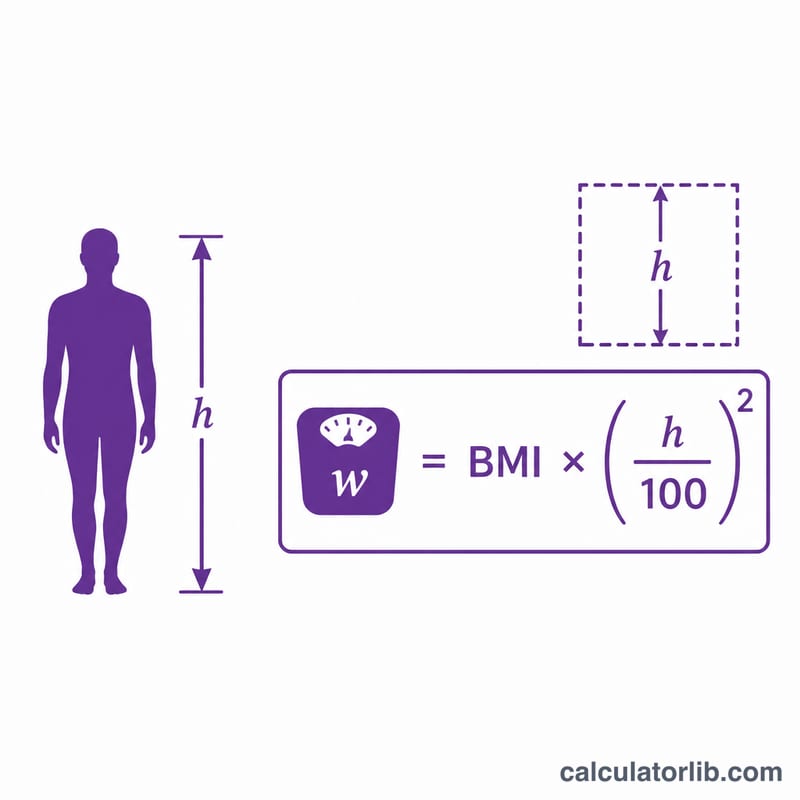
Worked example
Suppose BMI = 22 and height = 170 cm. Convert the height: \(170 / 100 = 1.70\) m. Then
$$\text{weight} = 22 \times 1.70^2 = 22 \times 2.89 = 63.58 \text{ kg}$$For a height table starting at 140 cm stepping by 1 cm: 140 cm gives \(22 \times 1.40^2 = 43.12\) kg, and 190 cm gives \(22 \times 1.90^2 = 79.42\) kg.
FAQ
Is this only for adults? Yes. BMI thresholds and the "ideal" reference of 22 apply to adults; children and adolescents use age- and sex-specific percentiles instead.
Does it depend on my country? No. BMI is the same physical relationship everywhere, so this tool is universal. The 22 reference is general health guidance, not a legal or country-specific rule.
What if I enter a BMI of zero? A BMI of zero or below is non-physical and would yield zero or negative weight, so BMI and height must both be positive numbers.