
What Is a Triangular Pyramid?
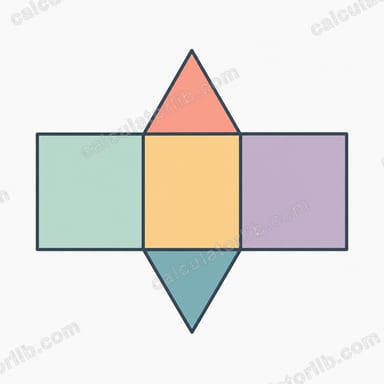
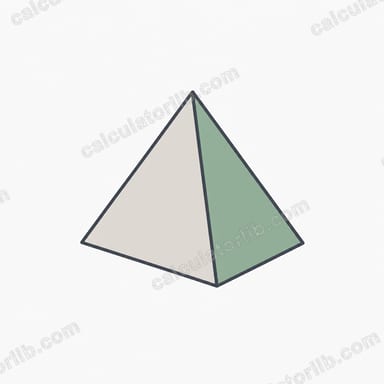
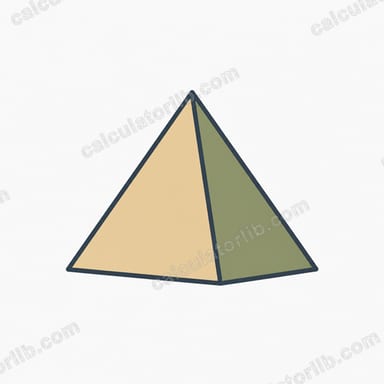
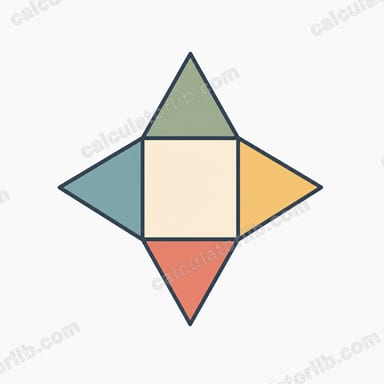
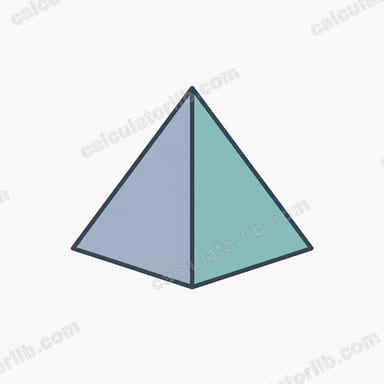
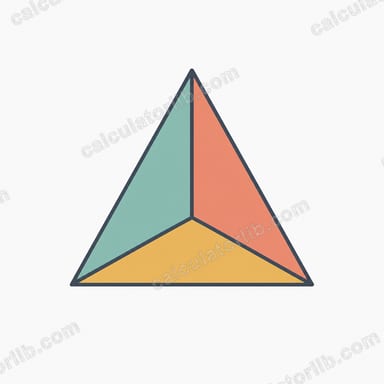
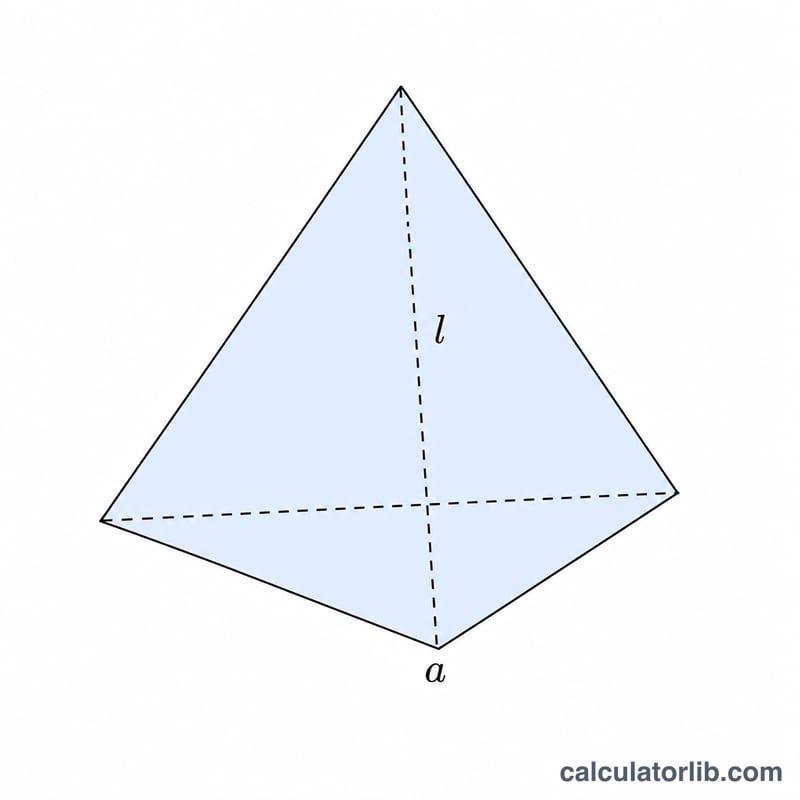
A triangular pyramid, also called a tetrahedron when all faces are triangles, is a solid with a triangular base and three triangular lateral faces meeting at an apex. This calculator finds the total surface area of a pyramid with an equilateral triangular base, using the base edge length a and the slant height l of each lateral face.
How to Use the Calculator
Enter the base edge length a (the length of one side of the equilateral triangle) and the slant height l (the height of each triangular side face, measured from the base edge up to the apex). The calculator instantly returns the total surface area along with a breakdown of the base area and lateral area. All inputs and outputs share the same unit; the result is in square units.
The Formula Explained
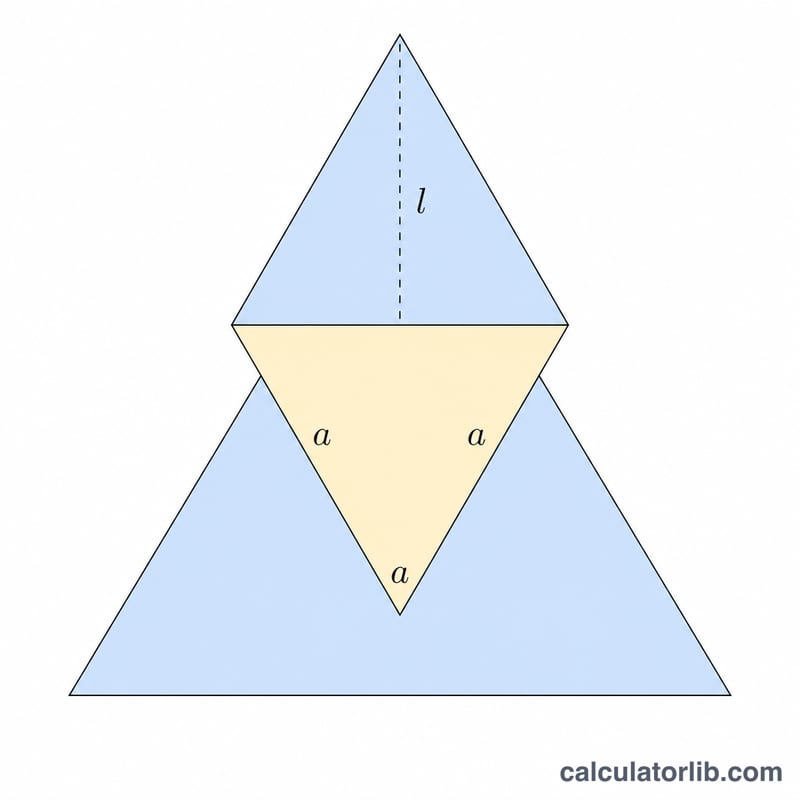
The total surface area is the sum of the base and the three lateral faces:
$$SA = \frac{\sqrt{3}}{4}\cdot a^{2} + \frac{3}{2}\cdot a\cdot l$$
The term \(\frac{\sqrt{3}}{4}\cdot a^{2}\) is the area of the equilateral triangular base. Each lateral face is a triangle with base a and height l, giving \(\frac{1}{2}\cdot a\cdot l\) per face; three such faces total \(\frac{3}{2}\cdot a\cdot l\).
Worked Example
Suppose the base edge \(a = 6\) and the slant height \(l = 5\). The base area is $$\frac{\sqrt{3}}{4}\cdot 6^{2} = \frac{\sqrt{3}}{4}\cdot 36 \approx 15.59.$$ The lateral area is $$\frac{3}{2}\cdot 6\cdot 5 = 45.$$ The total surface area is \(15.59 + 45 \approx\) 60.59 square units.
FAQ
Is slant height the same as the pyramid's height? No. The slant height is measured along a triangular face from the base edge to the apex, while the vertical height runs straight up from the base center to the apex.
Does this work for a regular tetrahedron? A regular tetrahedron has four identical equilateral faces. For that special case the slant height equals \(\frac{\sqrt{3}}{2}\cdot a\), and total surface area simplifies to \(\sqrt{3}\cdot a^{2}\).
What units should I use? Any consistent length unit. If a and l are in centimeters, the surface area is in square centimeters.