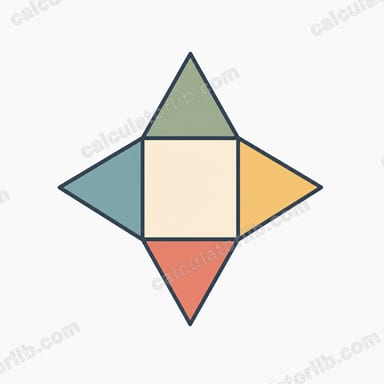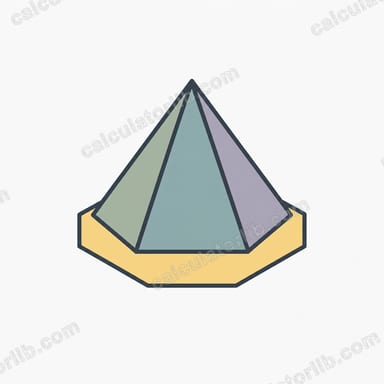

What Is a Hexagonal Pyramid Surface Area Calculator?
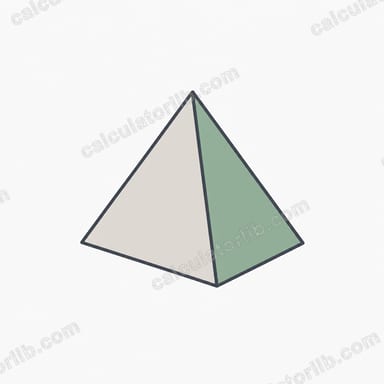
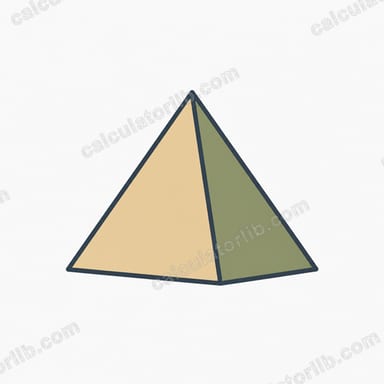
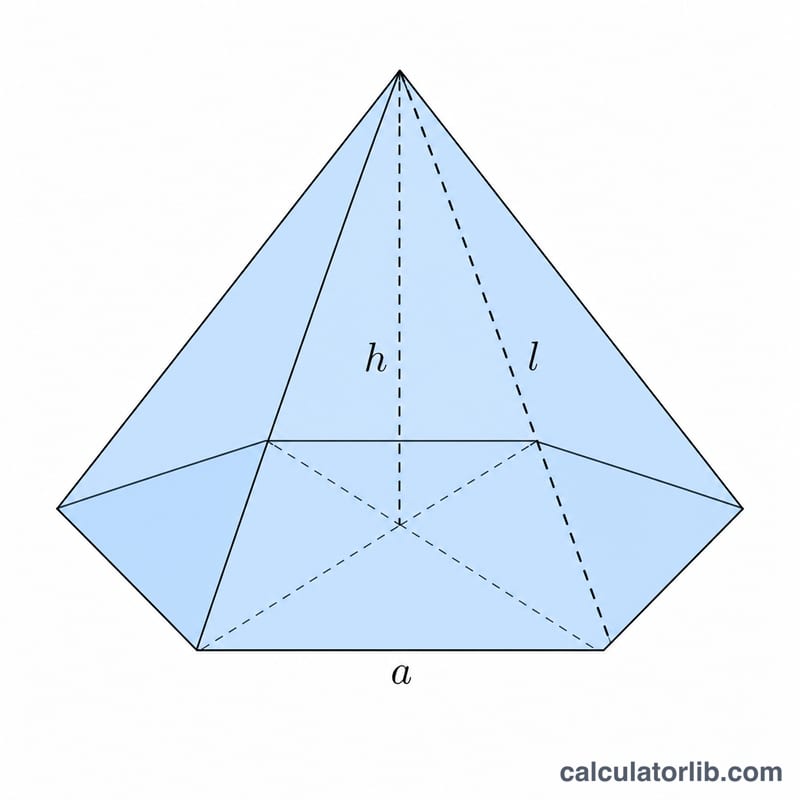
A hexagonal pyramid is a three-dimensional solid with a regular six-sided base and six triangular faces that meet at a single apex. This calculator finds its total surface area — the combined area of the hexagonal base plus all six lateral triangular faces — using just two measurements: the base edge length a and the perpendicular height h.
How to Use It
Enter the base edge length (the length of one side of the hexagon) and the pyramid's vertical height (from the center of the base straight up to the apex). The calculator returns the total surface area, along with the base area, lateral (side) area, and slant height as a helpful breakdown. All values share the same unit system, so if you input centimeters, areas come out in square centimeters.
The Formula Explained
The base is a regular hexagon, whose area is \(\frac{3\sqrt{3}}{2}\,a^{2}\). The apothem (distance from center to the middle of an edge) is \(\frac{\sqrt{3}}{2}\,a\). Combined with the height, the slant height of each triangular face is
$$\ell = \sqrt{h^{2} + \left(\tfrac{\sqrt{3}}{2}\,a\right)^{2}}$$Each of the six triangles has area \(\tfrac{1}{2}\,a\,\ell\), so the lateral area is \(6\cdot\left(\tfrac{1}{2}\,a\,\ell\right) = 3\,a\,\ell\). Adding base and lateral areas gives the full formula.
$$A = \frac{3\sqrt{3}}{2}\,a^{2} + 3\,a\,\ell$$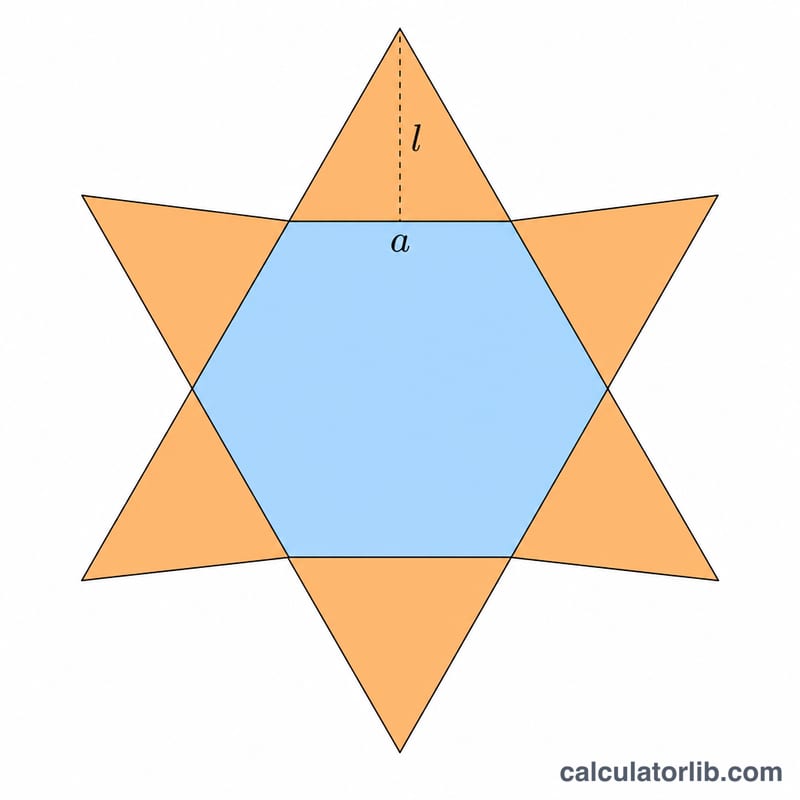
Worked Example
Suppose a = 6 and h = 10. The base area is \(\frac{3\sqrt{3}}{2}\cdot 36 \approx 93.53\). The apothem is \(\frac{\sqrt{3}}{2}\cdot 6 \approx 5.196\), so the slant height is
$$\ell = \sqrt{100 + 27} = \sqrt{127} \approx 11.269$$The lateral area is \(3\cdot 6\cdot 11.269 \approx 202.84\). Total surface area
$$A \approx 93.53 + 202.84 = \mathbf{296.37 \text{ square units}}$$FAQ
What is the difference between height and slant height? Height is the vertical distance from base center to apex; slant height runs along a triangular face from the apex to the midpoint of a base edge.
Do I need the slant height to use this tool? No — it is computed automatically from the base edge and the pyramid height.
What if I only want the lateral area? The result breakdown lists the lateral area separately, which is the surface area excluding the base.