
What this calculator does
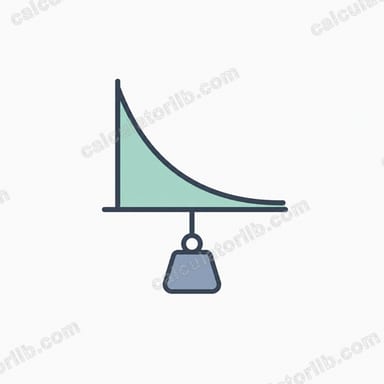
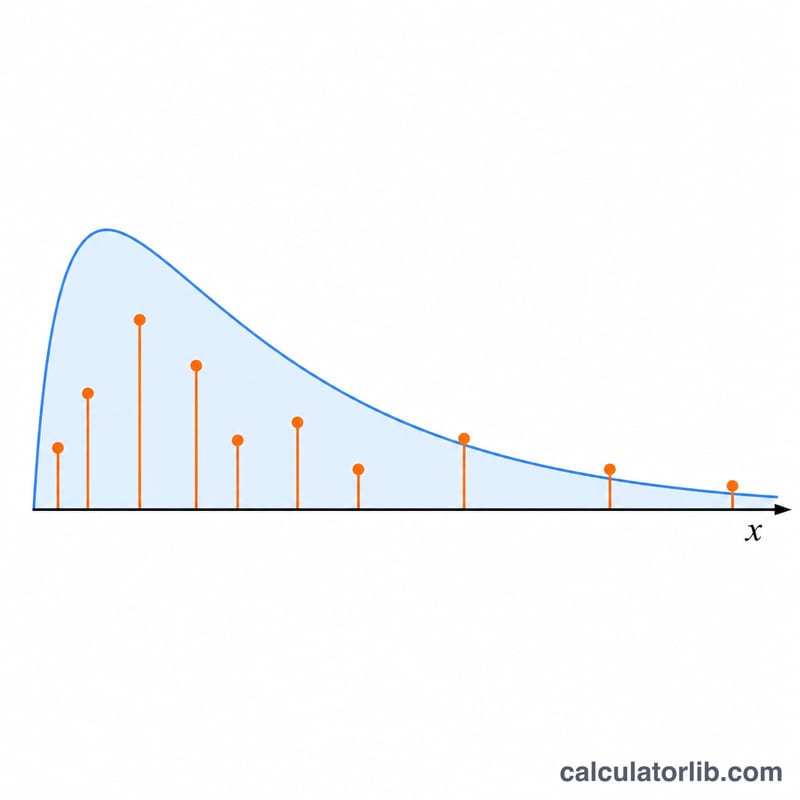
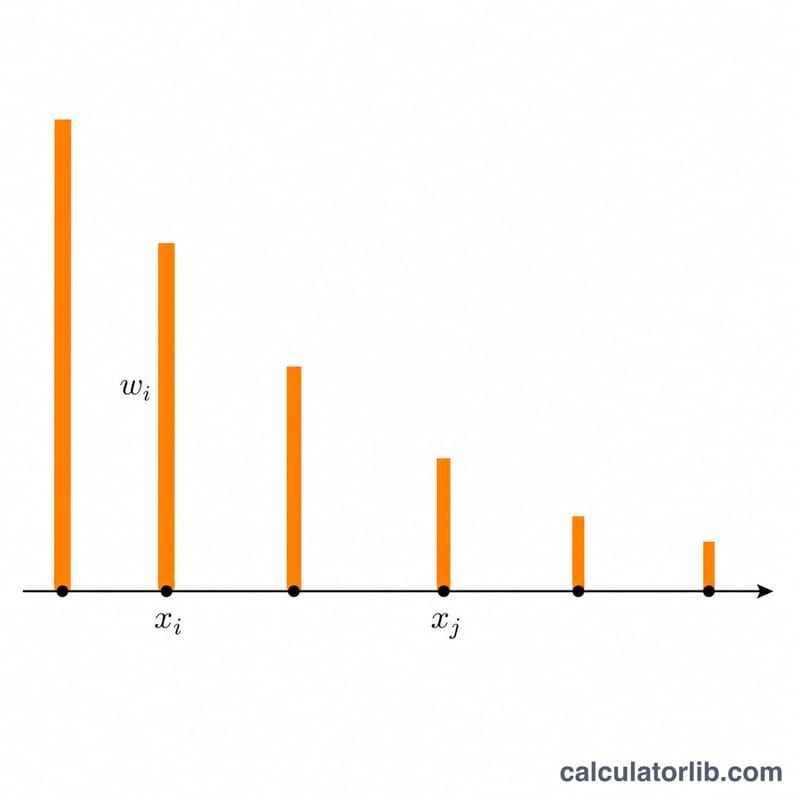
This tool computes the nodes (abscissas) \(x_i\) and weights \(w_i\) for n-point generalized Gauss-Laguerre quadrature. It is a pure-mathematics numerical-integration tool that works the same everywhere. The rule approximates integrals over the semi-infinite interval [0, ∞) that carry the weight function \(x^{\alpha}e^{-x}\):
$$\int_{0}^{\infty} x^{\alpha} e^{-x} f(x)\, dx \approx \sum_{i=1}^{n} w_i\, f(x_i)$$The nodes are the positive zeros of the generalized Laguerre polynomial \(L_n^{(\alpha)}(x)\), and the rule is exact whenever f is a polynomial of degree at most \(2n-1\).
How to use it
Pick the Order n (number of points, 2 to 100), enter the exponent parameter \(\alpha\) (any real number greater than −1; the classic Gauss-Laguerre rule uses \(\alpha = 0\)), and choose how many significant display digits you want. The result lists every node and its paired weight in increasing order of \(x_i\), plus a built-in self-check.
The formula and method
Each weight obeys the closed form $$w_i = \frac{\Gamma(n+\alpha+1)\cdot x_i}{n!\cdot\left[(n+1)L_{n+1}^{(\alpha)}(x_i)\right]^{2}}.$$ Internally we use the equivalent and numerically stable Golub-Welsch method: build the symmetric tridiagonal Jacobi matrix with diagonal \(a_k = 2k+\alpha+1\) and off-diagonals \(b_k = \sqrt{k(k+\alpha)}\). Its eigenvalues are the nodes, and each weight equals \(\mu_0\cdot(\text{first eigenvector component})^{2}\), where \(\mu_0 = \Gamma(\alpha+1)\) is the zeroth moment. This avoids overflow from large factorials.
Worked example
For \(n = 2\), \(\alpha = 0\): \(L_2^{(0)}(x) = (x^2-4x+2)/2\), so the roots are \(x = 2 \pm \sqrt{2}\), giving \(x_1 = 0.5857864\) and \(x_2 = 3.4142136\). The weights are $$w_1 = \frac{2+\sqrt{2}}{4} = 0.8535534 \quad\text{and}\quad w_2 = \frac{2-\sqrt{2}}{4} = 0.1464466.$$ Their sum is \(1 = \Gamma(1)\), confirming the result.
FAQ
What does \(\alpha\) do? It sets the weight \(x^{\alpha}\); \(\alpha = 0\) gives standard Gauss-Laguerre, while \(\alpha > 0\) emphasizes weight away from the origin. It must exceed −1.
How accurate is it? The n-point rule integrates polynomials up to degree \(2n-1\) exactly; smooth functions converge rapidly.
How can I check the output? The sum of all weights always equals \(\Gamma(\alpha+1)\), shown as the zeroth moment row.