
What This Calculator Does
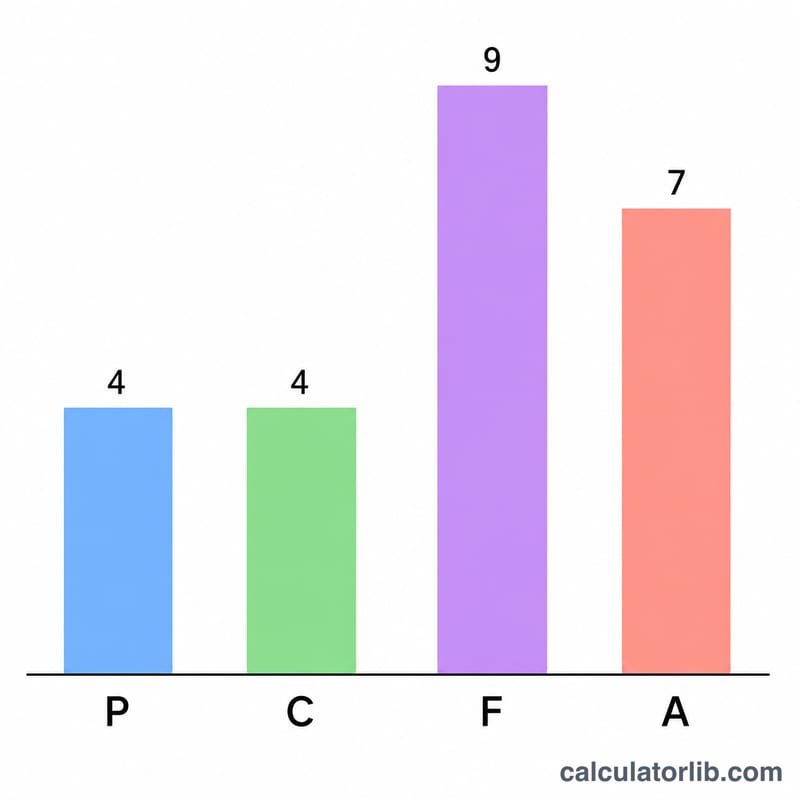
This tool converts the grams of each macronutrient in a food or meal into calories (kilocalories). It uses the standard Atwater energy factors: carbohydrates and protein each supply about 4 kcal per gram, fat supplies 9 kcal per gram, and alcohol supplies 7 kcal per gram. Enter the grams from any nutrition label and instantly see the total energy plus how those calories are split across macros.
How to Use It
Read the grams of carbohydrate, protein and fat from the nutrition facts panel and type each into its field. If the item contains alcohol (for example wine, beer or spirits), add the grams of pure alcohol too — otherwise leave it at 0. Press calculate to see the total calories and a percentage breakdown of where those calories come from.
The Formula Explained
The calculation is a simple weighted sum:
$$\text{calories} = 4 \times \text{carbs} + 4 \times \text{protein} + 9 \times \text{fat} + 7 \times \text{alcohol}$$Each gram of a macronutrient releases a known amount of energy when metabolised, so multiplying grams by the per-gram factor and adding them up gives total energy. The percentage for each macro is its calories divided by the total, times 100.
Worked Example
Suppose a meal has 50 g carbohydrate, 30 g protein, 20 g fat and no alcohol.
$$\text{Carbs} = 4 \times 50 = 200 \text{ kcal}$$$$\text{Protein} = 4 \times 30 = 120 \text{ kcal}$$$$\text{Fat} = 9 \times 20 = 180 \text{ kcal}$$$$\text{Total} = 200 + 120 + 180 = \mathbf{500 \text{ kcal}}$$The split is 40% carbs, 24% protein and 36% fat.
FAQ
Why does fat have more calories per gram? Fat molecules are more energy-dense, releasing roughly 9 kcal per gram versus 4 for carbs and protein.
Should I count fiber? Fiber is a carbohydrate but is largely indigestible; labels often already account for it, so this tool uses the listed total carbohydrate value.
Why might my total differ slightly from the label? Manufacturers may use modified Atwater factors or round values, so small differences of a few calories are normal.