
What Is the Ejection Fraction Calculator?
The ejection fraction (EF) calculator estimates left ventricular ejection fraction (LVEF) — the percentage of blood the left ventricle pumps out with each heartbeat. It is one of the most important measures of how well the heart is functioning and is widely used in echocardiography, cardiac MRI, and nuclear imaging. This tool is a general educational aid and is not a substitute for clinical interpretation by a physician.
How to Use It
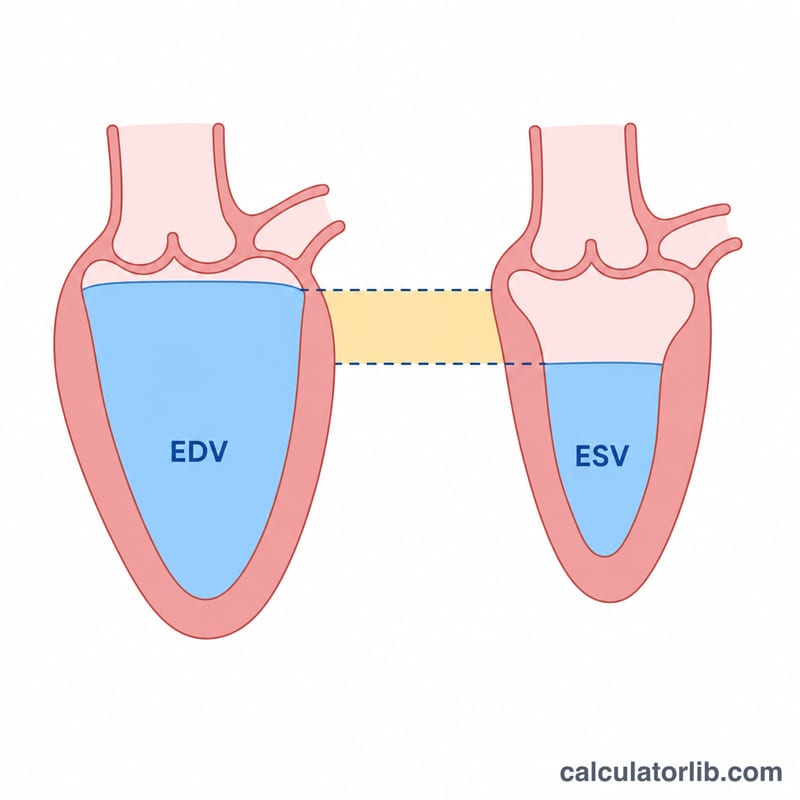
Enter the end-diastolic volume (EDV) — the amount of blood in the left ventricle when it is fully filled — and the end-systolic volume (ESV) — the blood remaining after contraction. Both are in milliliters (mL). The calculator returns the EF percentage, the stroke volume, and a general classification.
The Formula Explained
Ejection fraction is calculated as:
$$\text{EF\%} = \frac{\text{EDV (mL)} - \text{ESV (mL)}}{\text{EDV (mL)}} \times 100$$
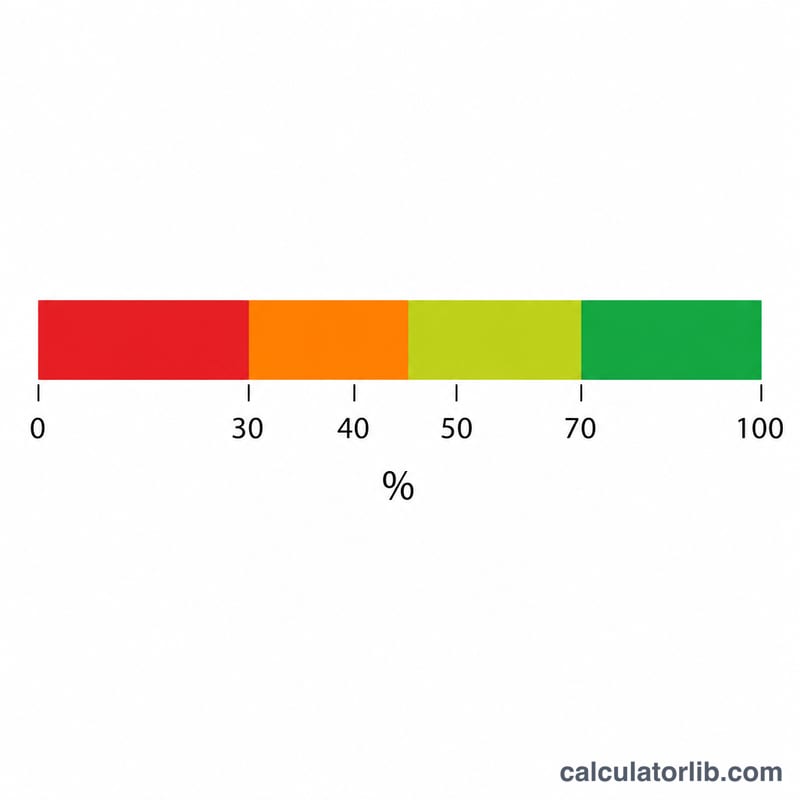
The difference EDV − ESV is the stroke volume (SV), the blood actually ejected per beat. Dividing by EDV and multiplying by 100 expresses that as a percentage of the filled volume. A normal LVEF is roughly 50–70%. Values of 40–49% are mildly reduced, and below 40% indicates reduced systolic function (heart failure with reduced ejection fraction, HFrEF).
Worked Example
Suppose EDV = 120 mL and ESV = 50 mL. Stroke volume = \(120 - 50 = 70\) mL. $$\text{EF\%} = \frac{70}{120} \times 100 = 58.33\%$$ which falls in the normal range.
FAQ
What is a normal ejection fraction? A healthy LVEF is typically 50–70%. Above ~75% can be hyperdynamic.
What does a low EF mean? An EF below 40% suggests reduced pumping ability and is associated with heart failure, warranting medical evaluation.
Can EF be over 100%? No. Because ESV is always less than EDV, EF is always between 0% and 100%.