
What is Mean Arterial Pressure (MAP)?
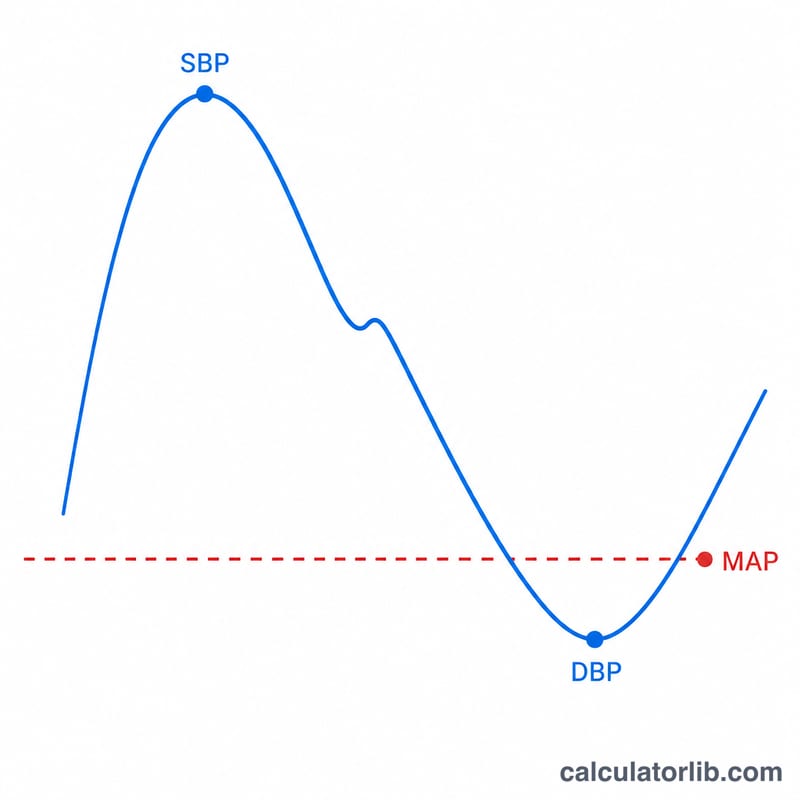
Mean Arterial Pressure (MAP) is the average pressure in a person's arteries during one cardiac cycle. Because the heart spends roughly two-thirds of each cycle in diastole, MAP is weighted toward the diastolic pressure rather than being a simple average of systolic and diastolic readings. Clinicians use MAP to gauge whether vital organs such as the brain, kidneys, and heart are receiving adequate blood flow. A MAP of about 70–100 mmHg is generally considered normal for perfusion.
How to Use This Calculator
Enter your systolic blood pressure (SBP, the top number) and diastolic blood pressure (DBP, the bottom number) in mmHg, then read the resulting MAP. The calculator also displays your pulse pressure (SBP − DBP) for reference. This tool is for educational estimation only and is not a substitute for professional medical advice.
The Formula Explained
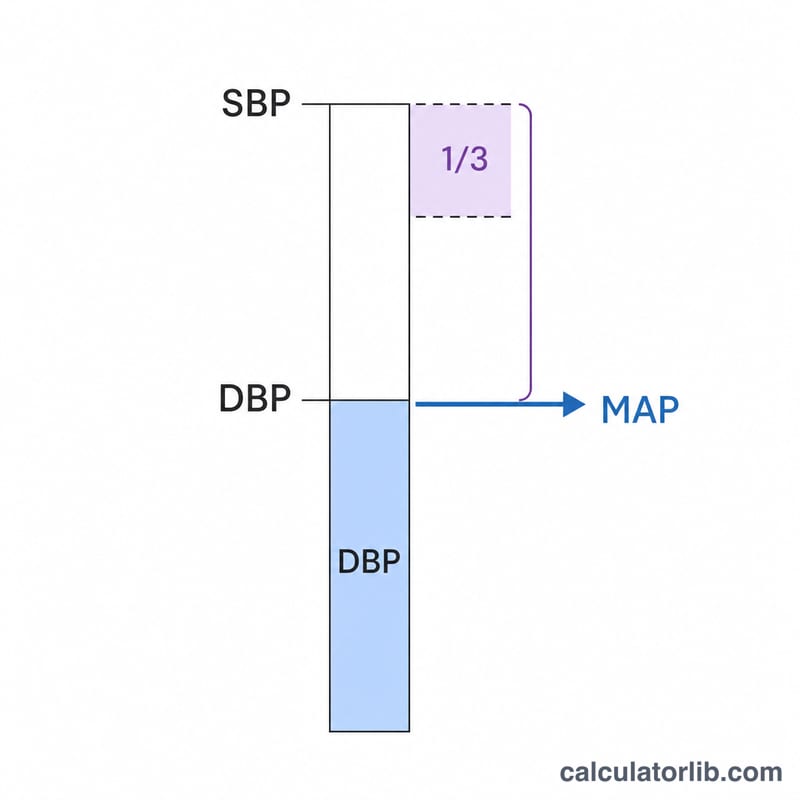
The standard estimate is $$\text{MAP} = \text{DBP} + \frac{\text{SBP} - \text{DBP}}{3}$$ The term \((\text{SBP} - \text{DBP})\) is the pulse pressure, and dividing it by three reflects the relative time the heart spends in diastole versus systole. An equivalent form is $$\text{MAP} = \frac{\text{SBP} + 2 \times \text{DBP}}{3}$$
Worked Example
For a blood pressure of 120/80 mmHg: pulse pressure = \(120 - 80 = 40\) mmHg. $$\text{MAP} = 80 + \frac{40}{3} = 80 + 13.33 = \mathbf{93.33}\ \textbf{mmHg}$$ which falls comfortably within the normal perfusion range.
FAQ
Is MAP just the average of SBP and DBP? No. Because diastole lasts longer than systole, MAP is weighted toward the diastolic value, so it is lower than the simple average.
What MAP is considered healthy? A MAP between roughly 70 and 100 mmHg is typically adequate for organ perfusion, though targets vary by clinical situation.
Does this formula work at high heart rates? The 1/3 weighting assumes a normal resting heart rate. At very high rates, diastole shortens and this estimate becomes less accurate.