
What is Systemic Vascular Resistance?
Systemic vascular resistance (SVR) is the resistance the left ventricle must overcome to eject blood into the systemic circulation. It reflects the degree of vasoconstriction or vasodilation in the peripheral arterioles and is a key hemodynamic parameter in critical care, anesthesia and the management of shock. SVR is most commonly reported in dynes·s·cm⁻⁵, with a typical normal range of about 800–1200 dynes·s·cm⁻⁵.
How to use this calculator
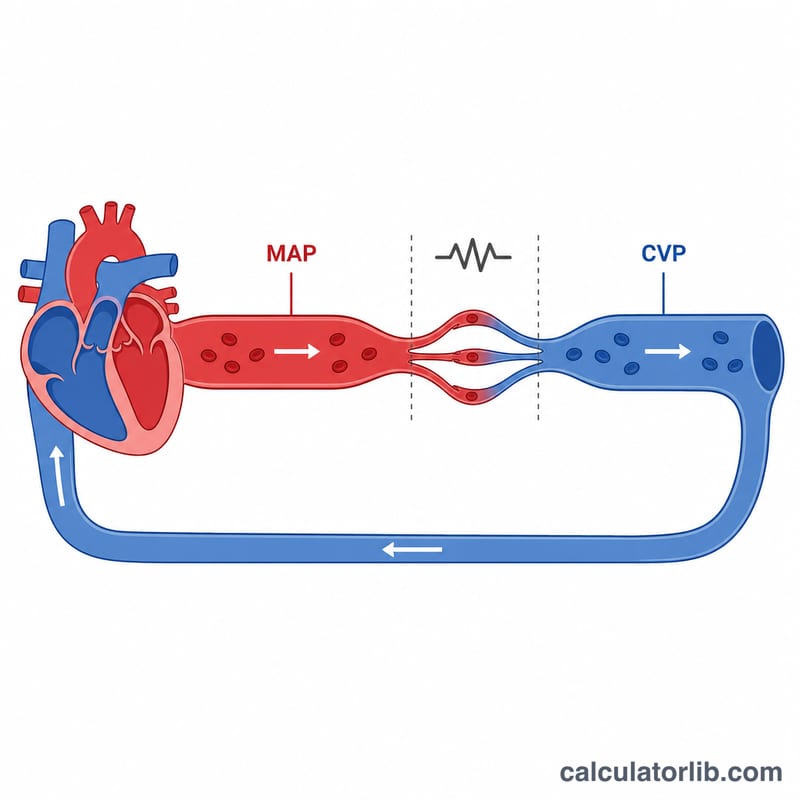
Enter three measured values: the mean arterial pressure (MAP) in mmHg, the central venous pressure (CVP) in mmHg, and the cardiac output (CO) in liters per minute. The calculator returns SVR in dynes·s·cm⁻⁵ and also in Wood units. MAP can be estimated as \((\text{systolic} + 2 \times \text{diastolic}) / 3\) if not measured directly, and CO is often obtained via thermodilution or echocardiography.
The formula explained
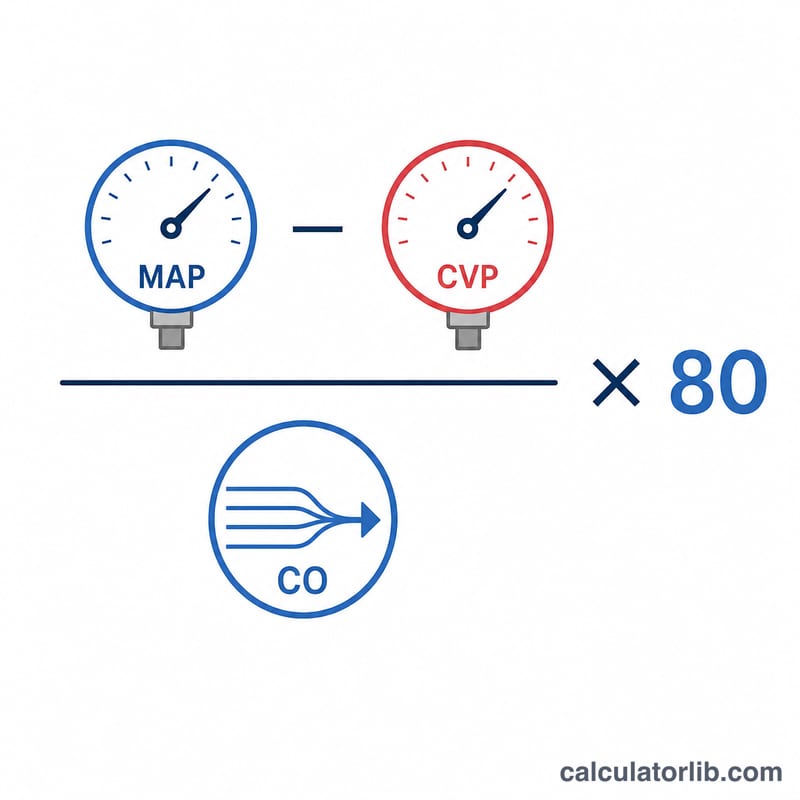
$$\text{SVR} = \frac{\text{MAP} - \text{CVP}}{\text{CO}} \times 80$$ The pressure difference \((\text{MAP} - \text{CVP})\) is the driving pressure gradient across the systemic circulation. Dividing by cardiac output gives resistance in Wood units (mmHg·min/L). Multiplying by the conversion factor 80 expresses the result in the standard CGS unit, dynes·s·cm⁻⁵.
Worked example
Suppose MAP = 93 mmHg, CVP = 5 mmHg, and CO = 5 L/min. Then $$\text{SVR} = \frac{93 - 5}{5} \times 80 = \frac{88}{5} \times 80 = 17.6 \times 80 = 1408 {\text{ dynes}\cdot{\text{s}\cdot\text{cm}}}^{-5},$$ which is slightly above the normal range, suggesting mild vasoconstriction.
FAQ
What is a normal SVR? Roughly 800–1200 dynes·s·cm⁻⁵. Low SVR is seen in distributive shock (e.g. sepsis); high SVR in hypovolemic or cardiogenic shock with compensatory vasoconstriction.
What is the difference between SVR and SVRI? SVRI is SVR indexed to body surface area (using cardiac index instead of cardiac output), making comparisons between patients of different sizes more meaningful.
Can I use Wood units instead? Yes — Wood units are simply \((\text{MAP} - \text{CVP}) / \text{CO}\) without the factor of 80. This calculator displays both.