
What this calculator does
This tool estimates your Blood Alcohol Content (BAC) — the percentage of alcohol in your bloodstream — using the classic Widmark equation. BAC is expressed as grams of alcohol per 100 mL of blood (g/100 mL, or simply "%"). It is an educational estimate based on the number of drinks, your body weight, your gender and how long ago you started drinking. Real BAC depends on many additional factors, so this should never be used to decide whether it is safe to drive.
How to use it
Select your gender, enter your body weight in kilograms, the number of standard drinks consumed, the grams of pure alcohol in each drink, and the number of hours since your first drink. A US standard drink contains about 14 g of pure alcohol; a UK unit is 8 g. The calculator multiplies drinks by grams per drink to get total alcohol, then applies the Widmark formula.
The formula explained
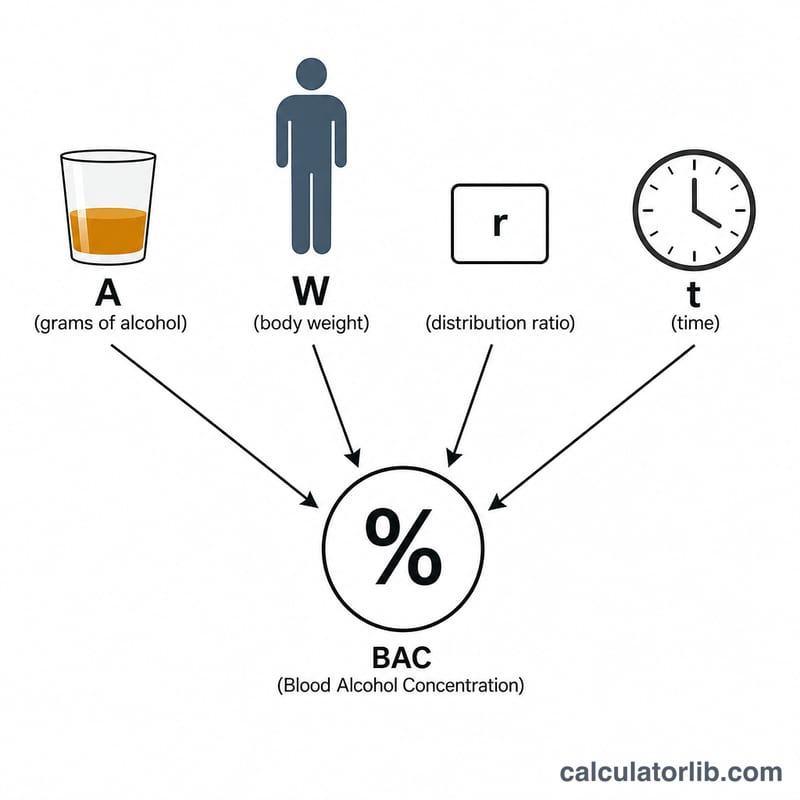
$$\text{BAC}\% = \frac{A}{W \times 1000 \cdot r} \times 100 - 0.015 \times t$$ Here \(A\) is grams of pure alcohol, \(W \times 1000\) converts kilograms to grams, and \(r\) is the Widmark distribution ratio — roughly \(0.68\) for men and \(0.55\) for women, reflecting that alcohol distributes through body water. The body clears about \(0.015\) percentage points of BAC per hour, which is subtracted as the \(0.015 \times t\) term.
Worked example
An 80 kg man drinks 3 standard drinks of 14 g each, 1 hour ago. \(A = 3 \times 14 = 42\) g, \(W \times 1000 = 80{,}000\) g, \(r = 0.68\). $$\text{BAC} = \frac{42}{80{,}000 \times 0.68} \times 100 - 0.015 \times 1 = \frac{42}{54{,}400} \times 100 - 0.015 = 0.07721 - 0.015 \approx 0.062\%$$ At \(0.015\%/\text{hr}\) it would take about 4.1 hours to reach 0.00%.
Interpreting Your BAC Result
Blood alcohol content (BAC) is expressed as a percentage of alcohol by mass in the blood — a BAC of 0.08% means 0.08 grams of alcohol per 100 mL of blood. The bands below are widely documented reference figures describing the typical effects of alcohol at given BAC levels. Individual responses vary substantially with tolerance, food intake, medication, hydration and health, so treat any single number as an approximation.
| BAC (%) | Typical documented effects |
|---|---|
| ~0.02 | Mild impairment; slight relaxation, minor decline in visual tracking and divided attention. |
| ~0.05 | Reduced coordination, lowered alertness, impaired judgement and slower response to driving situations. Legal limit for driving in Scotland and much of the EU. |
| 0.08 | Common legal driving limit in the United States and in England, Wales & Northern Ireland. Marked impairment of muscle coordination, balance, speech, reaction time and self-control. |
| 0.15–0.20 | Significant loss of balance and motor control; vomiting and disorientation likely. |
| 0.30 and above | Life-threatening. Risk of stupor, loss of consciousness, suppressed breathing and alcohol poisoning. Medical emergency. |
Important: These figures are established educational reference points, not a measurement. This calculator produces only an estimate and must never be used to decide whether it is safe or legal to drive. If you have consumed any alcohol, do not drive.
Standard Drink & Alcohol Unit Conversions
Different countries define a "standard drink" or alcohol "unit" by a fixed mass of pure ethanol, not by container size. The Widmark formula needs grams of pure alcohol, so it helps to know these reference amounts:
| Definition | Pure alcohol per unit |
|---|---|
| US standard drink | 14 g |
| UK unit | 8 g |
| EU / WHO standard drink | ~10 g |
To find the grams of pure alcohol in any beverage, use the density of ethanol (0.789 g/mL):
$$A_{\text{grams}} = V_{\text{mL}} \times \frac{\text{ABV}\%}{100} \times 0.789$$
| Drink | Volume | ABV | Pure alcohol |
|---|---|---|---|
| Regular beer | 12 oz (355 mL) | 5% | 355 × 0.05 × 0.789 ≈ 14.0 g |
| Wine | 5 oz (148 mL) | 12% | 148 × 0.12 × 0.789 ≈ 14.0 g |
| Distilled spirits | 1.5 oz (44 mL) | 40% | 44 × 0.40 × 0.789 ≈ 13.9 g |
Each of these common servings contains close to one US standard drink (14 g) of pure alcohol — which is why "a beer, a glass of wine, or a shot" are often treated as roughly equivalent. Enter the appropriate grams-per-drink value in the calculator to match your country's definition.
Definitions & Glossary
- BAC (Blood Alcohol Content)
- The concentration of alcohol in the bloodstream, expressed as a percentage of grams of ethanol per 100 mL of blood (e.g. 0.08% = 0.08 g/100 mL).
- Widmark formula
- A classic equation, developed by Erik Widmark, that estimates BAC from the mass of alcohol consumed, body weight, a body-water distribution ratio, and the time elapsed since drinking. It is an approximation for whole-body alcohol distribution.
- Distribution ratio (r)
- A dimensionless factor reflecting the fraction of body mass made up of water available to dilute alcohol. Commonly taken as ≈0.68 for men and ≈0.55 for women, because alcohol distributes into body water and men typically have a higher water proportion.
- Grams of pure alcohol (A)
- The total mass of ethanol consumed, computed as the number of drinks multiplied by the grams of alcohol per drink. This is the input that drives the BAC estimate.
- Elimination / clearance rate
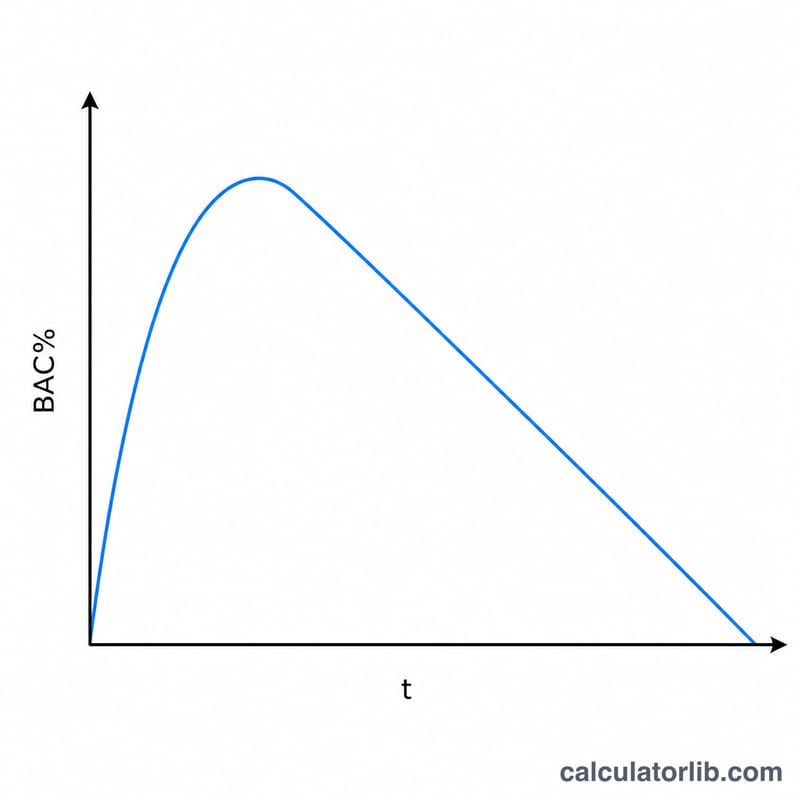
- The rate at which the body metabolizes alcohol, lowering BAC over time. A widely used average is about 0.015% per hour, though it ranges roughly 0.01–0.02%/hr between individuals. In the formula this appears as the \(-0.015 \times \text{hours}\) term.
- Standard drink
- A fixed reference quantity of pure alcohol used to compare beverages — 14 g in the US, 8 g (one unit) in the UK, and about 10 g in the EU/WHO definition.
- Body water proportion
- The share of body mass that is water. Because ethanol dissolves in water but not fat, people with a higher body-water proportion reach a lower BAC from the same amount of alcohol. This biological reality is captured by the distribution ratio \(r\).
FAQ
Is this legally accurate? No. It is a rough estimate. Legal BAC must be measured with a breathalyser or blood test.
Why are men and women different? Women generally have a lower proportion of body water, so the same alcohol produces a higher BAC, captured by the lower \(r\) value.
How long until I'm sober? The "hours to reach 0.00%" row divides your current estimated BAC by the \(0.015\%/\text{hr}\) clearance rate, but individual rates vary.