
What is the Roman Numeral to Number Calculator?
This tool converts Roman numerals such as MCMXCIV into their everyday decimal (Arabic) value, like 1994. Roman numerals use seven letters — I, V, X, L, C, D and M — each carrying a fixed value, combined according to additive and subtractive rules.
How to use it
Type a Roman numeral into the box and submit. The calculator reads each symbol from left to right, adds the values together, and subtracts any symbol that sits directly before a larger one. The result is the matching decimal number. If a character is not a valid Roman symbol, the calculator flags the input as invalid.
The formula explained
Each symbol has a value: \(I=1\), \(V=5\), \(X=10\), \(L=50\), \(C=100\), \(D=500\), \(M=1000\). Walking through the string, if a symbol is smaller than the one after it (for example I before V, giving \(IV=4\)), you subtract it; otherwise you add it. Summing all of these signed values yields the final number.
$$N = \sum_{i=1}^{k} \varepsilon_i \, v\!\left(\text{Roman Numeral}_i\right) \qquad \varepsilon_i = \begin{cases} -1 & v_i < v_{i+1} \\ +1 & \text{otherwise} \end{cases}$$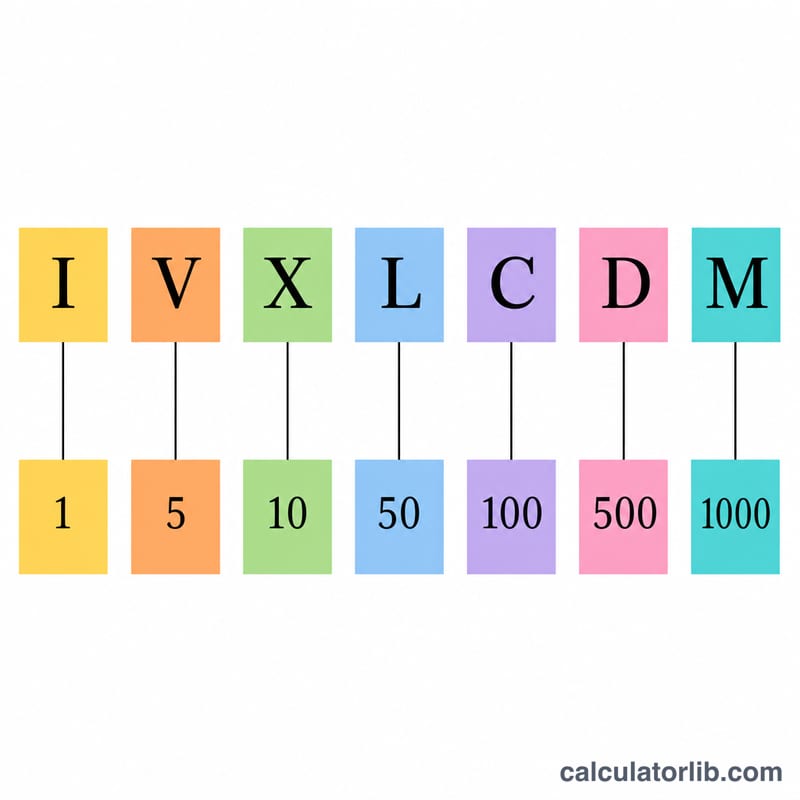
Worked example
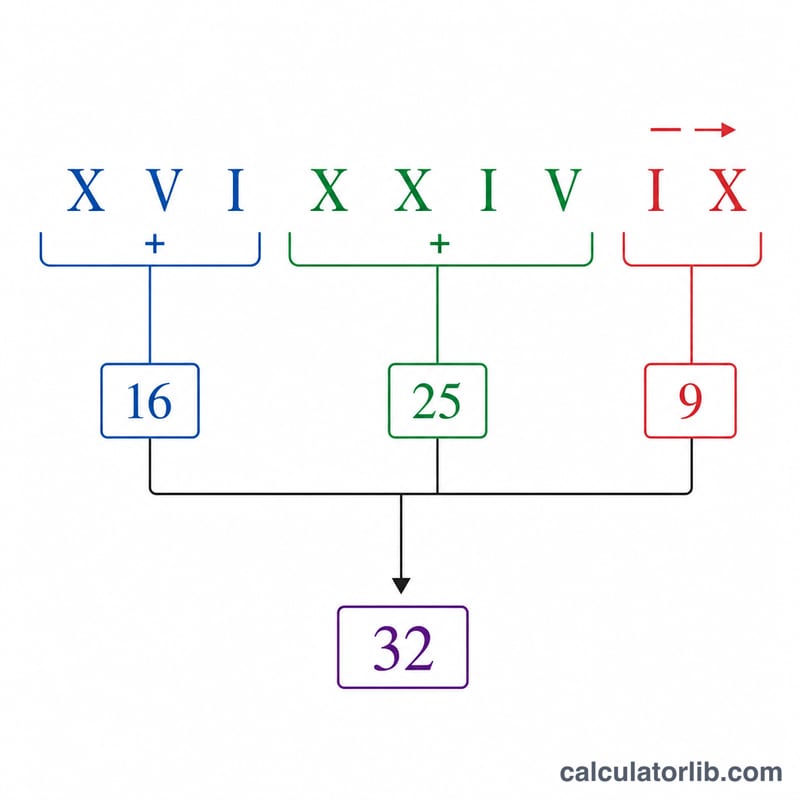
Take MCMXCIV. M=1000 (add). C before M is subtracted: −100, then M adds 1000 → \(CM = 900\). X before C is subtracted: −10, then C adds 100 → \(XC = 90\). I before V is subtracted: −1, then V adds 5 → \(IV = 4\). Total = $$1000 + 900 + 90 + 4 = 1994$$
FAQ
What is the largest standard Roman numeral? Without special notation, \(MMMCMXCIX = 3999\) is the largest commonly written value.
Is there a zero in Roman numerals? No. The classical system has no symbol for zero.
Why does my input show as invalid? Only the letters I, V, X, L, C, D and M are recognized; spaces and other characters make the input invalid.