

What is the Roman Numeral Converter?
This tool converts everyday decimal numbers into Roman numerals and converts Roman numerals back into ordinary numbers. It uses standard subtractive notation (the form used on clocks, book chapters, movie credits and monuments) and works for any integer from 1 to 3999 — the conventional range expressible without bars or special symbols.
How to use it
Pick a direction. For Number → Roman, type a whole number between 1 and 3999. For Roman → Number, type a Roman numeral such as MCMXCIV (case is ignored). The converter shows both the Roman numeral and its decimal value so you can double-check the result.
The formula explained
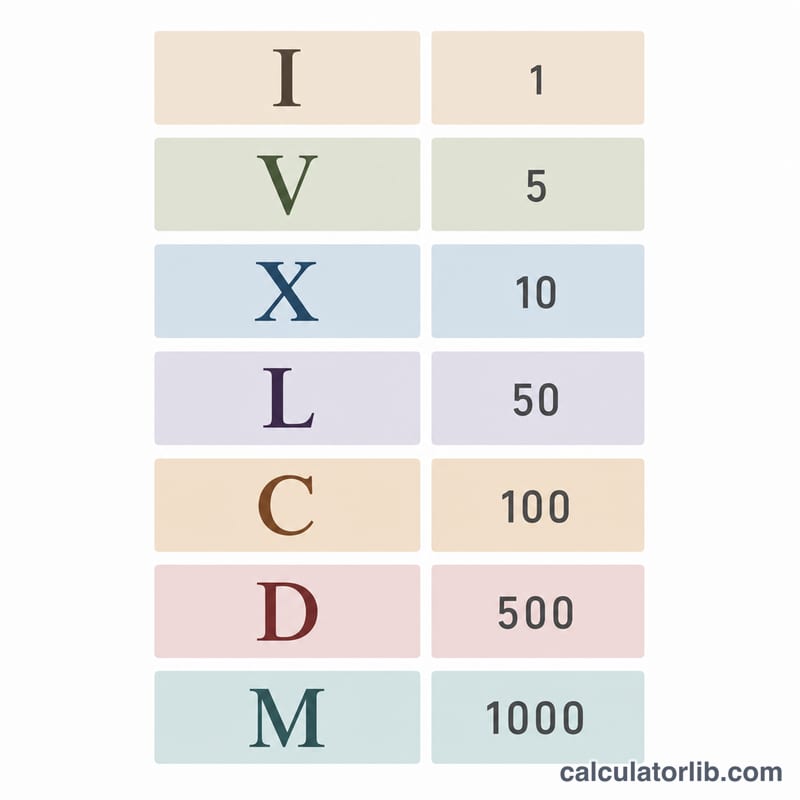
Roman numerals are built from seven symbols: \(\text{I}=1\), \(\text{V}=5\), \(\text{X}=10\), \(\text{L}=50\), \(\text{C}=100\), \(\text{D}=500\) and \(\text{M}=1000\). To convert a number, we use a greedy algorithm: starting from the largest value, we repeatedly subtract the biggest value-symbol that still fits and append its symbol:
$$\text{Roman} = \operatorname{greedy}\!\left(\text{Number}\right) = \sum_{k}\; \text{sym}_k \times \left\lfloor \frac{\text{remainder}}{\text{val}_k} \right\rfloor$$
$$\text{Roman} = \operatorname{greedy}\!\left(\text{Number}\right),\qquad 1 \le \text{Number} \le 3999$$
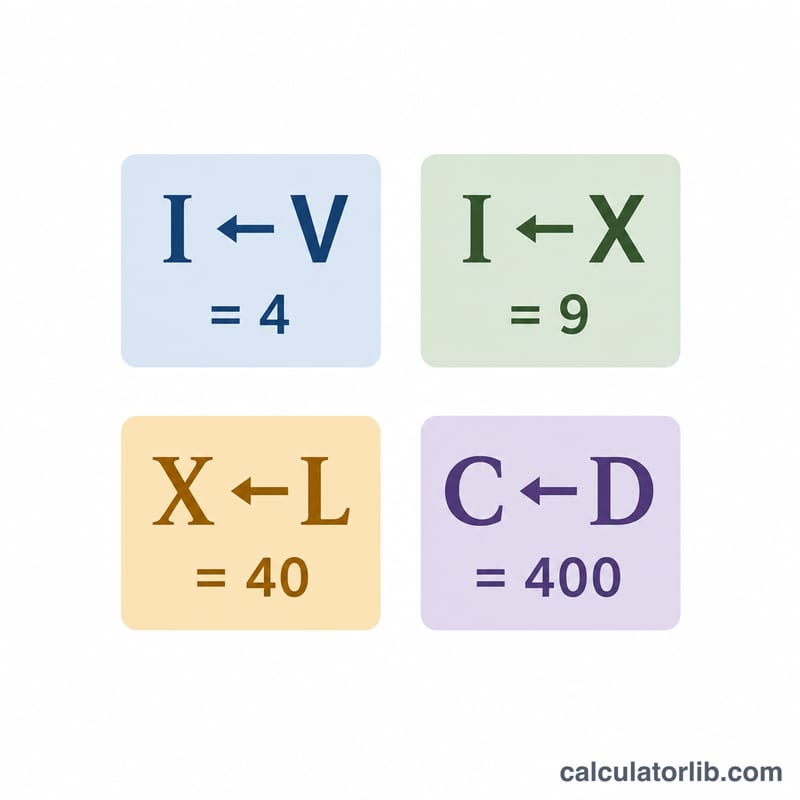
To handle subtractive pairs we include \(\text{CM}=900\), \(\text{CD}=400\), \(\text{XC}=90\), \(\text{XL}=40\), \(\text{IX}=9\) and \(\text{IV}=4\) in the list. This guarantees the canonical shortest spelling — for example 4 becomes IV, not IIII. The reverse conversion sums each token's value:
$$\text{Number} = \sum_{\text{token} \,\in\, \text{Roman Numeral}} \text{value}(\text{token})$$
Worked example
Convert 2024: \(2024 - 1000 = 1024\) (M), \(- 1000 = 24\) (MM), then \(24 - 10 = 14\) (X), \(- 10 = 4\) (XX), then 4 matches IV. Result: MMXXIV.
FAQ
Why only up to 3999? Standard Roman numerals top out at MMMCMXCIX (3999). Larger numbers traditionally need a bar (vinculum) over symbols to multiply by 1000, which isn't part of the basic system.
Is there a Roman numeral for zero? No. The Romans had no symbol for zero; the system has no place for it.
Is IIII ever correct? IIII appears on some clock faces for aesthetic balance, but the mathematically standard form for 4 is IV, which this tool produces.