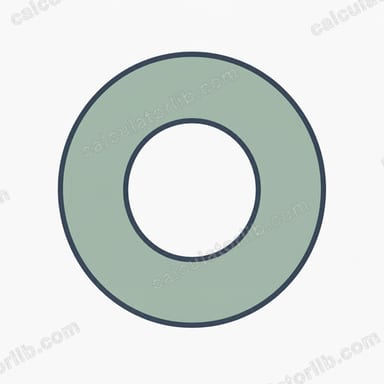

What is an annulus?
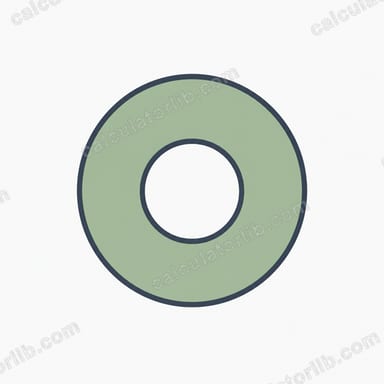
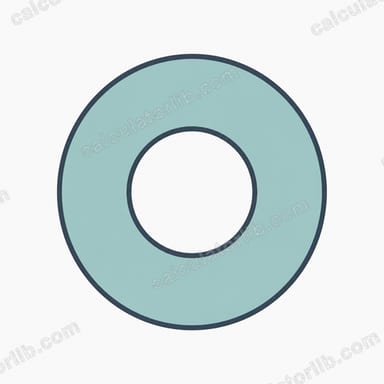
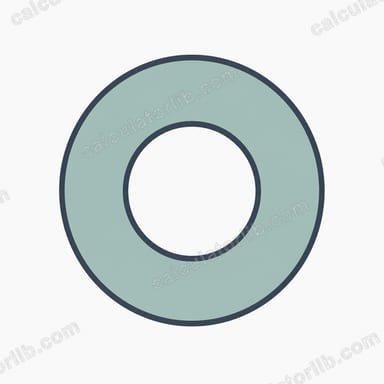
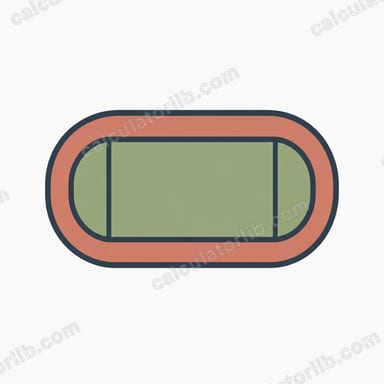
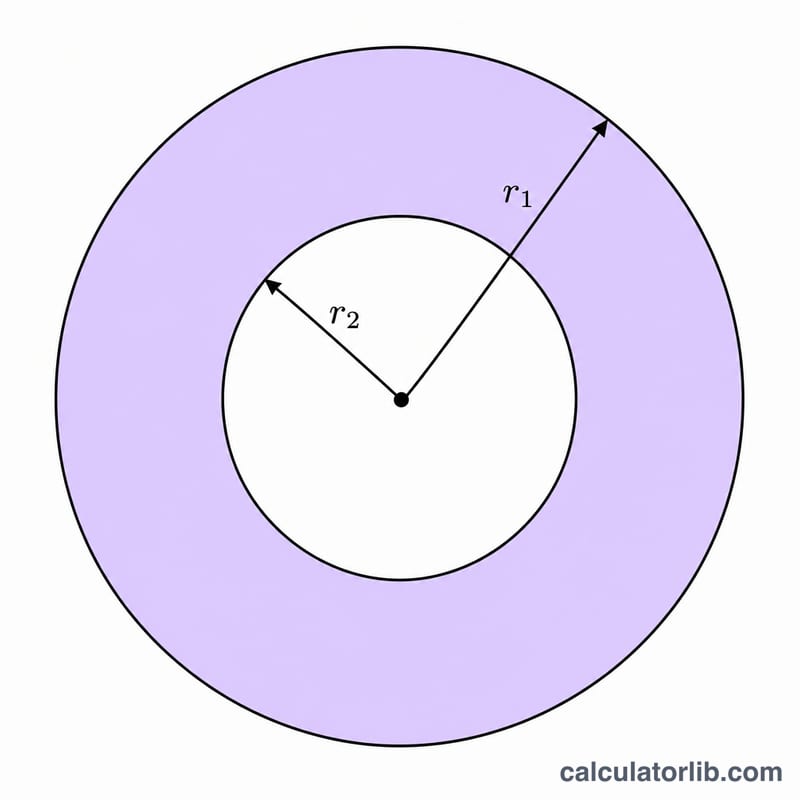
An annulus is a flat, ring-shaped region bounded by two concentric circles: an outer circle of radius \(r_1\) and a smaller inner circle of radius \(r_2\) (with \(r_1 > r_2\)). The annulus is everything between them — think of a washer, a CD, or a circular running track. This calculator solves every property of the ring from any two known quantities you provide.
How to use it
Pick a calculation from the dropdown that names the two quantities you already know (for example "given r1, r2" or "given A0, C1"). Enter those two values in the input fields, optionally change pi or pick a display unit, and choose how many significant figures to round to. The tool returns all seven values: both radii (\(r_1\), \(r_2\)), both circumferences (\(C_1\), \(C_2\)), both circle areas (\(A_1\), \(A_2\)) and the annulus area \(A_0\).
The formulas explained
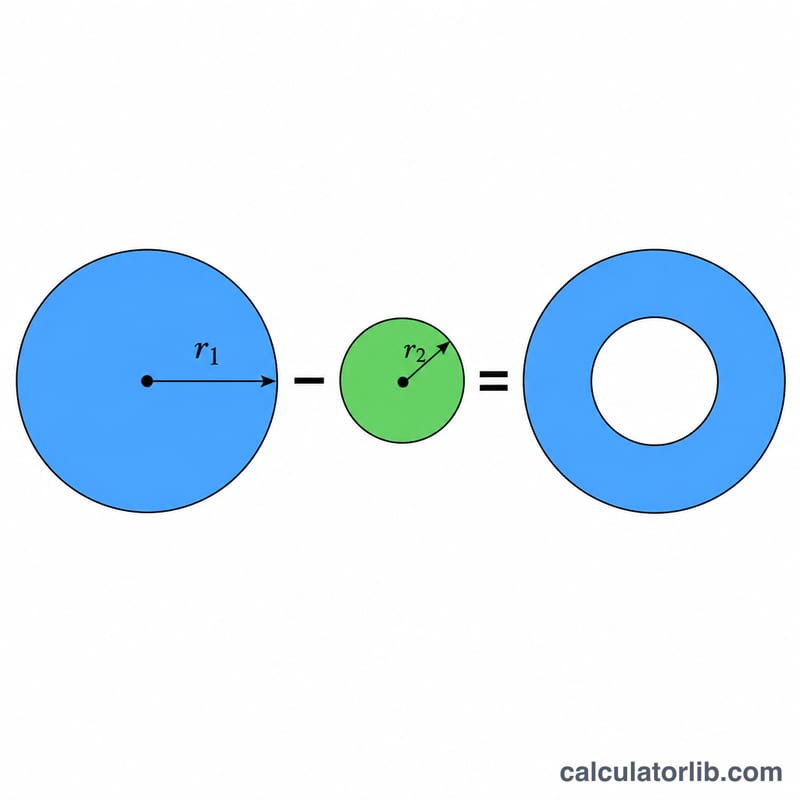
For a circle of radius \(r\) the circumference is \(C = 2\pi r\) and the area is \(A = \pi r^2\). The annulus area is simply the big disk minus the small disk:
$$A_0 = A_1 - A_2 = \pi\left(r_1^2 - r_2^2\right)$$To work backwards, a radius can be recovered from a circumference as \(r = C / (2\pi)\) or from a circle area as \(r = \sqrt{A / \pi}\). When the annulus area is given with one circle quantity, the partner pins one radius first, then the other is found from \(A_0 = \pi\left(r_1^2 - r_2^2\right)\), so every mode reduces to a single unknown — there are no coupled simultaneous equations to solve.
Worked example
Given \(r_1 = 5\) and \(r_2 = 3\) (units cm, \(\pi = 3.14159265359\)):
$$C_1 = 2\pi(5) = 31.4159 \text{ cm}$$$$C_2 = 2\pi(3) = 18.8496 \text{ cm}$$$$A_1 = \pi(25) = 78.5398 \text{ cm}^2$$$$A_2 = \pi(9) = 28.2743 \text{ cm}^2$$$$A_0 = \pi(25 - 9) = \pi(16) = 50.2655 \text{ cm}^2$$More Worked Examples
Each example below uses the standard ring relationships. With the two given quantities, every other property follows from \(C = 2\pi r\), \(A = \pi r^2\), and the annulus area \(A_0 = \pi\left(r_1^2 - r_2^2\right)\). We take \(\pi = 3.14159265\) throughout and report results to 5 significant figures.
Example 1 — Given the outer circumference \(C_1\) and the inner radius \(r_2\) (mode c1r2)
Suppose a ring has an outer circumference of \(C_1 = 40\text{ cm}\) and an inner radius of \(r_2 = 5\text{ cm}\). First recover the outer radius from the circumference:
$$r_1 = \frac{C_1}{2\pi} = \frac{40}{2\times 3.14159265} = 6.3662\text{ cm}$$
Now compute the remaining six outputs:
- Outer radius: \(r_1 = 6.3662\text{ cm}\)
- Inner radius: \(r_2 = 5\text{ cm}\)
- Outer circumference: \(C_1 = 40\text{ cm}\) (given)
- Inner circumference: \(C_2 = 2\pi r_2 = 2\times 3.14159265\times 5 = 31.416\text{ cm}\)
- Outer circle area: \(A_1 = \pi r_1^2 = 3.14159265\times 6.3662^2 = \)127.32\(\text{ cm}^2\)
- Inner circle area: \(A_2 = \pi r_2^2 = 3.14159265\times 5^2 = 78.540\text{ cm}^2\)
- Annulus area: \(A_0 = A_1 - A_2 = 127.32 - 78.540 = \)48.784\(\text{ cm}^2\)
Example 2 — Given the annulus area \(A_0\) and the outer radius \(r_1\) (mode a0r1)
Suppose the ring of material has an annulus area of \(A_0 = 60\text{ in}^2\) and an outer radius of \(r_1 = 8\text{ in}\). Solve the defining formula for the inner radius:
$$r_2 = \sqrt{r_1^2 - \frac{A_0}{\pi}} = \sqrt{8^2 - \frac{60}{3.14159265}} = \sqrt{64 - 19.099} = \sqrt{44.901} = 6.7008\text{ in}$$
The full set of seven outputs is then:
- Outer radius: \(r_1 = 8\text{ in}\) (given)
- Inner radius: \(r_2 = 6.7008\text{ in}\)
- Outer circumference: \(C_1 = 2\pi r_1 = 2\times 3.14159265\times 8 = 50.265\text{ in}\)
- Inner circumference: \(C_2 = 2\pi r_2 = 2\times 3.14159265\times 6.7008 = 42.102\text{ in}\)
- Outer circle area: \(A_1 = \pi r_1^2 = 3.14159265\times 8^2 = 201.06\text{ in}^2\)
- Inner circle area: \(A_2 = \pi r_2^2 = 3.14159265\times 6.7008^2 = 141.06\text{ in}^2\)
- Annulus area: \(A_0 = 201.06 - 141.06 = 60\text{ in}^2\) (given, confirming the solution)
Example 3 — Given both radii \(r_1\) and \(r_2\) (mode r1r2)
For a flat washer with \(r_1 = 12\text{ mm}\) and \(r_2 = 7\text{ mm}\), the outputs are computed directly:
- Outer radius: \(r_1 = 12\text{ mm}\)
- Inner radius: \(r_2 = 7\text{ mm}\)
- Outer circumference: \(C_1 = 2\pi\times 12 = 75.398\text{ mm}\)
- Inner circumference: \(C_2 = 2\pi\times 7 = 43.982\text{ mm}\)
- Outer circle area: \(A_1 = \pi\times 12^2 = 452.39\text{ mm}^2\)
- Inner circle area: \(A_2 = \pi\times 7^2 = 153.94\text{ mm}^2\)
- Annulus area: \(A_0 = \pi\left(12^2 - 7^2\right) = \pi\times 95 = \)298.45\(\text{ mm}^2\)
FAQ
Does it convert units? No. The unit is a display label only; all inputs are assumed to already be in the same chosen length unit, with areas in that unit squared.
Why must r1 be greater than r2? The annulus is the gap between the circles, so the outer circle must be larger. If your inputs imply \(r_2 \ge r_1\) (a negative square-root argument or an inner value bigger than the outer), the ring is degenerate and the calculator flags an error.
Can I change pi? Yes — the default is 3.14159265359, but you can enter 22/7 as 3.142857 or any positive value you like.