
What Is an Annulus?
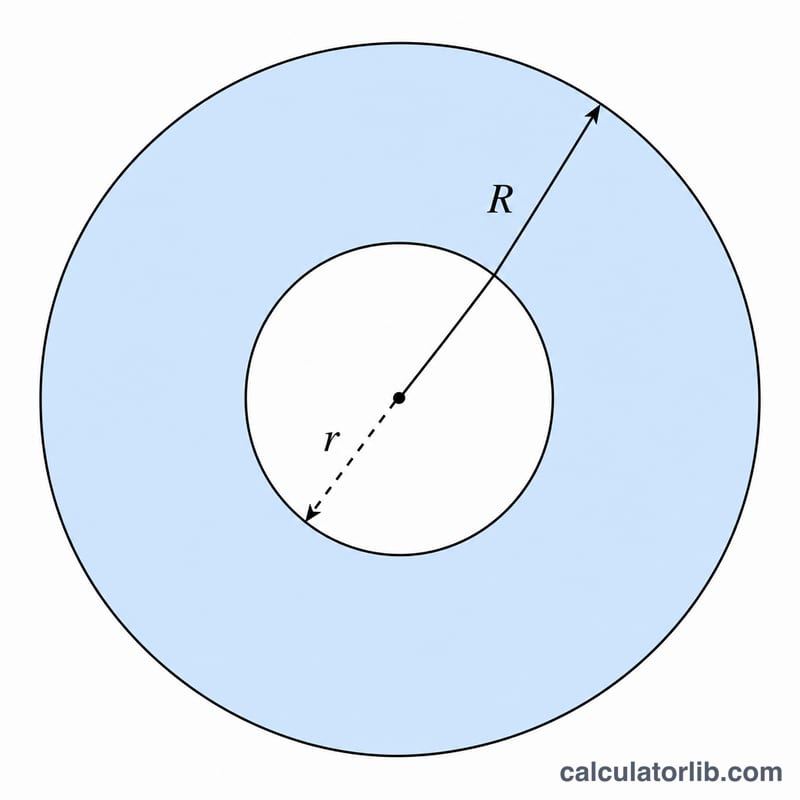
An annulus is the ring-shaped region between two concentric circles that share the same center but have different radii. The larger circle has the outer radius \(R\) and the smaller "hole" has the inner radius \(r\). Washers, pipe cross-sections, CD discs, and racetracks are everyday examples. This calculator finds the area of the ring, the inner and outer circumferences, the total perimeter, and the ring width.
How to Use the Calculator
Enter the outer radius (\(R\)) and the inner radius (\(r\)) in any consistent unit (mm, cm, inches, etc.). The area is returned in those units squared. If you accidentally enter the inner value larger than the outer, the calculator swaps them so the area stays positive. Press calculate to see all derived quantities instantly.
The Formula Explained
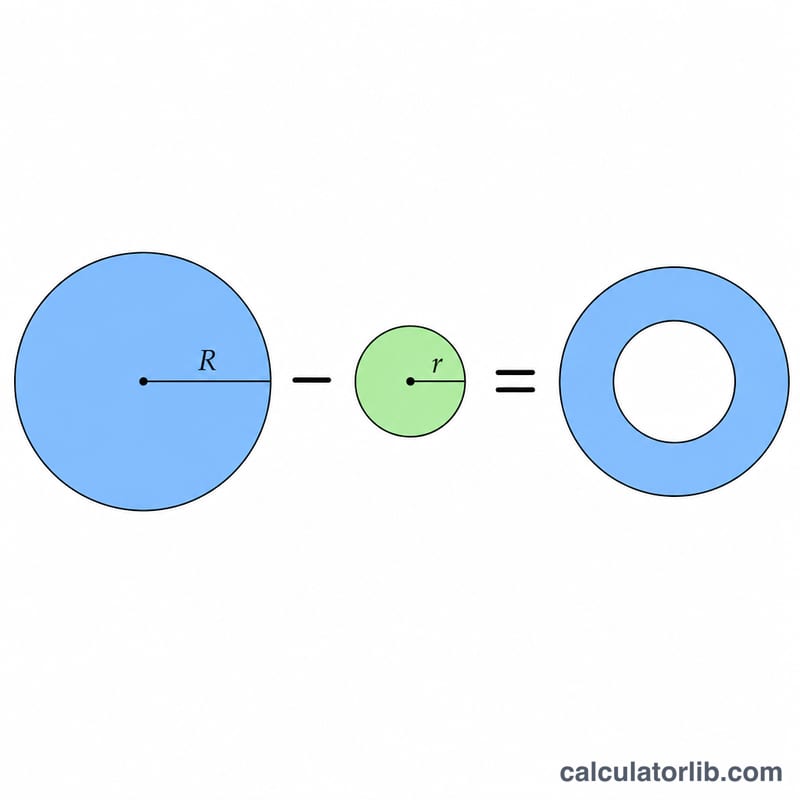
The annulus area equals the big circle minus the hole: $$A = \pi (R^2 - r^2)$$. The perimeter of the ring includes two boundaries — the outer edge (\(2\pi R\)) and the inner edge (\(2\pi r\)) — giving a total perimeter of $$2\pi (R + r)$$. The ring width is simply \(R - r\).
Worked Example
Suppose \(R = 5\) and \(r = 3\). The area is $$\pi(25 - 9) = 16\pi \approx 50.27$$ square units. The outer circumference is \(2\pi(5) \approx 31.42\), the inner is \(2\pi(3) \approx 18.85\), and the total perimeter is \(2\pi(8) \approx 50.27\). The ring width is \(5 - 3 = 2\).
Key Terms & Variables
- Annulus (ring): The flat region lying between two concentric circles — a circular disc with a smaller circular disc removed from its center, shaped like a washer, CD, or donut cross-section.
- Outer radius (R): The distance from the common center to the outer edge of the ring; it defines the larger bounding circle.
- Inner radius (r): The distance from the common center to the inner edge (the hole); it defines the smaller bounding circle. Always \(r < R\).
- Ring width (R − r): The radial thickness of the ring — the straight-line distance from the inner edge to the outer edge measured along a radius.
- Concentric circles: Two or more circles that share the same center point but have different radii. The two boundaries of an annulus are concentric.
- Area (A): The amount of surface enclosed by the ring, computed as the outer disc area minus the inner disc area: \(A=\pi R^2-\pi r^2=\pi(R^2-r^2)\), expressed in square units.
- Outer circumference: The length of the outer boundary circle, \(2\pi R\), in linear units.
- Inner circumference: The length of the inner boundary circle (around the hole), \(2\pi r\), in linear units.
- Total perimeter: The combined length of both boundaries of the annulus, \(2\pi R + 2\pi r = 2\pi(R+r)\), since the ring is bounded by both the outer and inner circles.
FAQ
What units should I use? Any unit works as long as both radii use the same one; the area comes out in that unit squared.
Can I use diameters instead of radii? No — divide each diameter by 2 first to get the radius.
What if R equals r? The area is zero because the two circles coincide, leaving no ring.