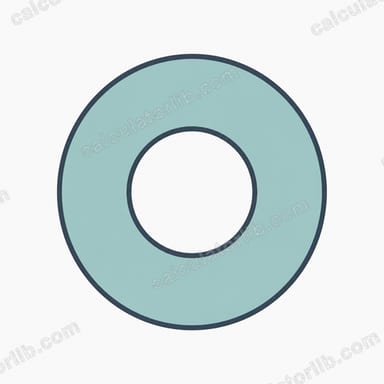

What is an annulus?
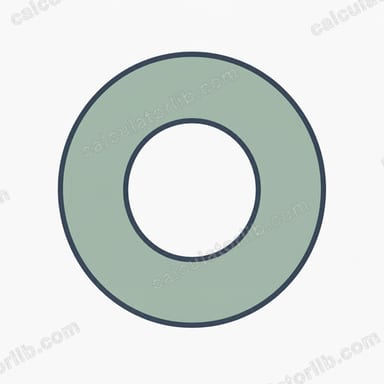
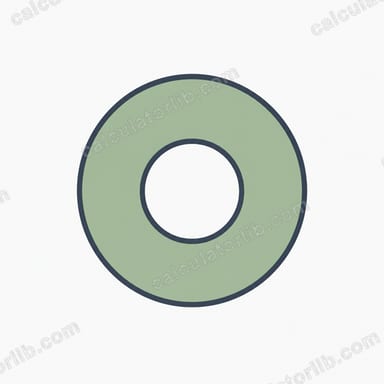
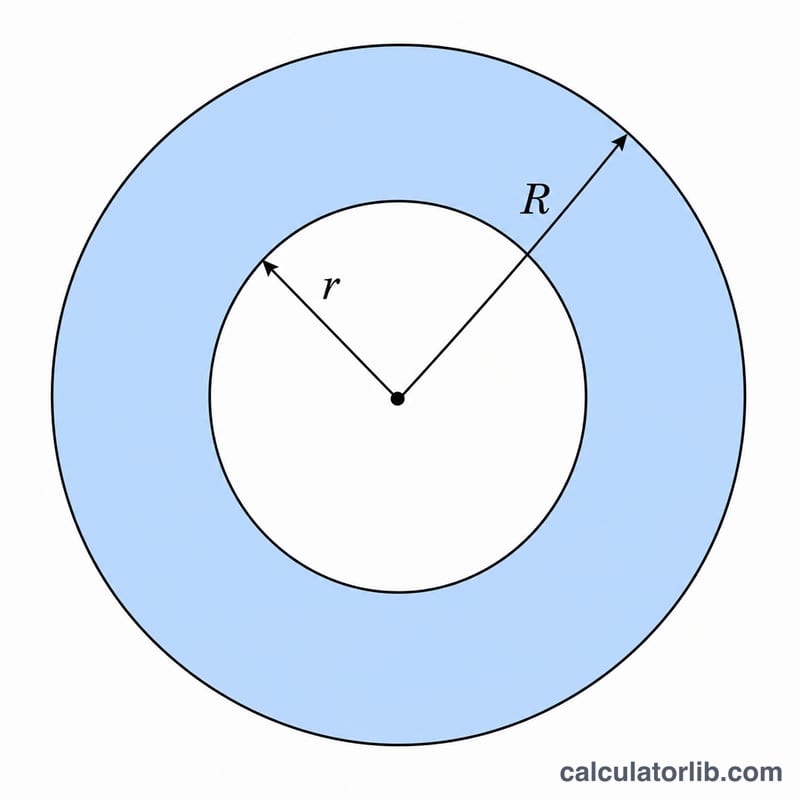
An annulus is a flat ring: the region between two concentric circles. The larger circle has outer radius R and the smaller has inner radius r, where R > r ≥ 0. This calculator finds the area, both circumferences, the radial width, and both diameters of an annulus from any two independent dimensions you supply.
How to use it
Choose a length unit (used for every length input and output), then enter exactly two of: outer radius, inner radius, width, outer diameter, or inner diameter. Diameters are halved to radii, and a width combines with one radius to give the other (\(r = R - w\) or \(R = r + w\)). The calculator then reports all eight properties. If \(r\) is 0, the annulus becomes a full disk.
The formula explained
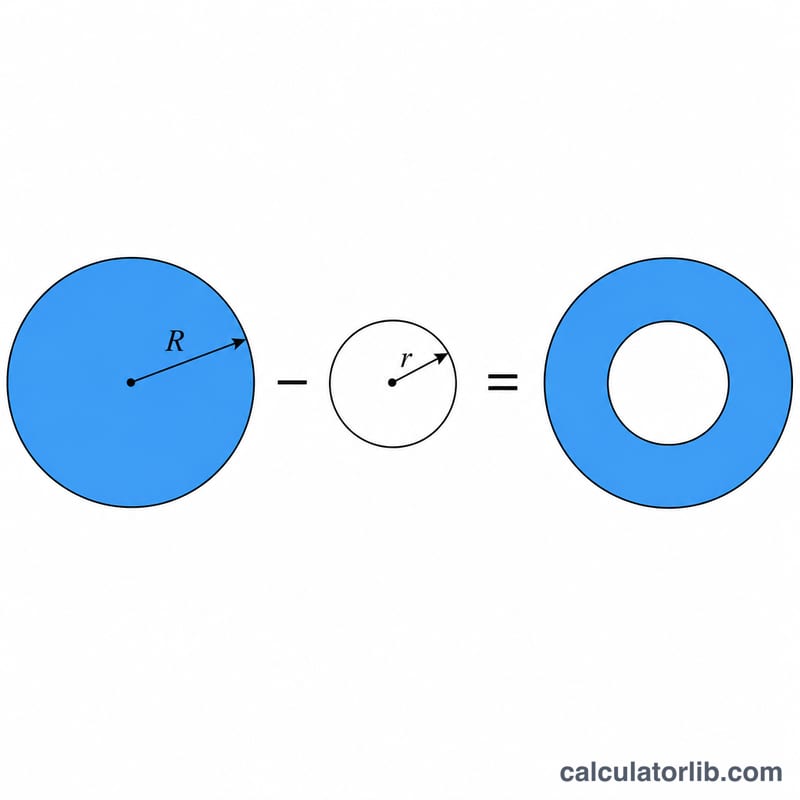
With outer radius \(R\) and inner radius \(r\): width \(w = R - r\), outer diameter \(D = 2R\), inner diameter \(d = 2r\), outer circumference \(C = 2\pi R\), inner circumference \(c = 2\pi r\), and area $$A = \pi \left(R^2 - r^2\right)$$ Equivalently \(A = \pi \cdot w \cdot (R + r)\), which highlights that the ring area depends on its width and the sum of the radii.
Worked example
For \(R = 8\) cm and \(r = 4\) cm: \(w = 4\) cm, \(D = 16\) cm, \(d = 8\) cm, \(C_{outer} = 16\pi \approx 50.27\) cm, \(C_{inner} = 8\pi \approx 25.13\) cm, and $$A = \pi (64 - 16) = 48\pi \approx 150.80 \text{ cm}^2$$
Length and Area Unit Conversions
Because annulus area scales with the square of length, every length conversion factor must be squared to convert the area. Pick one unit, enter your two dimensions in it, and use these exact factors to express the result elsewhere.
Length conversions
| From | To | Exact factor |
|---|---|---|
| 1 cm | mm | 10 |
| 1 m | cm | 100 |
| 1 m | mm | 1000 |
| 1 in | mm | 25.4 |
| 1 in | cm | 2.54 |
| 1 ft | in | 12 |
| 1 ft | cm | 30.48 |
| 1 ft | m | 0.3048 |
| 1 yd | m | 0.9144 |
Corresponding area conversions (length factor squared)
| From | To | Exact factor |
|---|---|---|
| 1 cm² | mm² | 100 |
| 1 m² | cm² | 10 000 |
| 1 m² | mm² | 1 000 000 |
| 1 in² | mm² | 645.16 |
| 1 in² | cm² | 6.4516 |
| 1 ft² | in² | 144 |
| 1 ft² | cm² | 929.0304 |
| 1 ft² | m² | 0.09290304 |
| 1 yd² | m² | 0.83612736 |
Example: the pipe-wall ring above is \(863.94\) mm². Since \(1\text{ cm}^2 = 100\text{ mm}^2\), that equals \(863.94 / 100 = 8.6394\) cm². You can confirm any single-circle step with an area unit converter for the full set of target units.
FAQ
Can I enter a width instead of a second radius? Yes — give one radius (or diameter) plus the width, and the missing radius is computed automatically.
Why must the inner radius be smaller? If \(r \ge R\) there is no ring, so the result is invalid. The calculator flags this case.
What unit is the area in? The chosen length unit squared (for example cm gives cm²).