
What Is the Poker Outs to Odds Calculator?
In Texas Hold'em, an "out" is any card still in the deck that improves your hand to a likely winner. This calculator converts your number of outs into the chance you will hit by the river, using the popular "Rule of 4 and 2." It also shows the mathematically exact probability and the odds against hitting so you can make sharper drawing decisions at the table.
How to Use It
Count your outs — for example, a flush draw has 9 outs because 13 cards of a suit minus the 4 you can see leaves 9. Enter that number, then choose whether you still have two cards to come (you are on the flop and will see the turn and river) or just one card to come (you are on the turn waiting for the river). The calculator returns the quick estimate, the exact percentage, and the odds against.
The Formula Explained
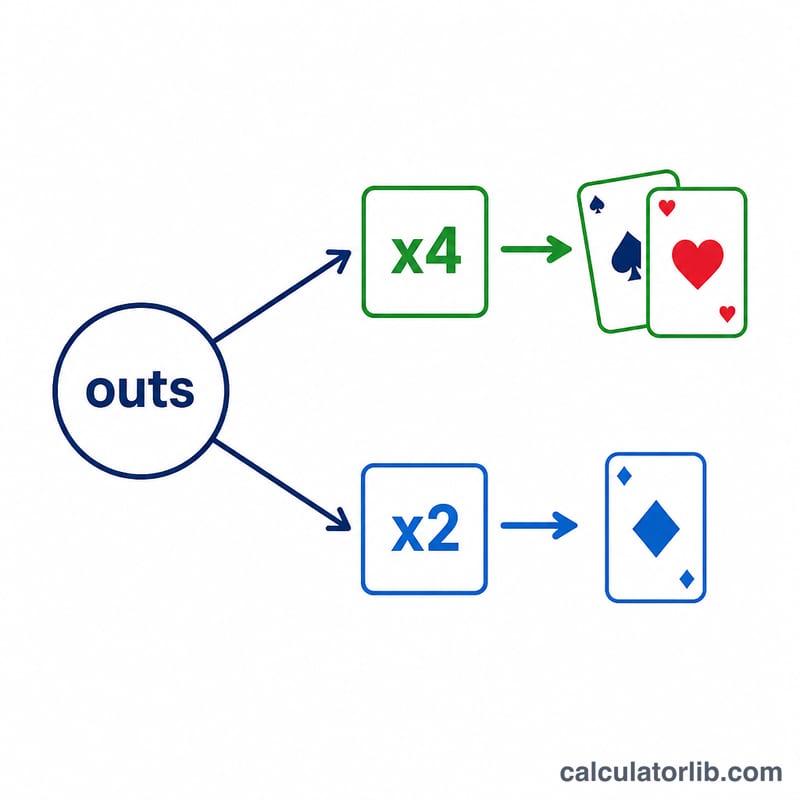
The Rule of 4 and 2 is a shortcut: multiply outs by 4 when two cards are still to come, or by 2 when only one card is to come. The exact figure for two cards is $$P = 1 - \left(\frac{47 - \text{outs}}{47}\right) \times \left(\frac{46 - \text{outs}}{46}\right)$$, where 47 is the number of unseen cards after the flop. For one card the exact value is simply \(\text{outs} / 46\). The rule of thumb is impressively close for small out counts and drifts a little high for large ones.
Worked Example
You flop a flush draw: 9 outs with two cards to come. Rule of 4 gives \(9 \times 4 = 36\%\). The exact math is $$1 - \left(\frac{38}{47}\right)\left(\frac{37}{46}\right) = 1 - 0.6504 = 34.97\%,$$ with odds against of about \(1.86 : 1\). Knowing you are roughly 35% to hit, you can compare that to the pot odds your opponent is offering.
FAQ
Why 47 unseen cards? After the flop you can see your 2 hole cards and 3 board cards (5 total), leaving \(52 - 5 = 47\) unknown cards.
When does the Rule of 4 overestimate? With many outs (say 12+), the rule double-counts overlap, so the real percentage is a few points lower. The exact column corrects for this.
What are odds against? It expresses your chance as a ratio of misses to hits. A 35% hit chance is about 1.86 misses for every hit, or \(1.86 : 1\) against.