
What Is the Resistor Color Code Calculator?
Resistors use colored bands printed around their body to encode their resistance value, because the components are too small to print numbers on. This calculator decodes a standard 4-band resistor color code into its resistance in ohms (Ω), along with the tolerance and the resulting minimum and maximum values. It works for any standard carbon-film or metal-film resistor that uses the international IEC 60062 color scheme.
How to Use It
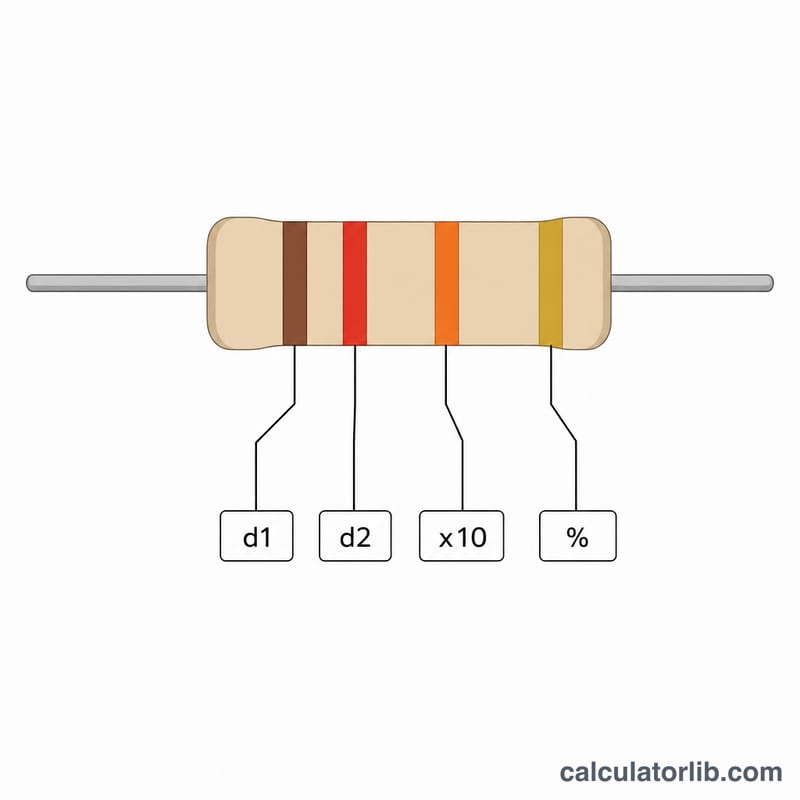
Hold the resistor so the tolerance band (usually gold or silver) is on the right. Then read the bands left to right and select each color in the matching dropdown: Band 1 (first digit), Band 2 (second digit), Band 3 (multiplier), and Band 4 (tolerance). The calculator instantly shows the resistance value and range.
The Formula Explained
The first two bands are significant digits, the third is a power-of-ten multiplier:
$$R = \left(d_1 \times 10 + d_2\right) \times 10^{m}$$
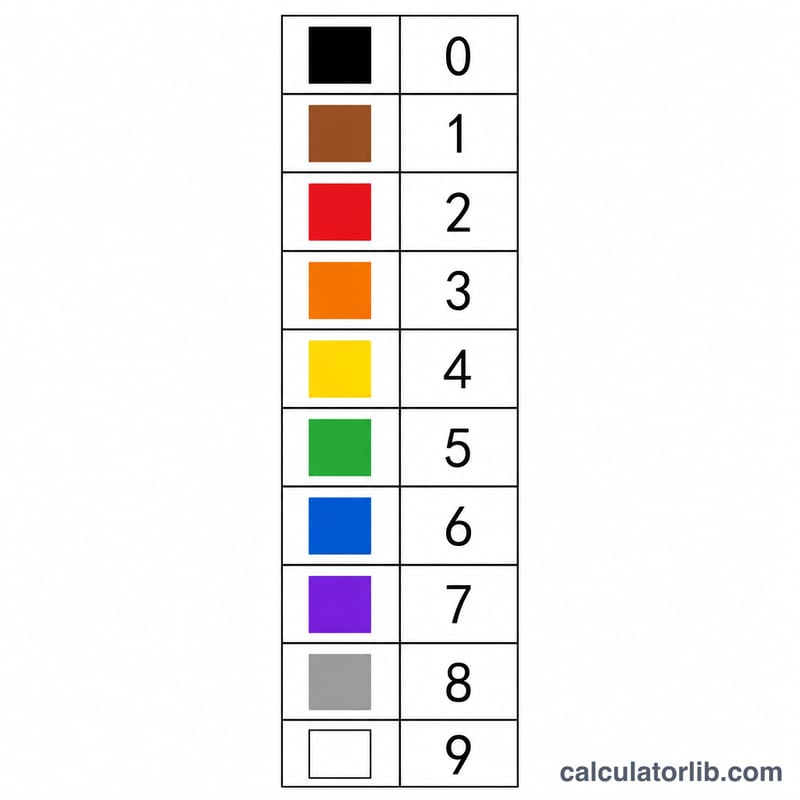
Here \(d_1\) and \(d_2\) are 0–9 (Black=0, Brown=1, Red=2 … White=9) and \(m\) is the multiplier exponent (Black=0, Brown=1, Red=2 … Gold=−1, Silver=−2). The fourth band's tolerance percentage then sets the acceptable range: \(R \pm R \times (t / 100)\).
Worked Example
Consider a resistor with bands Brown, Red, Red, Gold. Band 1 (Brown) = 1, Band 2 (Red) = 2, multiplier (Red) = \(10^2 = 100\), tolerance (Gold) = ±5%. So $$R = (1 \times 10 + 2) \times 100 = 12 \times 100 = 1{,}200 \ \Omega \ (1.2 \ \text{k}\Omega)$$ With ±5% tolerance the actual value lies between 1,140 Ω and 1,260 Ω.
FAQ
Which side do I start reading from? Start from the band closest to one end, with the tolerance band (often gold/silver, slightly spaced apart) on the right.
What if there is no fourth band? A resistor with only three bands typically has a ±20% tolerance.
Does this work for 5-band resistors? No — this tool is for 4-band resistors. 5-band parts use three significant digits plus a multiplier and tolerance band.