
What is the Power from Force and Velocity Calculator?
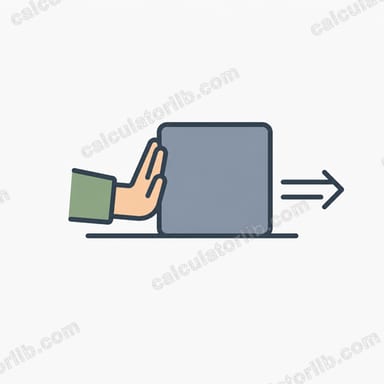
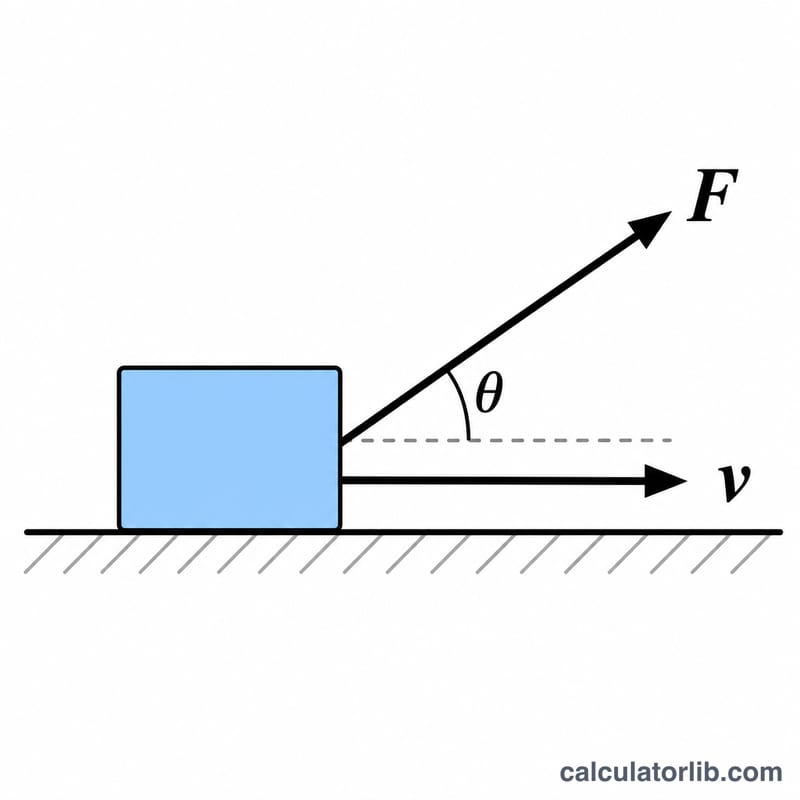
This calculator finds the instantaneous mechanical power delivered when a force acts on an object moving at a given velocity. Power is the rate at which work is done, and when a constant force pushes an object, the power equals the force multiplied by the velocity and the cosine of the angle between the force and the direction of motion.
How to use it
Enter the magnitude of the force in newtons (N), the velocity in metres per second (m/s), and the angle \(\theta\) between the force vector and the velocity vector in degrees. If the force is applied directly along the direction of motion, leave the angle at 0°. The calculator returns power in watts, kilowatts and horsepower.
The formula explained
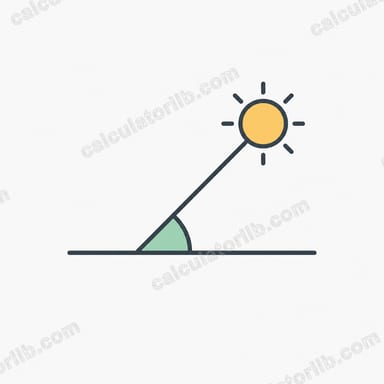
The governing equation is $$P = F \cdot v \cdot \cos\theta$$ Only the component of the force aligned with the motion (\(F\cdot\cos\theta\)) does work, so when the force is perpendicular to the motion (\(\theta = 90\degree\)), \(\cos\theta = 0\) and no power is delivered. When the force fully opposes motion (\(\theta = 180\degree\)), power is negative, meaning energy is being removed.
Worked example
Suppose a force of 200 N acts on a cart moving at 5 m/s, with the force at 0° to the motion. Then $$P = 200 \times 5 \times \cos(0\degree) = 200 \times 5 \times 1 = 1000 \text{ W}$$ or 1 kW (about 1.34 hp).
FAQ
What units does this use? SI units: newtons for force and metres per second for velocity, giving watts for power.
Why include the angle? Power depends only on the force component along the velocity. The cosine term accounts for forces applied at an angle.
Can power be negative? Yes. If the angle exceeds 90°, \(\cos\theta\) is negative and the force is doing negative work, removing kinetic energy.