
What this calculator does
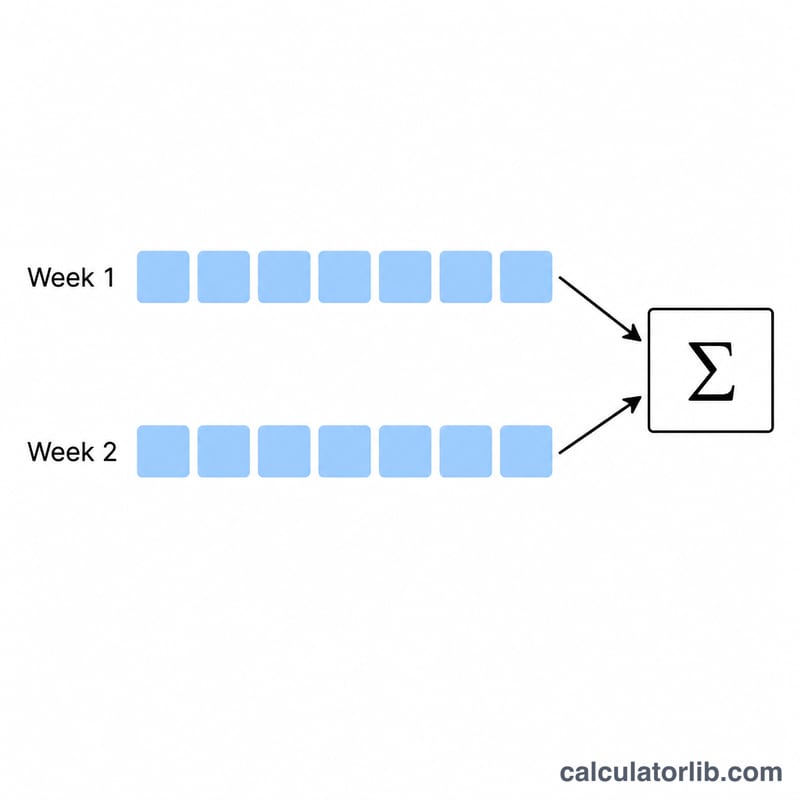
A biweekly pay period covers two work weeks (14 days). This calculator adds up the hours you actually worked across both weeks, subtracts any unpaid break time, and then splits the result into regular and overtime hours so you can see your gross pay before deductions. It is handy for hourly employees, shift workers, and small-business owners reconciling a paper or digital time card.
How to use it
Enter the total hours you worked over the full two-week period. If your day-by-day clock times include unpaid breaks (such as a 30-minute lunch), add up those break hours and enter them so they can be removed from paid time. Then provide your hourly rate. The overtime fields default to the common US standard — overtime after 40 hours per week at 1.5× pay — but you can change them to match your employer or jurisdiction.
The formula explained
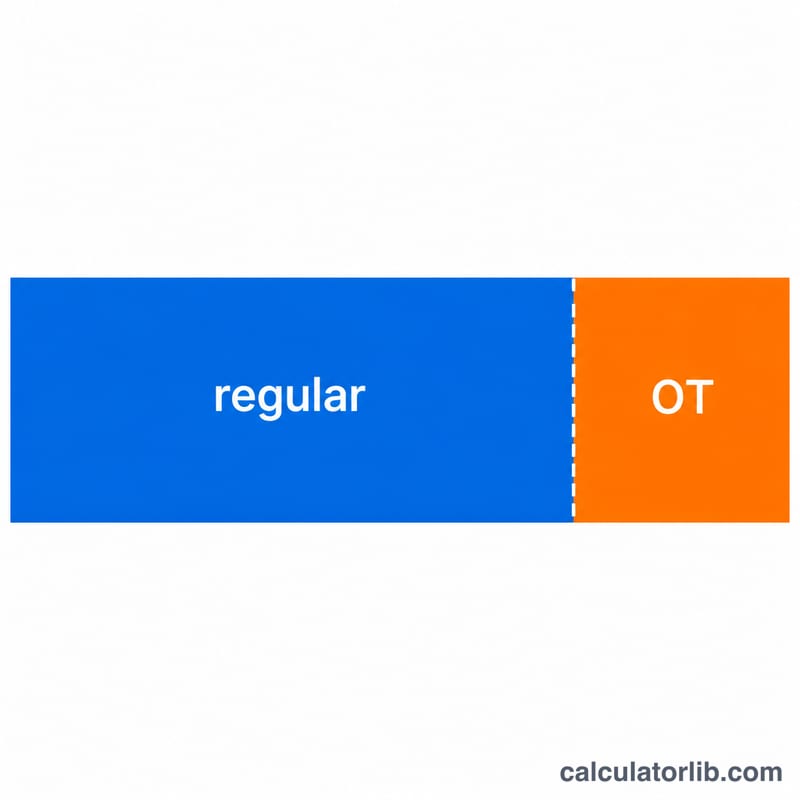
For each of the 14 days, paid time equals clock-out minus clock-in minus break. Summing those gives total worked hours, \(H\). Because overtime is usually measured weekly, the tool uses a biweekly cap of twice the weekly threshold (e.g. 80 hours). Hours up to the cap are regular (\(H_{\text{reg}}\)) and any excess is overtime (\(H_{\text{ot}}\)).
$$\text{Gross pay} = H_{\text{reg}} \times \text{rate} + H_{\text{ot}} \times \text{rate} \times \text{multiplier}$$
Worked example
Suppose you logged 85 worked hours with 5 hours of unpaid breaks, at $20/hour, overtime after 40 hrs/week at 1.5×. Net worked time is 80 hours. With an 80-hour biweekly cap, all 80 hours are regular:
$$\text{pay} = 80 \times \$20 = \$1{,}600$$
with $0 overtime.
More Worked Examples
Each example uses the biweekly formula: subtract unpaid breaks from total hours, split regular versus overtime at twice the weekly threshold, then apply the rate and overtime multiplier. The standard cap on regular hours over a two-week period is \(2 \times 40 = 80\) hours.
Example 1 — Exceeding the 80-Hour Cap (overtime at 1.5×)
An employee clocks 90 total hours over two weeks, takes no unpaid breaks, earns $22/hour, with a 40-hour weekly threshold and 1.5× overtime.
- Net hours: \(H = \max(0,\;90 - 0) = 90\)
- Regular hours: \(R = \min(90,\;2\times 40) = 80\)
- Overtime hours: \(O = \max(0,\;90 - 80) = 10\)
- Regular pay: \(80 \times 22 = \$1{,}760\)
- Overtime pay: \(10 \times 22 \times 1.5 = \$330\)
- Total: \(1{,}760 + 330 = \) $2,090
Example 2 — Day-by-Day Clock Times Minus Breaks
A worker logs the following shifts, each with an unpaid 30-minute (0.5 h) lunch:
| Day | Clock In | Clock Out | Gross Hours | Unpaid Break | Worked |
|---|---|---|---|---|---|
| Week 1 (×5) | 8:00 | 16:30 | 8.5 | 0.5 | 8.0 |
| Week 2 (×5) | 8:00 | 16:30 | 8.5 | 0.5 | 8.0 |
Total clocked time: \(10 \times 8.5 = 85\) hours; total unpaid breaks: \(10 \times 0.5 = 5\) hours. At $20/hour, 40-hour threshold, 1.5× OT:
- Net hours: \(H = \max(0,\;85 - 5) = 80\)
- Regular hours: \(R = \min(80,\;80) = 80\)
- Overtime hours: \(O = \max(0,\;80 - 80) = 0\)
- Total: \(80 \times 20 + 0 = \) $1,600
The unpaid breaks pulled the worker from a potential overtime situation back to exactly the 80-hour cap.
Example 3 — Non-Standard Weekly Threshold
Some agreements set a different weekly threshold (for example, a 35-hour standard workweek). An employee works 80 total hours, no unpaid breaks, at $25/hour with a 35-hour weekly threshold and 1.5× overtime.
- Net hours: \(H = 80\)
- Regular hours: \(R = \min(80,\;2\times 35) = 70\)
- Overtime hours: \(O = \max(0,\;80 - 70) = 10\)
- Regular pay: \(70 \times 25 = \$1{,}750\)
- Overtime pay: \(10 \times 25 \times 1.5 = \$375\)
- Total: \(1{,}750 + 375 = \) $2,125
Lowering the weekly threshold from 40 to 35 hours converts 10 of those hours from regular to overtime, raising gross pay.
Key Payroll Terms Defined
- Gross pay
- The total earnings for the pay period before any taxes or deductions are withheld. Here it equals regular pay plus overtime pay. Net (take-home) pay is what remains after deductions.
- Regular hours
- Hours worked up to the threshold — in a standard biweekly period, the first 80 hours (40 per week). These are paid at the base hourly rate.
- Overtime hours
- Hours worked beyond the threshold. Under the U.S. Fair Labor Standards Act (FLSA), nonexempt employees generally earn overtime for hours over 40 in a workweek.
- Unpaid break
- Time during a shift — typically a meal period of 30 minutes or more — that the employer does not pay for. It is subtracted from clocked hours before pay is calculated. Short rest breaks (usually under 20 minutes) are generally paid.
- Biweekly pay period
- A pay cycle covering two consecutive workweeks, totaling 14 calendar days. Employees on a biweekly schedule receive 26 paychecks per year.
- Overtime multiplier
- The factor applied to the base rate for overtime hours. The common FLSA minimum is 1.5× ("time-and-a-half"); some situations use 2× ("double time").
- Weekly threshold
- The number of hours per week before overtime begins — 40 under the FLSA. Some contracts or jurisdictions use a lower figure. Over a two-week period the regular-hours cap equals twice this threshold.
- 80-hour cap
- For a standard 40-hour weekly threshold, the maximum hours paid at the regular rate over a biweekly period is \(2 \times 40 = 80\). Hours beyond this are paid at the overtime rate.
Pay Across Common Time-Card Scenarios
The table below compares realistic two-week time cards at a sample rate of $20/hour, with a 40-hour weekly threshold and 1.5× overtime. Regular hours are capped at 80; everything above splits into overtime.
| Scenario | Total Hours | Unpaid Breaks | Net Hours | Regular Hrs | OT Hrs | Gross Pay |
|---|---|---|---|---|---|---|
| Exactly full-time, no OT | 80 | 0 | 80 | 80 | 0 | $1,600 |
| Full-time with overtime | 90 | 0 | 90 | 80 | 10 | $1,900 |
| Full clocked time, unpaid lunches | 85 | 5 | 80 | 80 | 0 | $1,600 |
| Heavy week with breaks | 100 | 5 | 95 | 80 | 15 | $2,050 |
| Part-time, under threshold | 50 | 0 | 50 | 50 | 0 | $1,000 |
Notice that the third scenario clocks 5 more hours than the first but yields identical pay, because the unpaid breaks bring net hours back to exactly 80 with no overtime.
FAQ
Is overtime weekly or biweekly? In the US, overtime is generally calculated per workweek, not per pay period. This tool approximates it by doubling the weekly threshold; for precise compliance, track each week separately.
Are breaks paid? Short rest breaks are often paid, but meal breaks usually are not. Enter only unpaid break hours.
Does this include taxes? No — the result is gross pay before taxes, benefits, and other deductions.