
What this calculator does
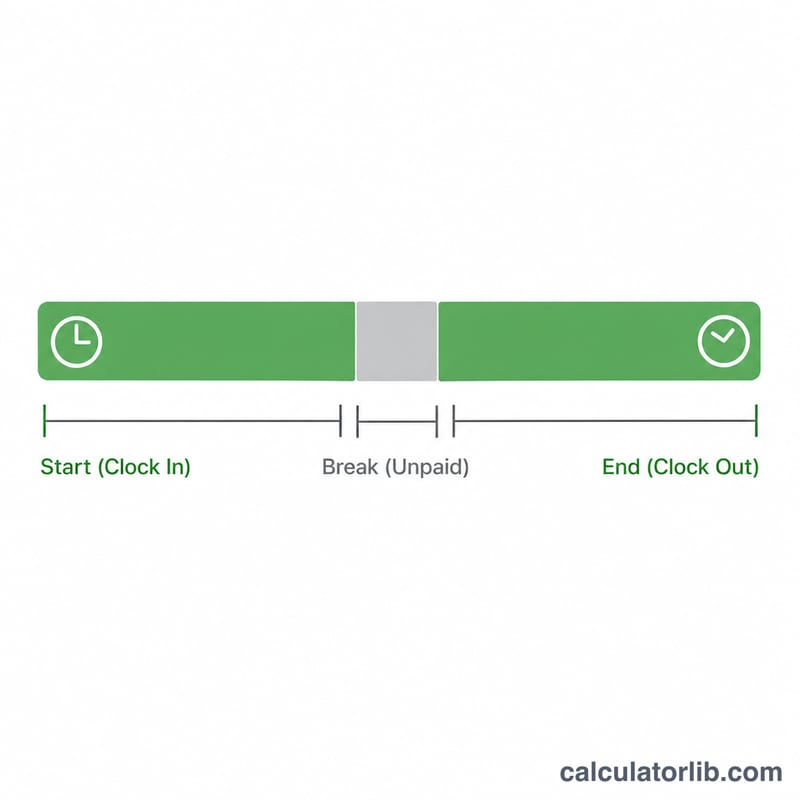
This weekly time card calculator adds up the hours you worked across all seven days of a week. For each day you enter a start time, an end time and any unpaid break, and the tool returns the hours worked that day plus a grand weekly total — shown both as hh:mm and as decimal hours, the number most payroll systems expect.
How to use it
Pick your time format: 12-hour (with am/pm) or 24-hour / military. Enter each time as an hhmm digit string with no colon — for example 915 means 9:15 and 1225 means 12:25. In 12-hour mode set the am/pm dropdown for each time; in 24-hour mode the dropdowns are ignored and a value like 1730 is read straight as 17:30. Add the unpaid break in minutes (leave blank for none). Days left completely blank simply count as zero.
The formula explained
Each hhmm value is split into hours = \(\lfloor n/100 \rfloor\) and minutes = \(n \bmod 100\), then converted to minutes after midnight. In 12-hour mode, 12:xx am becomes 00:xx and any pm time below 12 gets 12 hours added. If the end time is at or before the start time, the shift is treated as overnight and 24 hours (1440 minutes) is added to the end. Gross minutes are end minus start; worked minutes are gross minus the break, clamped to zero so a long break never produces negative time. All days are summed in whole minutes to avoid rounding drift, then divided by 60 for decimal hours.
$$\text{Decimal Hours} = \frac{\sum_{d=1}^{7}\big[(\text{End}_d - \text{Start}_d) - \text{Break}_d\big]}{60}$$$$\text{Worked}_d = (\text{End}_d - \text{Start}_d) - \text{Break}_d$$
Worked example
Monday: start 900 am, end 515 pm, break 30 minutes. Start = 9:00 = 540 minutes. End = 5:15 pm = 17:15 = 1035 minutes. Gross = \(1035 - 540 = 495\). Worked = \(495 - 30 = 465\) minutes = 7:45 = 7.75 hours. Repeat that across Monday to Friday: \(5 \times 465 = 2325\) minutes = 38:45 = 38.75 hours for the week.
FAQ
How do I convert hh:mm to decimal hours? \(\text{Decimal} = H + \frac{M}{60}\). So \(8:30 = 8 + \frac{30}{60} = 8.50\) hours and 7:45 = 7.75 hours.
Does it handle overnight shifts? Yes. If the end time is at or before the start time the calculator assumes the shift crossed midnight and adds 24 hours, so 22:00 to 06:00 returns 8 hours.
What if my break is longer than the shift? The day is clamped to zero hours — it never returns a negative value.