
What Is the Annual Work Hours Calculator?
This calculator estimates how many hours you work in a full year. It starts from the number of hours you work each week, multiplies by the working weeks in a year (52 minus any vacation weeks you take), and returns your total annual working hours. It's useful for budgeting, comparing job offers, converting an hourly wage to a yearly salary, or planning time off.
How to Use It
Enter your typical hours per week (for example, 40) and the number of vacation weeks you take off each year (for example, 2 weeks of paid leave). The calculator subtracts vacation weeks from the 52 weeks in a year, then multiplies by your weekly hours. It also shows the working weeks remaining and the equivalent number of standard 8-hour days.
The Formula Explained
The core formula is $$\text{Annual Hours} = \text{Hours per Week} \times \left(52 - \text{Vacation Weeks}\right)$$ A standard calendar year has 52 weeks. Every week you take off as vacation removes one week of work. So a 40-hour week with 2 vacation weeks equals \(40 \times (52 - 2) = 40 \times 50 = 2{,}000\) hours. The equivalent working days simply divides total hours by 8.
Worked Example
Suppose you work 37.5 hours per week and take 4 weeks of vacation. Working weeks = \(52 - 4 = 48\). Annual hours: $$37.5 \times 48 = 1{,}800 \text{ hours}$$ In 8-hour days that's \(1{,}800 \div 8 = 225\) working days.
Standard Full-Time Hour References
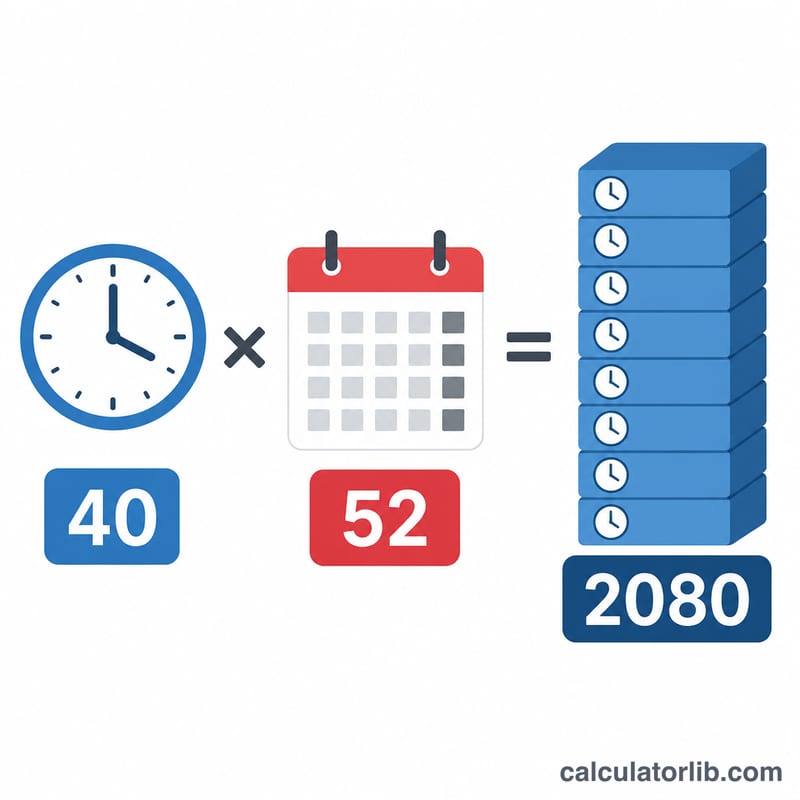
The number of hours in a "full-time" work year depends on which convention you use. The most common benchmark in US payroll is 2,080 hours, which assumes 40 hours per week across all 52 weeks of the year (no unpaid time off subtracted). When you account for paid vacation, the actual hours worked are lower, but salaried full-time employees are typically still paid on the 2,080-hour basis. The table below summarizes the most widely used reference points.
| Reference | Value | Basis / Convention |
|---|---|---|
| Full-time payroll year | 2,080 hrs/yr | 40 h/week × 52 weeks; standard US payroll convention for salaried full-time work |
| Full-time minus 2 weeks PTO | 2,000 hrs/yr | 40 h/week × (52 − 2) weeks; common baseline with two weeks paid vacation |
| Full-time at 37.5 h/week | 1,950 hrs/yr | 37.5 h/week × 52; common where a 30- or 60-minute unpaid lunch is excluded from an 8-hour day |
| Full-time at 35 h/week | 1,820 hrs/yr | 35 h/week × 52; common "short" full-time norm in some office and European-style schedules |
| FLSA overtime threshold | 40 hrs/week | US Fair Labor Standards Act: non-exempt hours over 40 in a workweek are paid at 1.5× the regular rate |
| Typical PTO baseline | 2 weeks (10 workdays) | Common starting paid-vacation allotment for new US full-time employees; often increases with tenure |
| Equivalent 8-hour days | 260 days/yr | 2,080 hrs ÷ 8 h per day; the count of weekdays in a typical 52-week year before holidays |
"Full-time" itself is not fixed by federal law for hours-worked purposes — the FLSA sets the overtime line at 40 hours but does not define full-time vs. part-time. Many employers use 30+ hours/week (the threshold under the Affordable Care Act for benefits eligibility), while 35–40 hours/week is the most common practical standard.
FAQ
Does this include holidays? No — public holidays are not subtracted automatically. To include them, convert holiday days into weeks (e.g. 5 holidays ≈ 1 week) and add them to your vacation weeks.
Why 52 weeks? A year contains about 52.14 weeks; 52 is the standard convention used for payroll and scheduling estimates.
Can I use part-time hours? Yes. Enter any weekly hours, including decimals such as 22.5, and the calculator scales the result accordingly.