
What the Horse Color Calculator Does
This Horse Color Calculator predicts the probability that a foal will be bay, black, or chestnut based on the coat colors of the sire (father) and dam (mother). It works with the two foundation genes that control these base colors, helping breeders, students, and curious horse owners understand what coat colors a planned mating could produce — and roughly how likely each one is.
How to Use It
- Select the sire's base coat color: bay, black, or chestnut.
- Select the dam's base coat color.
- Read the results, which show the estimated percentage chance of each base color in the foal.
Because the calculator assumes each parent could carry hidden recessive genes, the results are probabilities rather than guarantees. For exact outcomes, genetic testing of the parents is the only sure method.
The Genetics Behind the Formula
Two genes drive these base colors:
$$P(\text{Foal Color}) = f\left(\text{Sire Color},\; \text{Dam Color}\right)$$
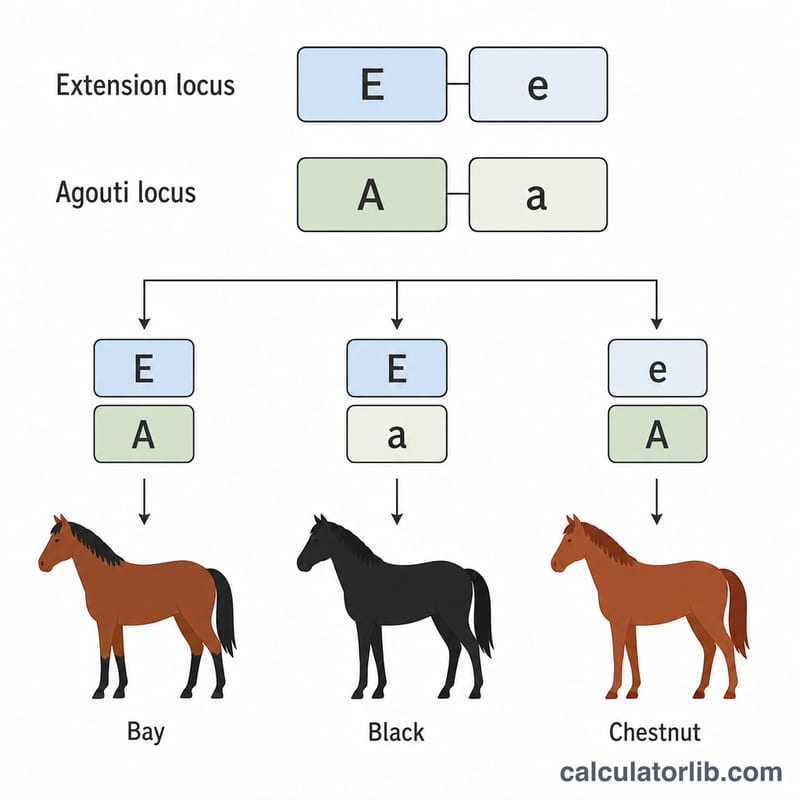
- Extension (E/e): The dominant E allows black pigment; the recessive "ee" produces chestnut. A chestnut horse is always "ee".
- Agouti (A/a): The dominant A restricts black pigment to the points (mane, tail, legs), creating bay. Without A, a horse with black pigment is solid black.
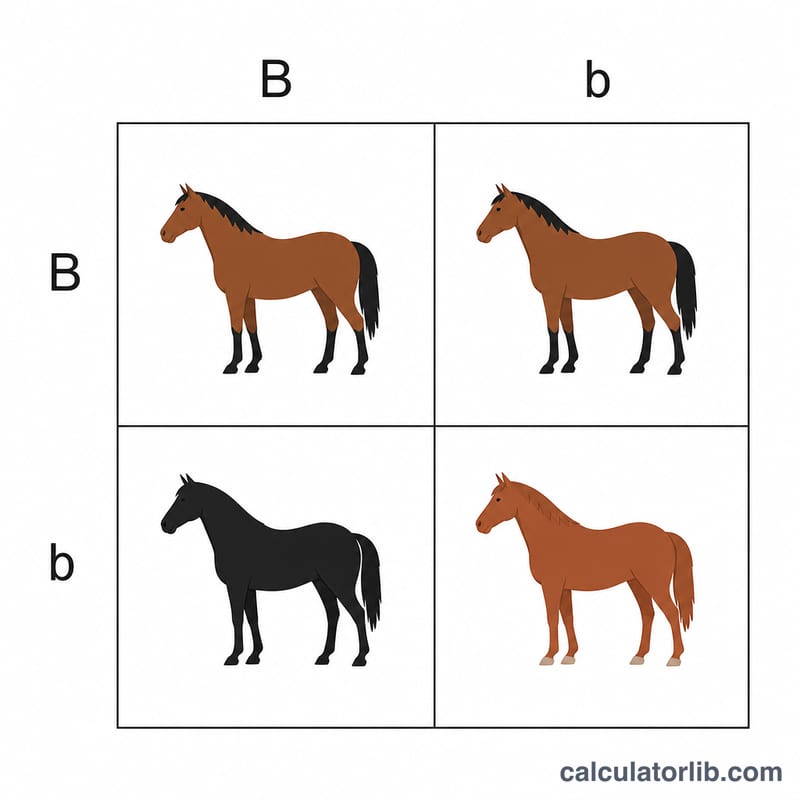
So bay = E_A_, black = E_aa, and chestnut = ee (agouti hidden but irrelevant). The calculator combines the possible genotypes each parent could have and uses Punnett-square logic to estimate offspring color odds.
Worked Example
Cross a bay sire with a chestnut dam. The chestnut parent is "ee", so it always passes an "e". The bay sire carries at least one E and one A but may also carry recessive "e" and "a". If the bay is heterozygous (Ee Aa), the foal could be bay, black, or chestnut. A common result is roughly \(25\%\) bay, \(25\%\) black, and \(50\%\) chestnut — though the exact split shifts depending on what hidden alleles the bay parent carries.
Frequently Asked Questions
Does this cover colors like palomino, gray, or roan? No. Those come from modifier genes (Cream, Gray, Roan) layered on top of the base colors. This tool predicts only the bay/black/chestnut foundation.
Why can't it give a definite answer? Because bay and black horses may carry recessive chestnut or agouti genes you cannot see. Without DNA testing, several genotypes look identical.
Is chestnut always recessive? Yes. Two chestnut parents will always produce a chestnut foal, since both can only pass the "ee" combination.