
What the Exposure Calculator Does
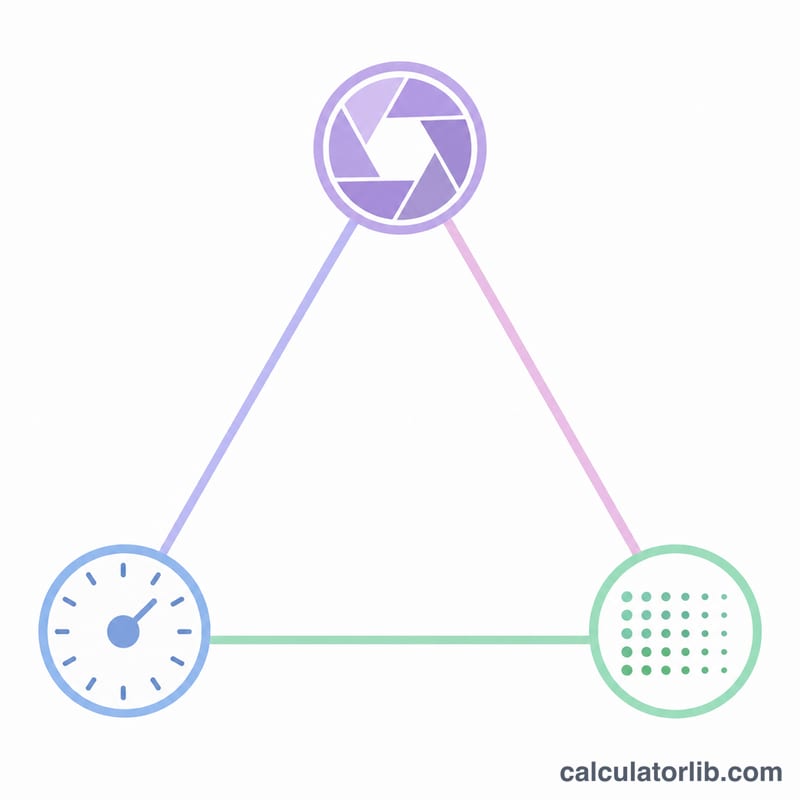
The Exposure Calculator works out the Exposure Value (EV) for a given camera setting. EV is a single number that summarises how much light a particular combination of aperture, shutter speed and ISO captures. Photographers use it to compare settings, balance the exposure triangle and judge whether a scene falls into low, normal or bright light. The tool is universal — it uses the standard photographic EV definition and works with any camera brand or country.
The Three Inputs
- Aperture (f-number): the lens opening, e.g. 2.8, 5.6 or 16. Higher numbers mean a smaller opening and less light.
- Shutter Speed (seconds): how long the sensor is exposed, entered in seconds (e.g. 0.004 for 1/250s, or 1 for one second).
- ISO: the sensor sensitivity, e.g. 100, 400 or 1600. Higher ISO captures more light but adds noise.
The Formula Explained
The calculator uses the standard EV equation, normalised to ISO 100:
$$\text{EV} = \log_{2}\!\left(\frac{\text{Aperture}^{2}}{\text{Shutter Speed (s)}}\right) - \log_{2}\!\left(\frac{\text{ISO}}{100}\right)$$
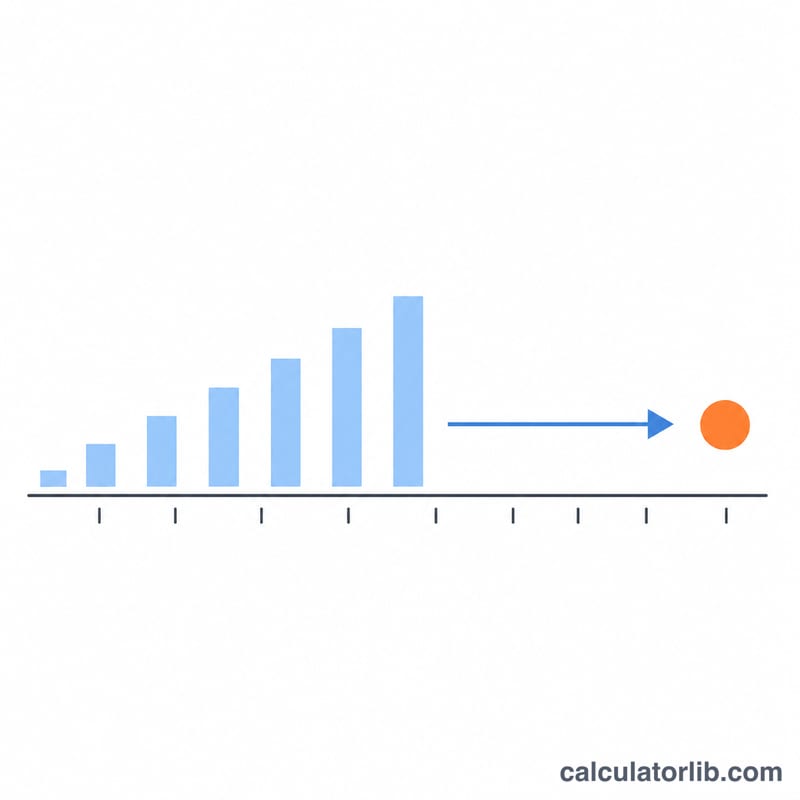
Here N is the aperture (f-number), t is the shutter speed in seconds, and ISO is your sensitivity setting. The first term gives the EV at ISO 100; the second term shifts it for higher or lower ISO. The result is then classified: under 8 is "Low Light", 8 to 13 is "Normal Light", and above 13 is "Bright Light". The value is also clamped between −6 and 20 to position a marker on a visual scale.
Worked Example
Suppose you shoot at f/8, 1/250s (0.004 seconds) and ISO 100:
- \(N^{2} / t = 64 / 0.004 = 16{,}000\)
- \(\log_{2}(16{,}000) \approx 13.97\)
- \(\log_{2}(100 / 100) = 0\)
- \(\text{EV} \approx 13.97\) → classified as Bright Light
This matches a typical sunny daytime exposure.
Frequently Asked Questions
Does a higher EV mean more or less light? A higher EV corresponds to a brighter scene. Bright sunlight is often around EV 15, while dim indoor light may be EV 5 or lower.
How do I enter a shutter speed like 1/500? Convert it to a decimal in seconds: \(1 \div 500 = 0.002\). Enter 0.002 in the shutter speed field.
Why does ISO affect the EV? The formula normalises to ISO 100. Raising the ISO effectively makes the sensor "see" more light, so the calculator subtracts \(\log_{2}(\text{ISO}/100)\), lowering the EV needed for a correct exposure.