What Is a Gas Surcharge Calculator?
A gas surcharge (also called a fuel surcharge) is an extra fee added to the base price of a service to offset rising fuel costs. It is commonly used by trucking companies, freight carriers, delivery services, taxis, moving companies, and shipping providers worldwide. This calculator helps you estimate how much extra to charge—or how much you'll pay—when fuel prices climb above an agreed threshold. The method shown here is generic and works with any currency, so it applies in the US, UK, EU, Canada, Australia, and beyond.
How to Use the Calculator
Enter the four key values and the calculator does the math instantly:
- Base rate – the price of the service before any surcharge.
- Current gas price – the price of fuel per gallon or litre today.
- Threshold price – the fuel price baseline included in the base rate.
- Surcharge percentage – the percent added for each unit of fuel price above the threshold.
Once entered, the tool returns the surcharge amount and the total adjusted price.
The Formula Explained
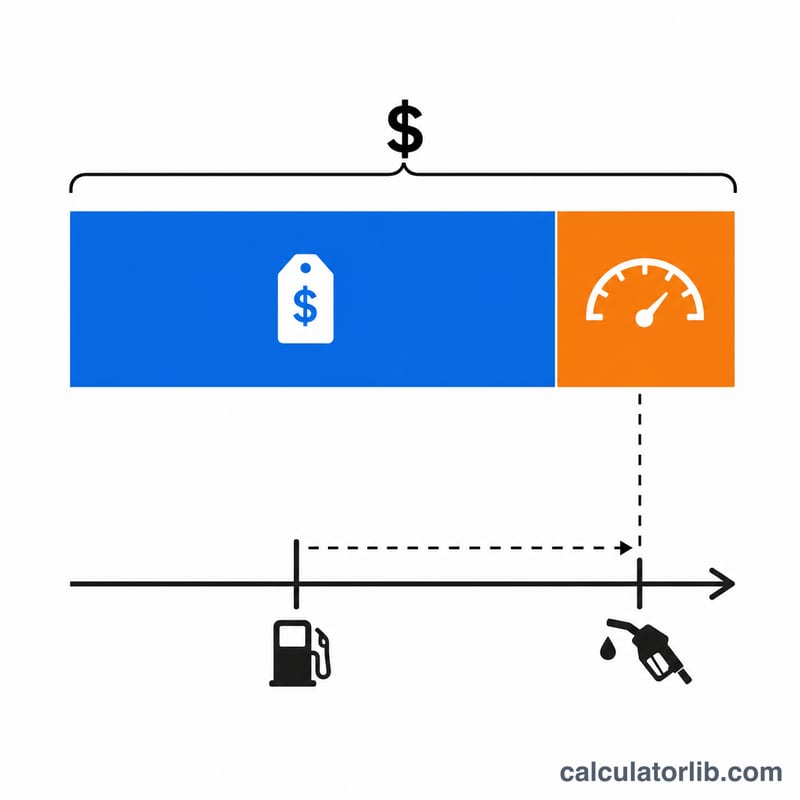
The surcharge is triggered only when the current fuel price rises above the threshold. A simple, widely used version is:
$$\text{Surcharge} = \text{Base Rate} \times \text{Surcharge \%} \times (\text{Current Price} - \text{Threshold Price})$$
If the current price is at or below the threshold, the surcharge is zero. The total you pay is the base rate plus the surcharge.
Worked Example
Suppose a delivery has a base rate of $500. The contract threshold is $3.00 per gallon, but fuel now costs $4.00 per gallon. The agreed surcharge is 5% (0.05) per dollar over the threshold.
- Price gap: \(\$4.00 - \$3.00 = \$1.00\)
- Surcharge: \(\$500 \times 0.05 \times \$1.00 = \$25.00\)
- Total price: \(\$500 + \$25 = \$525.00\)
The customer pays an extra $25 to cover the increased fuel expense.
Surcharge Comparison at Different Fuel Prices
This table uses a $500 base rate, a $3.00 per gallon threshold and a surcharge of 5% of the base rate for every $1.00 the fuel price is above the threshold. The surcharge is calculated as:
$$\text{Surcharge} = \text{Base} \times \text{Rate} \times (\text{Price} - \text{Threshold})$$
With these inputs, each $1.00 above the threshold adds \(500 \times 0.05 = 25\) dollars.
| Current gas price | Price gap above threshold | Surcharge amount | Total price |
|---|---|---|---|
| $2.50 | $0.00 (below threshold) | $0.00 | $500.00 |
| $3.00 | $0.00 (at threshold) | $0.00 | $500.00 |
| $3.50 | $0.50 | $12.50 | $512.50 |
| $4.00 | $1.00 | $25.00 | $525.00 |
| $5.00 | $2.00 | $50.00 | $550.00 |
| $6.00 | $3.00 | $75.00 | $575.00 |
Example for $5.00 fuel: \(500 \times 0.05 \times (5.00 - 3.00) = 500 \times 0.05 \times 2 = 50\), so the total is \(500 + 50 = 550\).
Note: this table uses the per-currency-unit convention described above. The calculator's formula instead divides the gap by the threshold, \((G - T)/T\), so its output for the same inputs will differ from these figures.
Fuel Surcharge Terms Explained
- Base rate: the price of the service before any fuel adjustment, such as a freight or delivery charge.
- Threshold (peg) price: the fuel price per gallon (or liter) up to which no surcharge is charged. It is set in the contract or carrier schedule.
- Current fuel price: the fuel price used for the calculation, often a published average for a given period or region.
- Surcharge percentage: the share of the base rate added for each one currency unit (for example, $1.00) that the fuel price is above the threshold. In this article, 5% means 5% of the base rate per $1.00 over.
- Price gap: the current fuel price minus the threshold. If it is zero or negative, no surcharge applies.
- Total adjusted price: the base rate plus the surcharge amount.
Carriers do not all use this method. Some charge a fixed amount per mile, and others use a stepped table where the surcharge percentage changes in bands of fuel price (for example, a set percentage for each price range). Check the actual terms of your contract or carrier.
Interpreting Your Surcharge Result
- A result of zero means the current fuel price is at or below the threshold, so no fuel adjustment is added and the total equals the base rate.
- Surcharge as a share of the base rate equals the surcharge percentage multiplied by the price gap. With a 5% rate and a $1.00 gap, \(5\% \times 1.00 = 5\%\), so the surcharge is 5% of $500, which is $25. A $2.00 gap gives 10% ($50) and a $3.00 gap gives 15% ($75).
- Linear growth: under this per-unit method, each additional $1.00 of fuel price adds the same surcharge amount ($25 on a $500 base). The surcharge rises in a straight line as fuel prices rise.
- Contract dependence: the result depends on the threshold, the percentage, and how the gap is measured (per currency unit, relative to the threshold, or by stepped bands). Different terms give different figures from the same fuel price.
- Estimate only: the figure is an estimate. Actual invoices may use a different fuel price source, timing, rounding or rate schedule.
Frequently Asked Questions
Why do companies use a fuel surcharge instead of raising prices? A surcharge lets businesses adjust quickly to volatile fuel markets without renegotiating base contracts, then drop the fee when prices fall.
What threshold should I set? Use the average fuel price that was assumed when you set your base rate—often a regional or national average published by a transport authority.
Is the surcharge negotiable? Yes. The threshold and percentage are usually defined in the service contract and can be adjusted by agreement between both parties.