What is the PHQ-9?
The Patient Health Questionnaire-9 (PHQ-9) is a widely used, validated self-report screening tool for depression. It maps the nine diagnostic criteria for major depressive disorder onto nine questions, each asking how often you have been bothered by a symptom over the last two weeks. This calculator adds your responses into a single 0-27 score and tells you the corresponding severity band. It is an educational screening aid, not a diagnosis — only a qualified clinician can diagnose depression.
How to use this calculator
For each of the nine items, pick the option that best describes how often the problem affected you over the past two weeks: 0 = Not at all, 1 = Several days, 2 = More than half the days, and 3 = Nearly every day. The calculator sums the nine values and classifies the result into one of five severity categories.
The formula explained
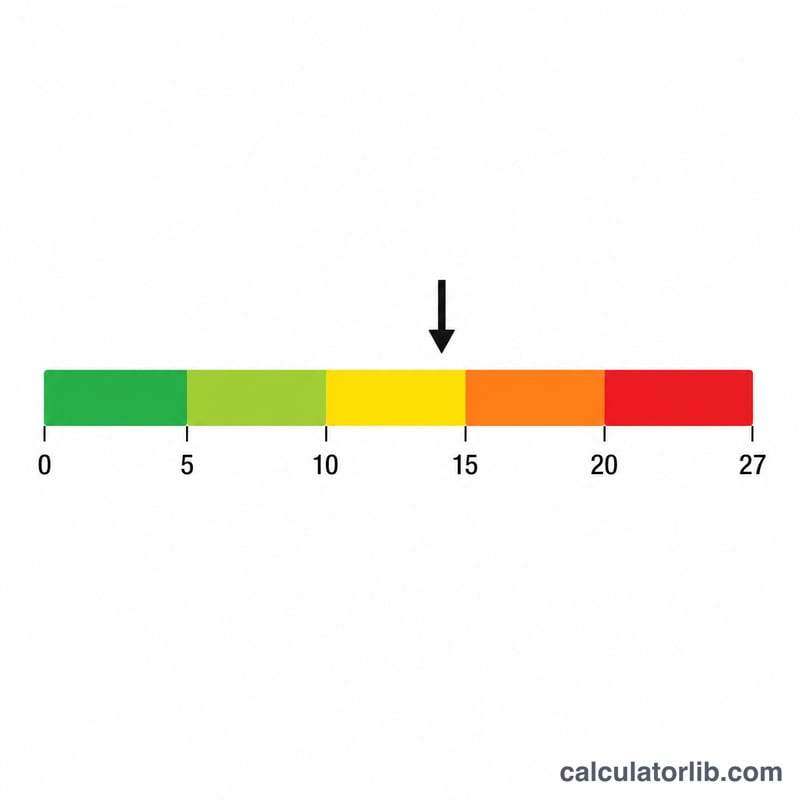
The PHQ-9 score is simply the sum of all nine item scores: $$\text{Score} = \sum_{i=1}^{9} Q_i = \text{Q1} + \text{Q2} + \text{Q3} + \text{Q4} + \text{Q5} + \text{Q6} + \text{Q7} + \text{Q8} + \text{Q9}$$ Because each item ranges from 0 to 3, the minimum possible score is 0 and the maximum is 27. Standard interpretation bands are: 0-4 minimal, 5-9 mild, 10-14 moderate, 15-19 moderately severe, and 20-27 severe. A score of 10 or higher is the commonly used threshold suggesting that further clinical evaluation for depression may be warranted.
Worked example
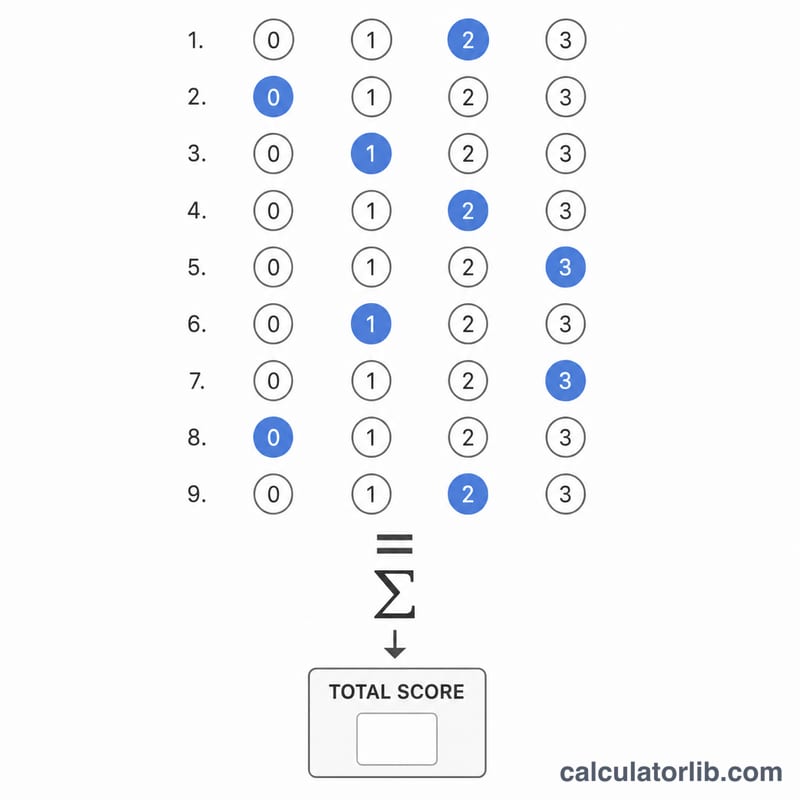
Suppose someone answers: \(q1=2\), \(q2=3\), \(q3=1\), \(q4=2\), \(q5=1\), \(q6=0\), \(q7=2\), \(q8=0\), \(q9=1\). The total is $$2+3+1+2+1+0+2+0+1 = 12$$ A score of 12 falls in the 10-14 band, which is classified as moderate depression. Because item 9 (thoughts of self-harm) is greater than 0, the result also flags that the person should seek support.
PHQ-9 Severity Bands at a Glance
The PHQ-9 (Patient Health Questionnaire-9) has nine items, each scored 0 (not at all), 1 (several days), 2 (more than half the days) or 3 (nearly every day). The total therefore ranges from 0 to 27. The severity bands below come from the original validation work by Kroenke, Spitzer and Williams (2001) and the published scoring guidance that followed it. The questionnaire is used internationally, but the clinical-context wording below reflects that published guidance.
| Total score | Severity label | General clinical context in the published guidance |
|---|---|---|
| 0-4 | Minimal or none | Few or no depressive symptoms reported; no treatment action is proposed by the scoring guidance. |
| 5-9 | Mild | Some symptoms present; the guidance describes watchful waiting, with the questionnaire repeated at follow-up. |
| 10-14 | Moderate | At or above the standard screening cutoff; the guidance describes developing a treatment plan, which may include counseling, follow-up and/or medication, based on clinical judgment. |
| 15-19 | Moderately severe | The guidance describes active treatment with medication and/or psychotherapy. |
| 20-27 | Severe | The guidance describes prompt treatment and, where impairment is marked or response is poor, expedited referral to a mental health specialist. |
In the original validation, a total score of 10 or higher had roughly 88% sensitivity and 88% specificity for major depression. These figures come from the primary-care and obstetrics-gynecology samples in that study, and performance can differ in other populations and settings. The bands describe symptom burden. They are not diagnoses.
Interpreting Your PHQ-9 Score
What the bands represent. The cutoffs at 5, 10, 15 and 20 mark mild, moderate, moderately severe and severe levels of depressive symptoms. They are roughly equal steps on the 0-27 scale. A higher total means more symptoms and/or more frequent symptoms. It does not by itself say what is causing them.
The 10-point cutoff. A score of 10 or more is the most widely used threshold for flagging possible major depression. It balances sensitivity and specificity at about 88% each in the original study.
Time frame. Each item asks how often a problem has bothered the person over the last 2 weeks. The score is a snapshot of that period, not a measure of lifetime or long-term mood, and it can change from one administration to the next.
Screening versus diagnosis. The PHQ-9 is a screening and severity-monitoring tool. Diagnosing depression requires a clinical assessment that considers symptom duration, impact, medical conditions, medications, substance use, bereavement, bipolar history and other factors. The original paper also describes a diagnostic algorithm, in which a major depressive syndrome is suggested when at least 5 of the 9 items are endorsed at "more than half the days" (item 9 counts if endorsed at all) and one of those is item 1 (little interest or pleasure) or item 2 (feeling down or hopeless). Even then, that result needs confirmation by a clinician.
Item 9. Item 9 asks about thoughts of being better off dead or of hurting oneself. It is reviewed on its own, because any response above 0 is considered important for a clinician to follow up regardless of the total score. It is not a reliable predictor of future behavior, and a low total does not cancel a positive item 9. Anyone in immediate danger should contact local emergency services or a crisis line. In the United States, the 988 Suicide & Crisis Lifeline is available by call or text to 988.
The functional-difficulty question. Many versions add a final, unscored question asking how difficult the problems have made it to work, take care of things at home or get along with other people. The answers are: not difficult at all, somewhat difficult, very difficult or extremely difficult. It is not added to the 0-27 total. It captures real-world impact, which clinicians consider alongside the score.
Tracking change over time. When the same person completes the PHQ-9 repeatedly under similar conditions, the series of totals shows how symptoms change over time. Small shifts may reflect normal fluctuation or the way the items were interpreted on a given day.
This is general information, not medical advice. The score cannot diagnose a condition or determine what care is appropriate. A qualified clinician, such as a physician, psychologist or psychiatrist, can interpret the result in context and discuss options. Seek help promptly if symptoms are distressing, interfere with daily life, or involve thoughts of self-harm.
FAQ
Does a high score mean I have depression? No. The PHQ-9 is a screening tool. A high score suggests you should discuss your symptoms with a healthcare professional for a proper assessment.
What does item 9 measure? Item 9 asks about thoughts of being better off dead or hurting yourself. Any score above 0 on this item warrants attention regardless of the total score. If you are having these thoughts, please seek help immediately — in the US call or text 988.
How often can I take it? The PHQ-9 is often repeated over time to track changes in symptoms and treatment response, typically every few weeks.