
What is the AUDIT-C?
The AUDIT-C (Alcohol Use Disorders Identification Test – Consumption) is a brief, validated three-question screening tool used by clinicians worldwide to identify hazardous drinking and possible alcohol use disorders. It is a shortened version of the full 10-item AUDIT developed by the World Health Organization, focusing only on the consumption questions. This calculator is an educational aid and is not a diagnosis — only a qualified healthcare professional can interpret your result in full clinical context.
How to use it
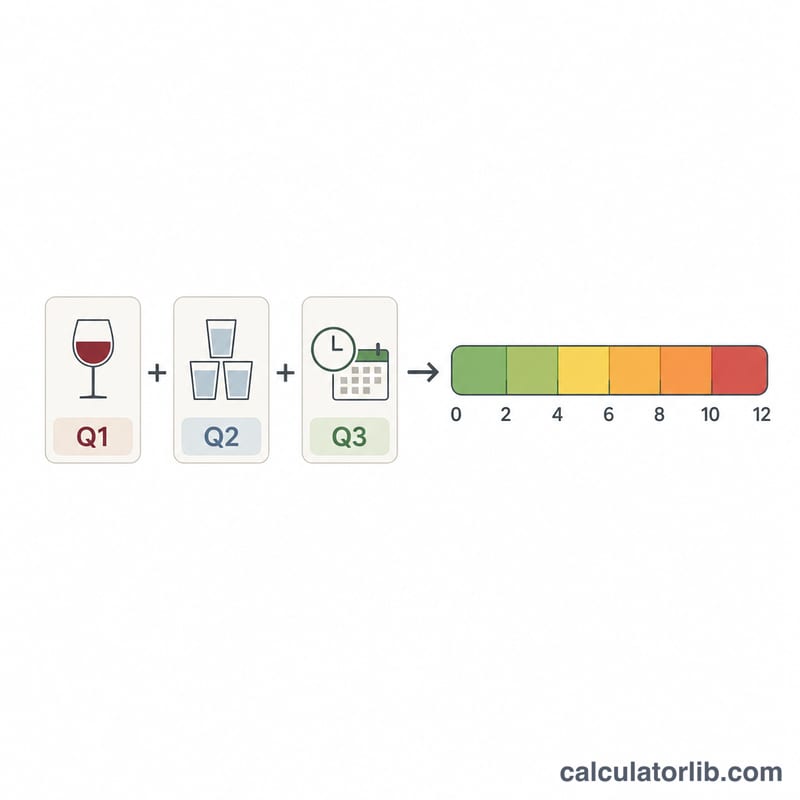
Select your sex, then answer each of the three questions about your typical drinking pattern. Each answer scores between 0 and 4 points. The calculator adds the three answers for a total between 0 and 12 and compares it to the recommended cutoff for your sex.
The formula explained
Score = Q1 + Q2 + Q3. Q1 measures frequency of any drinking, Q2 measures the typical quantity per occasion, and Q3 measures frequency of heavy episodic ("binge") drinking. The commonly used positive-screen thresholds are 4 or more for men and 3 or more for women. Higher scores indicate a greater likelihood of alcohol misuse.
$$\text{Score} = \text{Q1} + \text{Q2} + \text{Q3} \;\geq\; 4 \;\Rightarrow\; \text{Positive}$$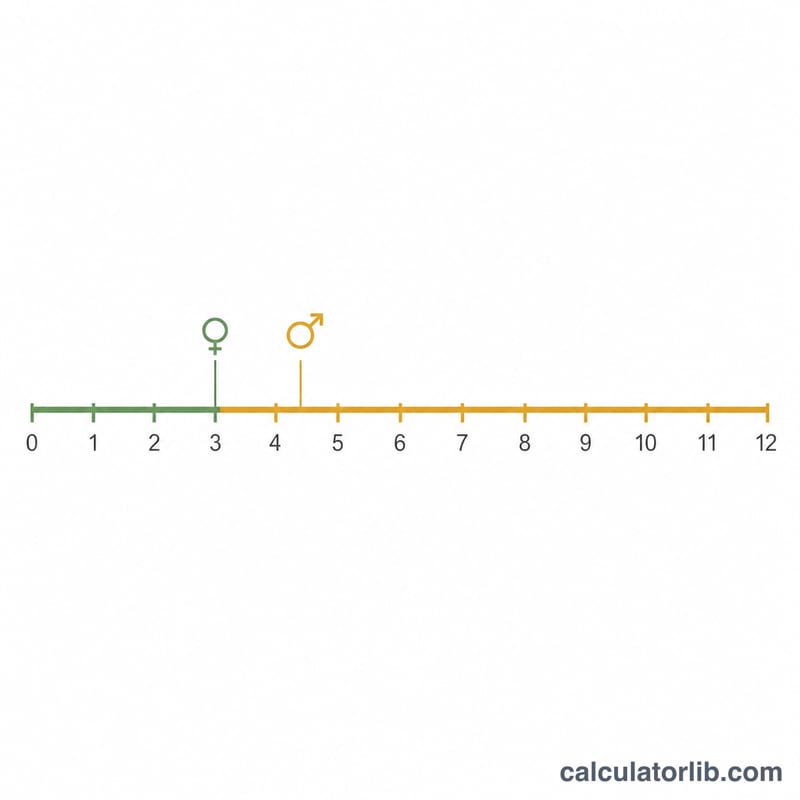
Worked example
A woman reports drinking 2–4 times a month (Q1 = 2), typically 3–4 drinks (Q2 = 1), and having 6+ drinks less than monthly (Q3 = 1). Her total is \(2 + 1 + 1 = 4\). Because \(4 \geq 3\) (the female threshold), this is a positive screen indicating possible alcohol misuse and warrants further assessment.
AUDIT-C Question Scoring Guide
The AUDIT-C consists of three questions, each scored from 0 to 4 points. The total score is the sum of all three answers, giving a possible range of 0 to 12. One standard drink in this context contains roughly 14 grams of pure alcohol (about a 12 oz beer, 5 oz wine, or 1.5 oz of 80-proof spirits).
| Points | Q1: How often do you have a drink containing alcohol? | Q2: How many standard drinks on a typical drinking day? | Q3: How often do you have 6 or more drinks on one occasion? |
|---|---|---|---|
| 0 | Never | 1 or 2 | Never |
| 1 | Monthly or less | 3 or 4 | Less than monthly |
| 2 | 2–4 times a month | 5 or 6 | Monthly |
| 3 | 2–3 times a week | 7 to 9 | Weekly |
| 4 | 4 or more times a week | 10 or more | Daily or almost daily |
Note: if the answer to Q1 is “Never,” the respondent is a non-drinker and the total AUDIT-C score is 0 (Q2 and Q3 are not applicable).
Interpreting Your AUDIT-C Score
The AUDIT-C uses sex-specific cutoffs because of physiological differences in how alcohol is metabolized. A screen is considered positive when the total score reaches the threshold for the respondent's sex:
- Men: a score of 4 or higher is a positive screen.
- Women: a score of 3 or higher is a positive screen.
A positive screen suggests that drinking may be affecting health or safety and that a fuller assessment is warranted. A score below the cutoff is a negative screen, indicating a lower likelihood of alcohol misuse, though it does not rule it out entirely.
Higher scores correlate with a greater likelihood and severity of alcohol misuse. Published validation studies report that the higher the score, the more likely the drinking reflects active alcohol use disorder (alcohol abuse or dependence). In particular, scores of 4 or more in women and roughly 5–6 or more in men are associated with a substantially increased likelihood of active alcohol use disorder. A score of 12 reflects the most severe drinking pattern measurable by the instrument.
The AUDIT-C is a screening tool, not a diagnosis. A positive result indicates the need for further evaluation by a qualified clinician, who may use a full diagnostic interview to determine whether an alcohol use disorder is present. This page provides general information and is not a substitute for professional medical advice.
Example Scores Across Drinking Patterns
The examples below show how different drinking patterns translate into AUDIT-C totals and how the same score can yield different screen outcomes depending on the sex-specific cutoff (men ≥4, women ≥3).
| Pattern | Q1 | Q2 | Q3 | Total | Men (≥4) | Women (≥3) |
|---|---|---|---|---|---|---|
| Light, occasional drinker | Monthly or less (1) | 1 or 2 (0) | Never (0) | 1 | Negative | Negative |
| Moderate weekly drinker | 2–3 times a week (3) | 3 or 4 (1) | Less than monthly (1) | 5 | Positive | Positive |
| Frequent heavier drinker | 4+ times a week (4) | 5 or 6 (2) | Weekly (3) | 9 | Positive | Positive |
| Borderline social drinker | 2–4 times a month (2) | 1 or 2 (0) | Less than monthly (1) | 3 | Negative | Positive |
The last row illustrates the importance of the sex-specific cutoff: a total of 3 is a negative screen for men but a positive screen for women.
FAQ
Is a positive screen a diagnosis? No. A positive AUDIT-C means further evaluation is recommended, not that an alcohol use disorder is confirmed.
Why are the cutoffs different for men and women? Women generally reach higher blood-alcohol concentrations than men at the same intake, so a lower threshold better captures risk.
What counts as a standard drink? It varies by country, but roughly 14 g of pure alcohol — about a 12 oz beer, 5 oz wine, or 1.5 oz spirits in the US.