
What Is a Pallet Configuration Calculator?
A pallet configuration calculator estimates how many boxes (cartons) you can stack on a single pallet. It looks at your box footprint, the pallet base size, the maximum allowed stacking height, and the height of the pallet itself, then computes the number of boxes per layer, the number of layers, and the total carton count. This helps with shipping quotes, warehouse slotting, and freight planning.
How to Use It
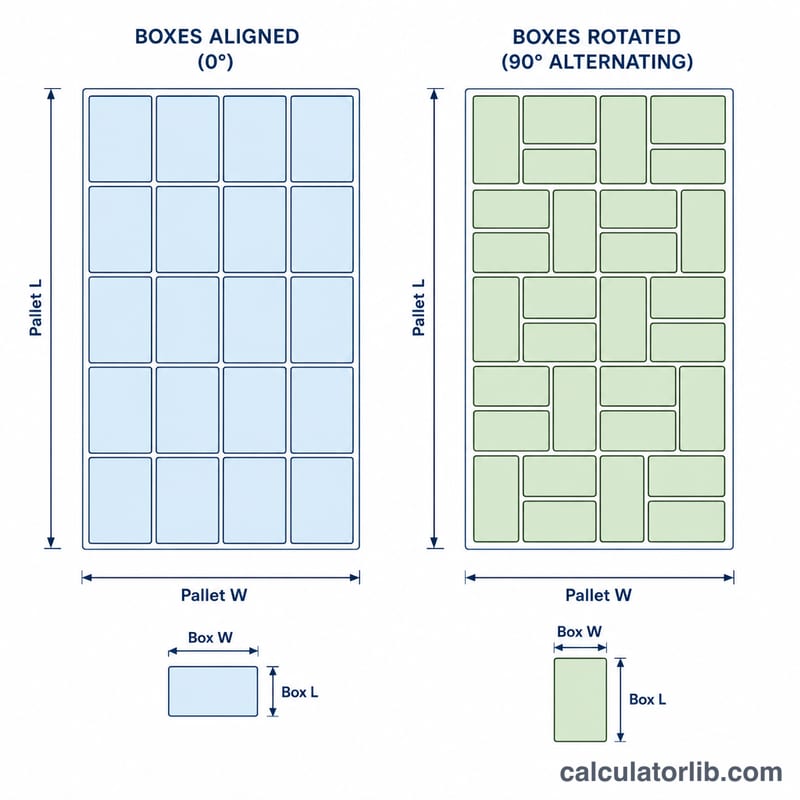
Enter the pallet length and width (a standard US/GMA pallet is \(48 \times 40\) inches), the maximum stack height your carrier or rack allows, and the dimensions and height of one box. Also enter the pallet base height (typically about \(6\) inches). The calculator tries both box orientations on the layer and keeps whichever fits more.
The Formula
With \(L,W\) = pallet length and width, \(l,w,h\) = box dimensions, \(H_{max}\) = max stack height and \(H_{base}\) = pallet base height:
$$N_{layer} = \left\lfloor \frac{L}{l} \right\rfloor \times \left\lfloor \frac{W}{w} \right\rfloor$$ $$N_{layers} = \left\lfloor \frac{H_{max} - H_{base}}{h} \right\rfloor$$The total is \(N_{layer} \times N_{layers}\). The \(\lfloor \cdot \rfloor\) (floor) operation ensures only whole boxes are counted.
Worked Example
Pallet \(48 \times 40\) in, max height \(72\) in, base \(6\) in. Box \(12 \times 10 \times 8\) in.
$$N_{layer} = \left\lfloor \tfrac{48}{12} \right\rfloor \times \left\lfloor \tfrac{40}{10} \right\rfloor = 4 \times 4 = 16$$ $$N_{layers} = \left\lfloor \tfrac{72 - 6}{8} \right\rfloor = \left\lfloor 8.25 \right\rfloor = 8$$ $$\text{Total} = 16 \times 8 = 128 \text{ boxes}$$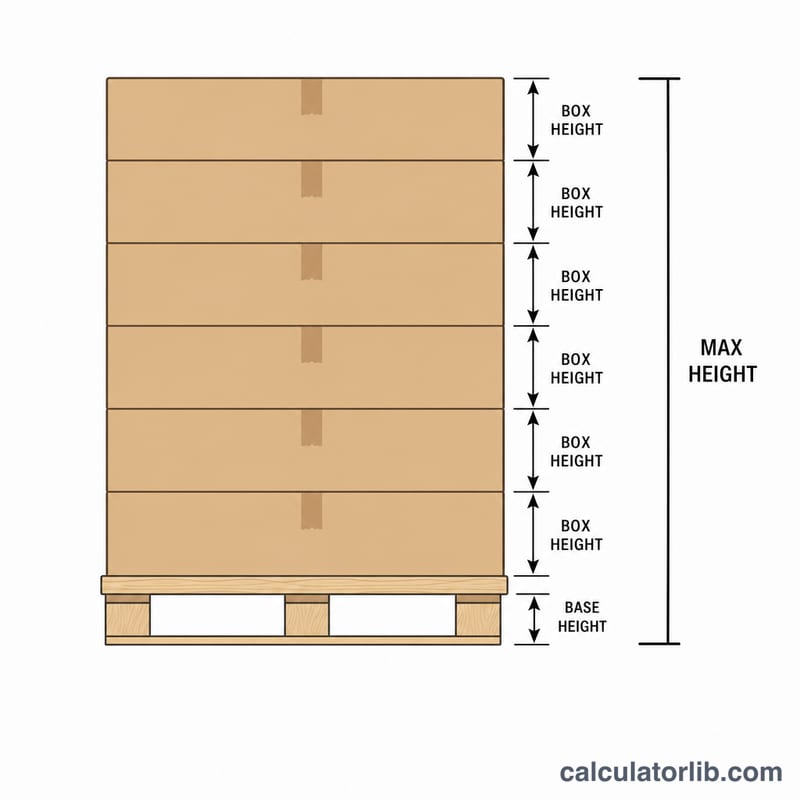
FAQ
Does it allow mixed orientations? It compares two simple grid orientations and picks the larger, but it does not compute interlocked or pinwheel patterns, which can fit a few more boxes.
What units should I use? Use consistent units for every field (all inches or all cm). The result is unit-independent.
What about overhang and weight limits? This tool counts geometric fit only. Always check carrier weight limits and avoid overhanging the pallet edges.