

What this calculator does
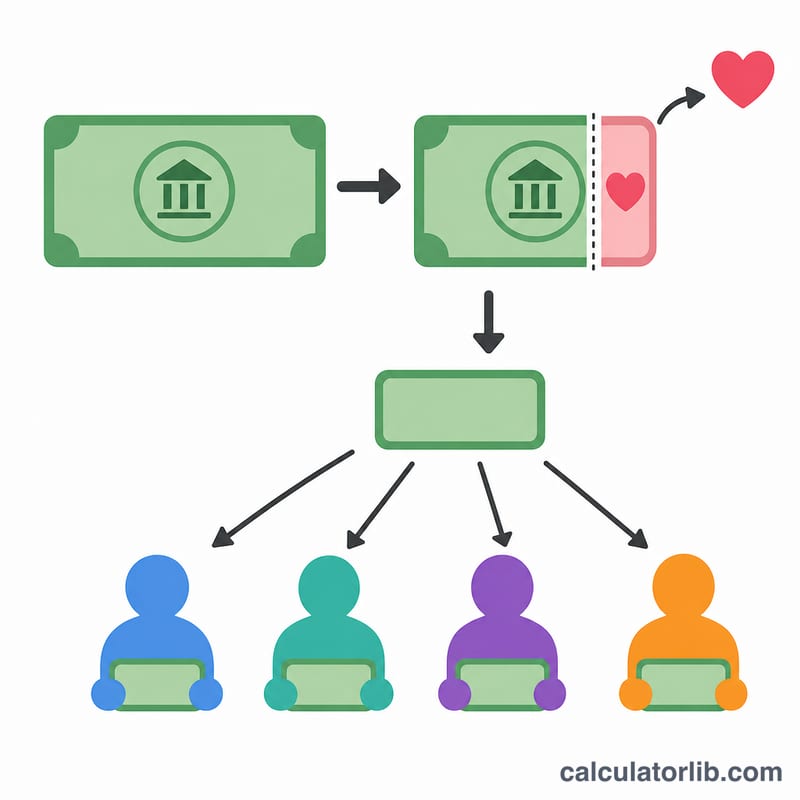
This is a "warikan" (Japanese-style bill splitting) tool that divides a total bill among a group while keeping every payment a clean, cash-friendly number. It first subtracts a donation or contribution (for example, the amount the guest of honor chips in), then splits the rest among everyone, rounding each person's share up to a unit you choose (10, 100, 500 or 1000). Because rounding up collects a little extra, one person absorbs the leftover so the totals balance exactly. The currency shown defaults to yen, but the math is universal and works for any currency.
How to use it
Enter the total bill, the number of people, and pick a rounding unit. Optionally enter a donation that is deducted from the total before splitting. Then choose who handles the leftover: the organizer (everyone pays the rounded-up share and the organizer pays a bit less) or the senior (juniors pay a lower rounded-down share and the senior tops up the rest).
The formula explained
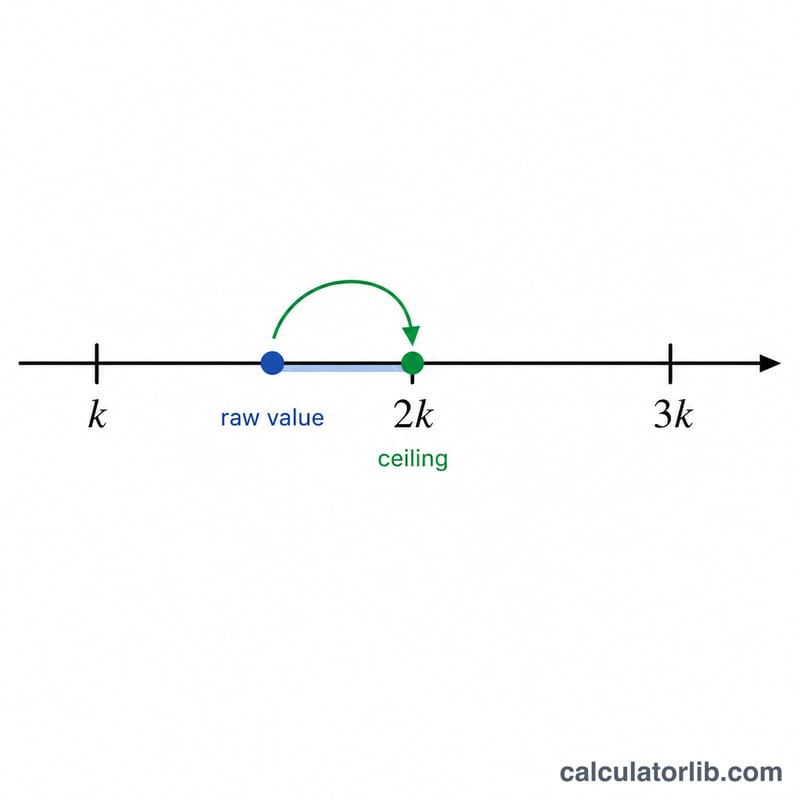
Let net = total - donation, n = people, k = rounding unit. The per-head share is \(\lceil (\text{net}/n)/k \rceil \times k\). The amount collected is \(\text{perHead} \times n\), and the rounding remainder is \(\text{collected} - \text{net}\). In organizer mode the organizer pays \(\text{perHead} - \text{remainder}\). In senior mode the junior share is \(\lfloor (\text{net}/n)/k \rfloor \times k\) and the senior pays net minus the juniors' total.
$$P = \left\lceil \frac{N}{n \cdot k} \right\rceil \cdot k, \qquad A = P - (P\,n - N)$$
$$\text{where}\quad \left\{ \begin{aligned} N &= \text{Total Bill} - \text{Donation} \\ n &= \text{People} \\ k &= \text{Rounding Unit} \end{aligned} \right.$$
Worked example
Bill 12,850, donation 0, unit 100, 5 people, organizer covers. net = 12,850; net/5 = 2,570; perHead = ceil(25.7) x 100 = 2,600. Collected = 13,000, so remainder = 150. The organizer pays 2,600 - 150 = 2,450. Four people pay 2,600 and the organizer pays 2,450, totaling exactly 12,850.
$$\text{net} = 12{,}850, \quad \frac{\text{net}}{5} = 2{,}570, \quad \text{perHead} = \lceil 25.7 \rceil \times 100 = 2{,}600$$
$$\text{Collected} = 13{,}000, \quad \text{remainder} = 150, \quad 2{,}600 - 150 = 2{,}450$$
Definitions & Glossary
- Net amount (\(N\))
- The amount actually divided among the group, equal to the total bill minus any donation: \(N = \text{Total Bill} - \text{Donation}\). All splitting is performed on \(N\), not on the raw total.
- Donation
- A sum carved out of the total bill before splitting — for example a tip, a charity contribution, or a covered guest's portion. It is never charged to the per-head payers.
- Rounding unit (\(k\))
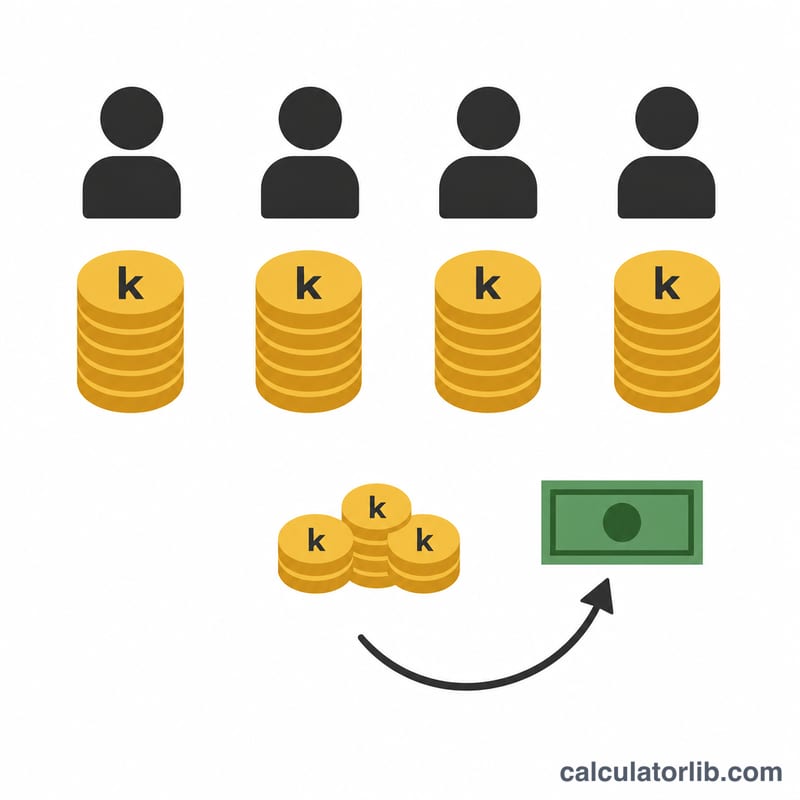
- The clean increment each share is rounded down to (10, 100, 500 or 1000). A larger \(k\) produces tidier individual amounts but concentrates more of the bill into the remainder.
- Per-head share (\(P\))
- The rounded-down amount each ordinary payer contributes, \(P = \lfloor N / (n\cdot k) \rfloor \cdot k\). It is always a multiple of \(k\) and never more than an even split would be.
- Remainder (\(A\))
- The leftover one person pays so the collected amounts equal \(N\): \(A = N - P(n-1)\). Because shares are rounded down, \(A\) is at least as large as \(P\) and absorbs the rounding gap.
- Organizer mode
- The remainder \(A\) is assigned to the event organizer — the person who booked or fronted the bill — while everyone else pays the clean \(P\).
- Senior mode
- The remainder \(A\) is assigned to the most senior member, a common courtesy where the senior covers the odd amount and the juniors pay round figures.
- Juniors
- The \(n-1\) ordinary payers (everyone except the organizer or senior) who each pay exactly the rounded-down per-head share \(P\).
FAQ
What is the donation field for? It is an amount deducted from the total before splitting — useful when the guest of honor pays little or nothing.
Why is the organizer's amount lower? Rounding up over-collects slightly; the organizer absorbs that surplus so the group pays exactly the bill.
What does senior mode change? Juniors pay a rounded-down share and the senior covers the difference, paying a bit more so the others get the convenient number.