
What this calculator does
This tool computes the new position of a point in the 2D plane after it is rotated about the origin (0, 0) by a chosen angle. Rotation about the origin is a fundamental transformation in geometry, computer graphics, robotics and physics. The math is universal — it works the same everywhere, with no country-specific rules.
How to use it
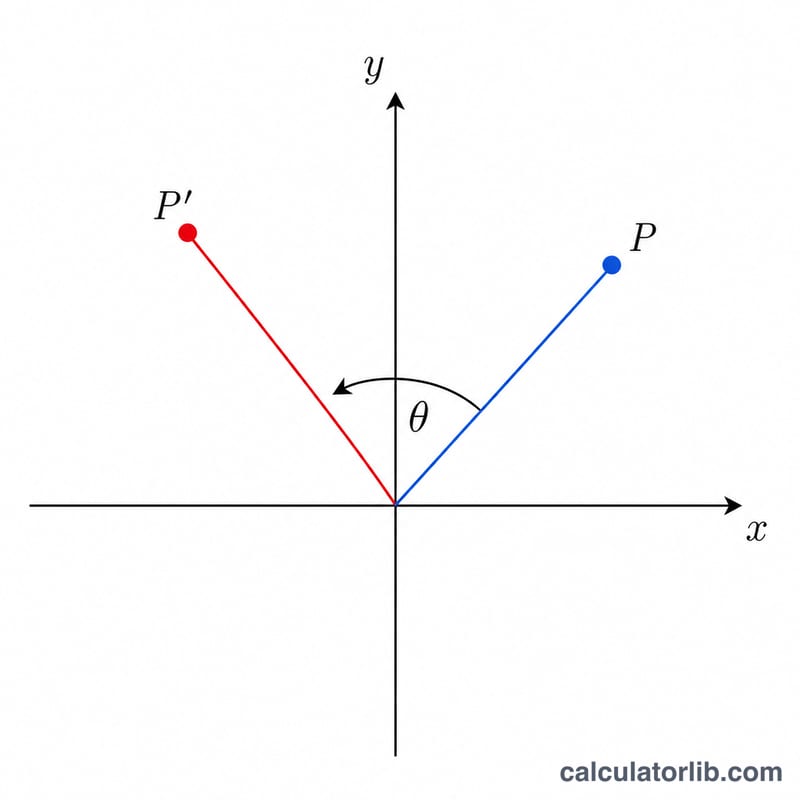
Enter the original coordinates x and y, type the rotation angle \(\theta\), and pick whether the angle is in degrees or radians. By convention a positive angle rotates the point counter-clockwise; enter a negative angle to rotate clockwise. Press calculate to read the new coordinates.
The formula explained
If degrees are chosen, the angle is first converted to radians with \(\theta_{\text{rad}} = \theta \times \pi/180\). The new coordinates are then found with the standard rotation equations: $$x^{\prime} = x\cos\theta - y\sin\theta \quad\text{and}\quad y^{\prime} = x\sin\theta + y\cos\theta.$$ This is equivalent to multiplying the point by the rotation matrix \(R(\theta) = \begin{bmatrix} \cos\theta & -\sin\theta \\ \sin\theta & \cos\theta \end{bmatrix}\). Because rotation is rigid, the distance from the origin \(\sqrt{x^2+y^2}\) never changes — a handy self-check.
Worked example
Rotate (3, 4) by 30°. Convert: \(30\degree = 0.5236\text{ rad}\), so \(\cos = 0.866025\) and \(\sin = 0.5\). Then $$x^{\prime} = 3\cdot 0.866025 - 4\cdot 0.5 = 0.598076$$ and $$y^{\prime} = 3\cdot 0.5 + 4\cdot 0.866025 = 4.964102.$$ The rotated point is about (0.598076, 4.964102), and its distance from the origin is still \(\sqrt{0.598076^2+4.964102^2} = 5\), exactly equal to the original \(\sqrt{3^2+4^2} = 5\).
FAQ
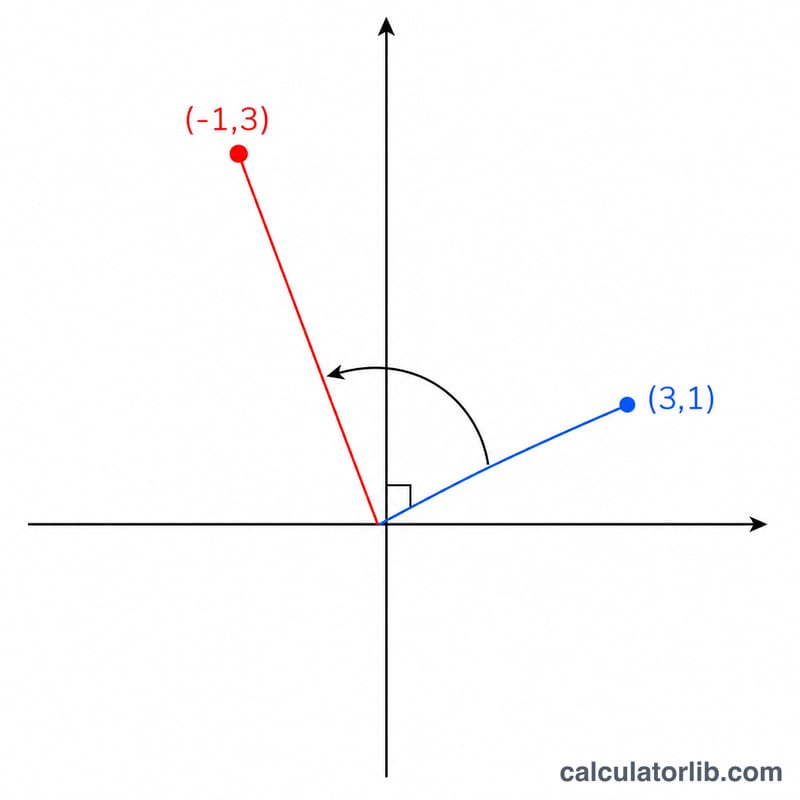
Which way does a positive angle rotate? Counter-clockwise, following the standard mathematical orientation. Use a negative angle for clockwise rotation.
Why is the distance from the origin unchanged? A rotation is an isometry — it preserves lengths and angles, so every point keeps its distance from the center of rotation.
What happens at angle 0 or 360°? The point is returned unchanged, since a full turn (or no turn) maps every point onto itself. The origin (0, 0) also stays fixed for any angle.