
What is Completing the Square?
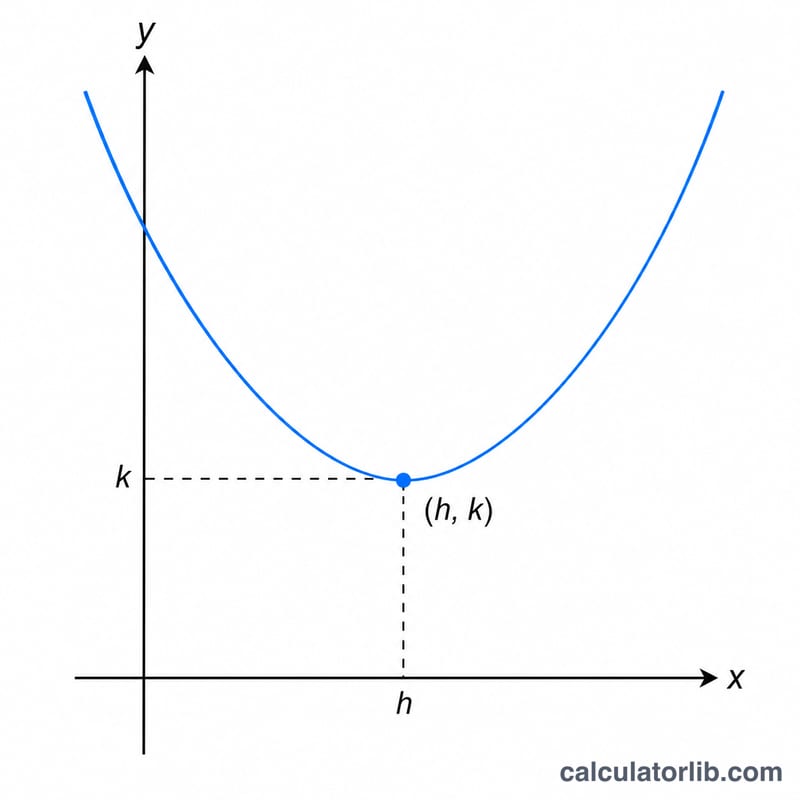
Completing the square rewrites a quadratic expression ax² + bx + c into the equivalent vertex form a(x − h)² + k. This form instantly reveals the vertex of the parabola at the point (h, k), making it easy to graph, find maximum or minimum values, and solve quadratic equations.
How to Use the Calculator
Enter the three coefficients: a (the coefficient of x²), b (the coefficient of x), and c (the constant term). The calculator returns the completed-square form along with h, k, and the vertex coordinates. Note that a cannot be zero, otherwise the expression is not quadratic.
The Formula Explained
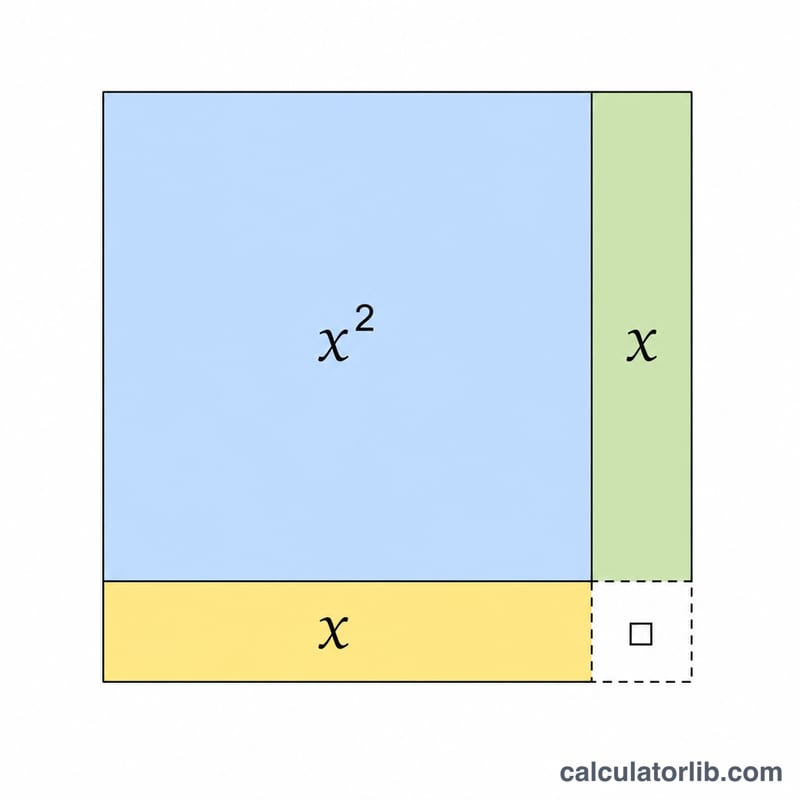
Starting from ax² + bx + c, factor a from the first two terms and add/subtract the square term. The result is $$ax^2 + bx + c = a\left(x - h\right)^2 + k,\quad h = -\frac{b}{2a},\ k = c - \frac{b^2}{4a}$$ where \(h = -\frac{b}{2a}\) and \(k = c - \frac{b^2}{4a}\). The value h shifts the parabola horizontally and k shifts it vertically.
Worked Example
For x² + 6x + 5: a = 1, b = 6, c = 5. Then $$h = -\frac{6}{2\cdot 1} = -3 \quad\text{and}\quad k = 5 - \frac{36}{4\cdot 1} = 5 - 9 = -4$$ So x² + 6x + 5 = (x + 3)² − 4, with vertex at (−3, −4).
FAQ
Why is the vertex (h, k)? Because \(a(x - h)^2\) is always ≥ 0 (or ≤ 0 if a is negative), the expression reaches its extreme value of k exactly when x = h.
Does this solve the equation? Setting \(a(x - h)^2 + k = 0\) and solving for x gives the roots, so completing the square is the basis of the quadratic formula.
What if a is negative? The parabola opens downward and the vertex is a maximum, but the same formulas apply.