
What is the Steel Plate Weight Calculator?
This tool estimates the weight of a rectangular steel (or other metal) plate from its three dimensions and material density. It is widely used by fabricators, engineers, structural designers and metal buyers to plan shipping, costing, lifting and load calculations before cutting a single sheet.
How to use it
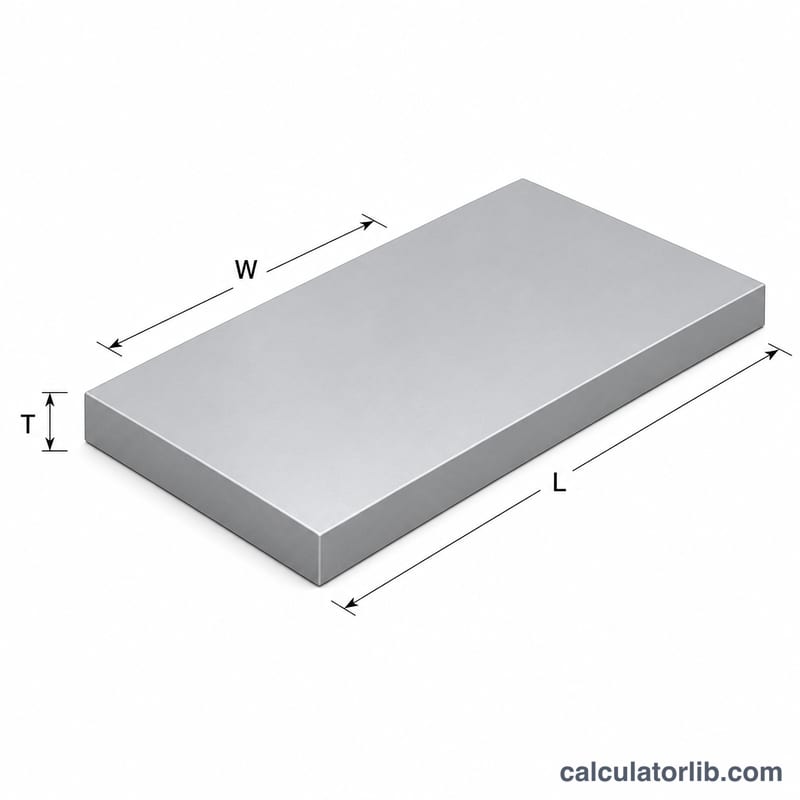
Enter the plate's length, width and thickness in millimetres, then the material density in g/cm³. Mild steel is about 7.85 g/cm³; stainless steel is roughly 7.93 g/cm³ and aluminium about 2.70 g/cm³. The calculator returns the plate volume in cm³ and its weight in kilograms.
The formula explained
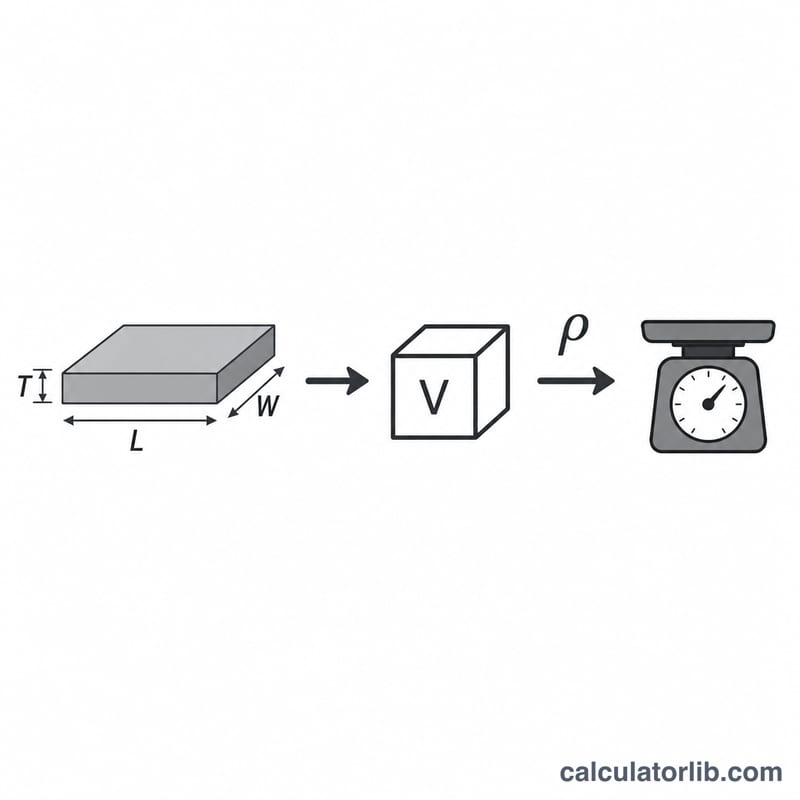
Because the dimensions are entered in millimetres, each side is divided by 10 to convert to centimetres before multiplying. That is the same as dividing the product L \(\times\) W \(\times\) T by 1,000 to get volume in cm³. Multiplying by density (g/cm³) gives the mass in grams, and dividing by 1,000 converts grams to kilograms.
$$\text{Weight (kg)} = \frac{\text{Length (mm)} \times \text{Width (mm)} \times \text{Thickness (mm)} \times \text{Density (g/cm}^3)}{1{,}000{,}000}$$
Worked example
A mild steel plate 1000 mm \(\times\) 500 mm \(\times\) 10 mm: volume $$= \frac{1000 \times 500 \times 10}{1000} = 5{,}000 \text{ cm}^3.$$ Weight $$= \frac{5{,}000 \times 7.85}{1000} = 39.25 \text{ kg}.$$
FAQ
What density should I use? Mild/carbon steel ≈ 7.85, stainless ≈ 7.93, aluminium ≈ 2.70 g/cm³. Adjust for your exact grade if known.
Does it work for non-steel plates? Yes — just change the density to match your material.
Is the result exact? It is a close theoretical estimate; real plates vary slightly due to manufacturing tolerances and surface finish.