
What is the River Rock Calculator?
This calculator estimates how much decorative river rock you need to cover a landscaping area at a chosen depth. It converts your measurements into cubic yards and then into tons, so you can order the right amount and avoid costly second deliveries or leftover piles of stone.
How to use it
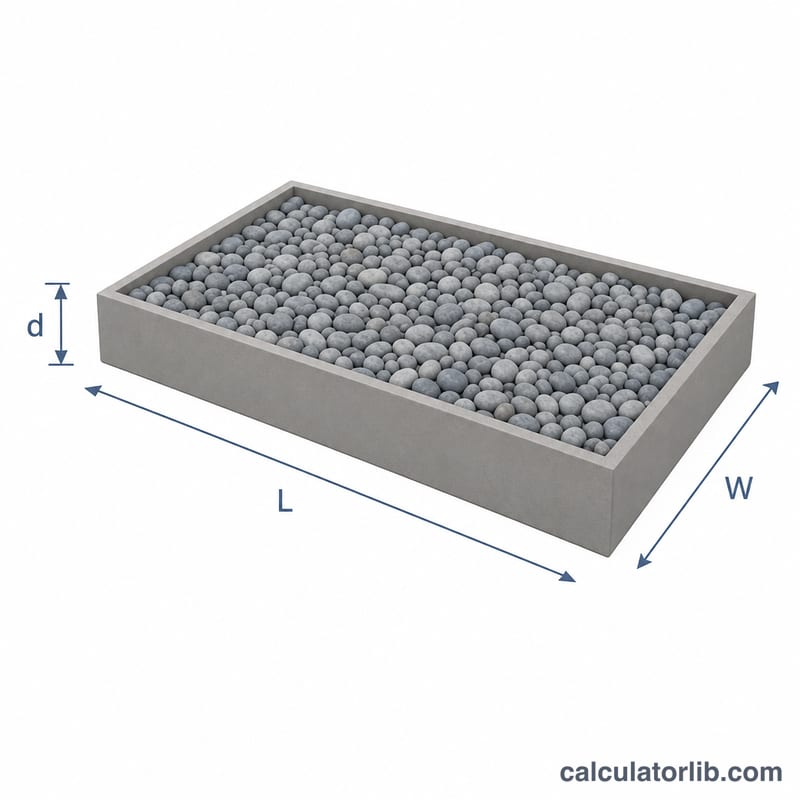
Enter the length and width of your area in feet, then the desired depth in inches (2–3 inches is typical for ground cover). The default density of 1.4 tons per cubic yard suits most river rock, but you can adjust it if your supplier provides an exact figure. The calculator returns tons, cubic yards, total square footage and pounds.
The formula explained
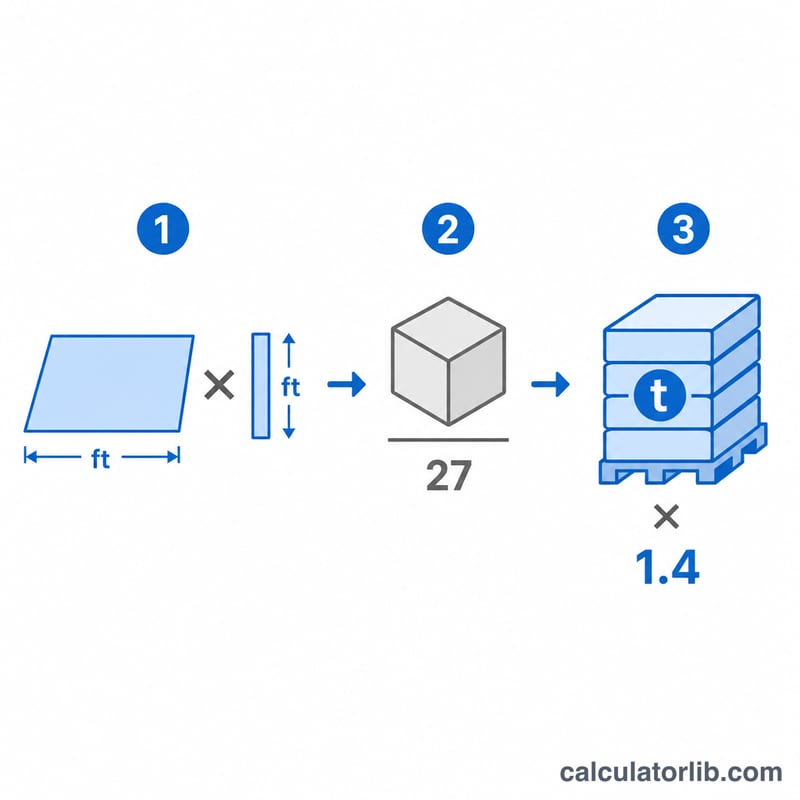
First the area is found (length × width). The depth is converted from inches to feet (÷12), and the volume in cubic feet is divided by 27 to get cubic yards. Multiplying by the density (tons/yd³) gives the weight in tons:
$$\text{Tons} = \frac{\text{Area} \times \text{Depth}_{\text{ft}}}{27} \times \text{density}$$
Worked example
For a 10 ft × 10 ft bed at 3 inches deep: area = 100 ft². Depth = \(3 \div 12 = 0.25\) ft. Volume = \(100 \times 0.25 \div 27 = 0.9259\) yd³. At 1.4 tons/yd³ that is about 1.3 tons (≈2,593 lbs).
FAQ
How deep should river rock be? For pure decoration 2 inches is fine; for weed suppression or pathways aim for 3–4 inches.
Why use 1.4 tons per cubic yard? It is a common average for washed river rock. Crushed or denser stone can run 1.3–1.5 tons/yd³, so confirm with your supplier.
Should I order extra? Adding 5–10% covers settling, uneven ground and compaction.