

What is the Texas Overtime Calculator?
This calculator applies to the United States (Texas). Texas does not have its own state overtime law, so overtime is governed by the federal Fair Labor Standards Act (FLSA). Under the FLSA, non-exempt employees must be paid at least 1.5 times their regular hourly rate for all hours worked beyond 40 in a single workweek. This tool estimates your gross weekly pay before taxes based on your hourly rate and total hours worked.
How to use it
Enter your hourly rate in dollars and the total number of hours you worked in the week. The calculator splits your hours into regular hours (up to 40) and overtime hours (anything over 40), then computes pay for each portion and adds them together. Note: Texas/FLSA overtime is based on a weekly threshold of 40 hours, not on hours over 8 per day.
The formula explained
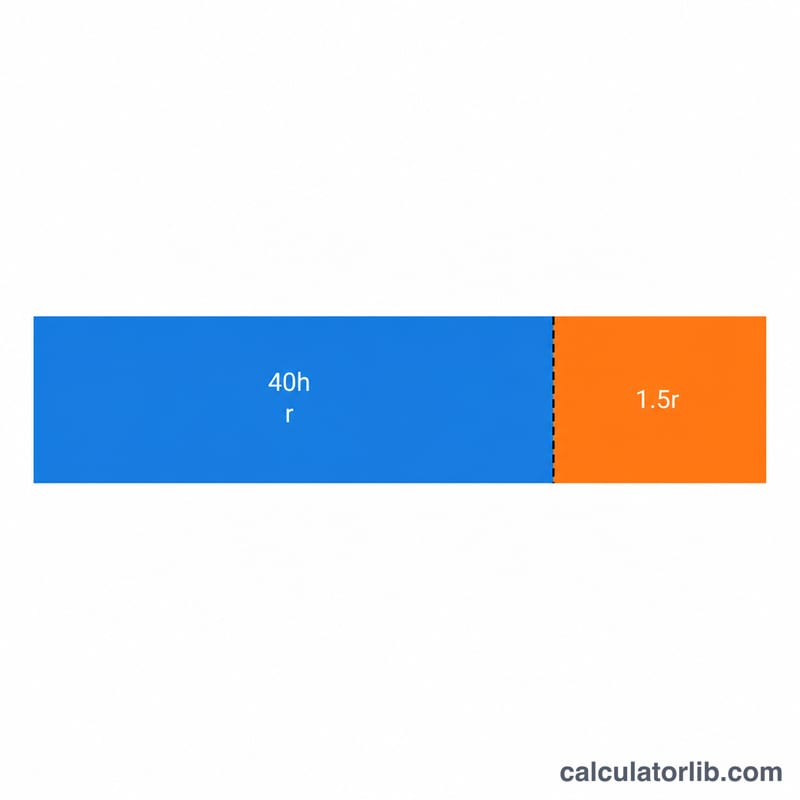
Regular pay equals your rate times the lesser of your hours or 40. Overtime pay equals your rate times 1.5 times any hours above 40. The total is the sum of the two.
$$\text{Total} = r \times \min(h, 40) + r \times 1.5 \times \max(h - 40,\ 0)$$
Worked example
Suppose you earn $20/hour and work 45 hours. Regular pay = \(20 \times 40 = \$800\). Overtime hours = \(45 - 40 = 5\). Overtime pay = \(20 \times 1.5 \times 5 = \$150\). Total weekly pay = \(800 + 150 = \$950\) gross.

FAQ
Does Texas have daily overtime? No. The FLSA, which governs Texas, calculates overtime only on hours over 40 per workweek, not per day.
Are all employees eligible for overtime? No. Exempt salaried employees (such as certain executive, administrative, and professional roles) may not qualify. This tool assumes a non-exempt hourly worker.
Does this include taxes? No. The result is gross pay before federal income tax, Social Security, and Medicare withholding.