
What Is This Calculator?
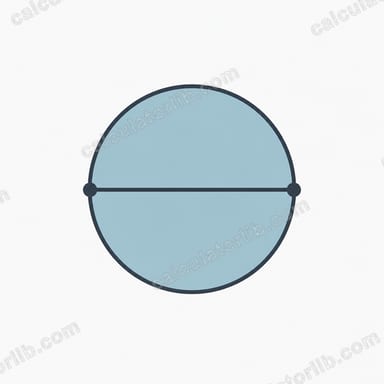
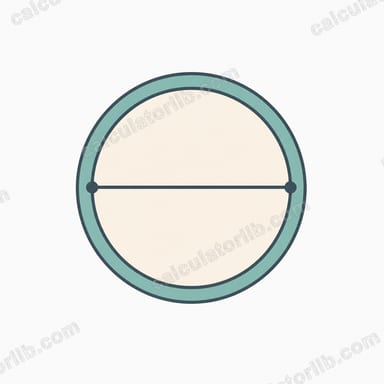
The Circle Perimeter from Diameter Calculator finds the perimeter of a circle — more commonly called its circumference — directly from the diameter. The perimeter is the total distance around the edge of the circle. Because the diameter passes straight through the center, this is the quickest way to measure or estimate the size of a round object such as a pipe, wheel, plate, or table.
How to Use It
Enter the diameter of your circle in any unit you like (cm, inches, meters, feet). The calculator returns the circumference using the formula \(C = \pi d\), and also shows the radius (half the diameter) and the area as bonus results. Whatever unit you put in, the circumference comes out in the same unit and the area in that unit squared.
The Formula Explained
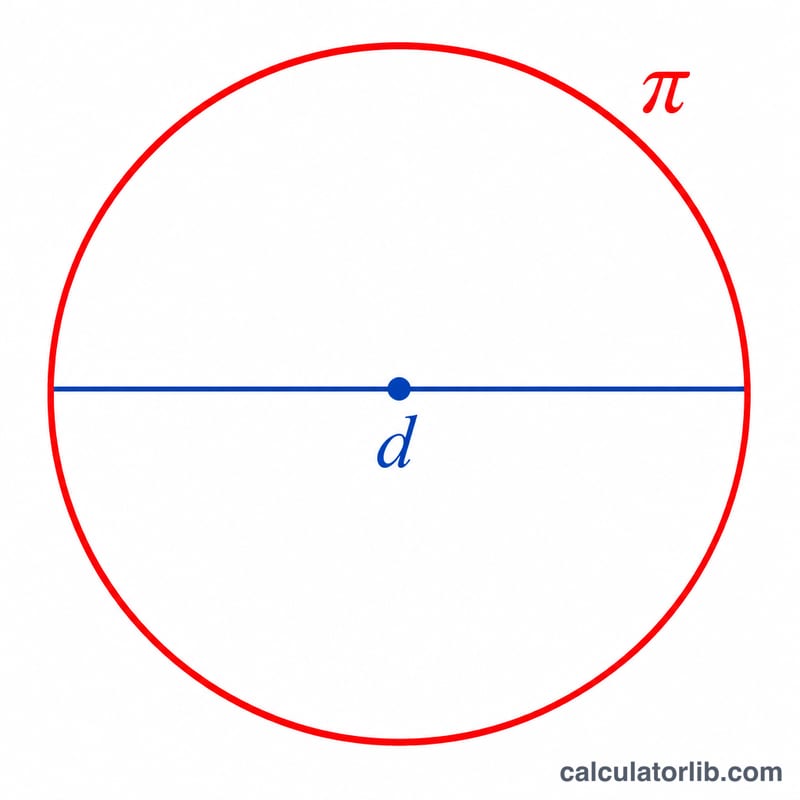
The relationship between a circle's circumference and its diameter is constant for every circle — that constant is \(\pi\) (pi \(\approx 3.14159\)). This gives the famous formula:
$$C = \pi \times d$$
where \(C\) is the circumference (perimeter) and \(d\) is the diameter. If you only know the radius, just double it to get the diameter, since \(d = 2r\).
Worked Example
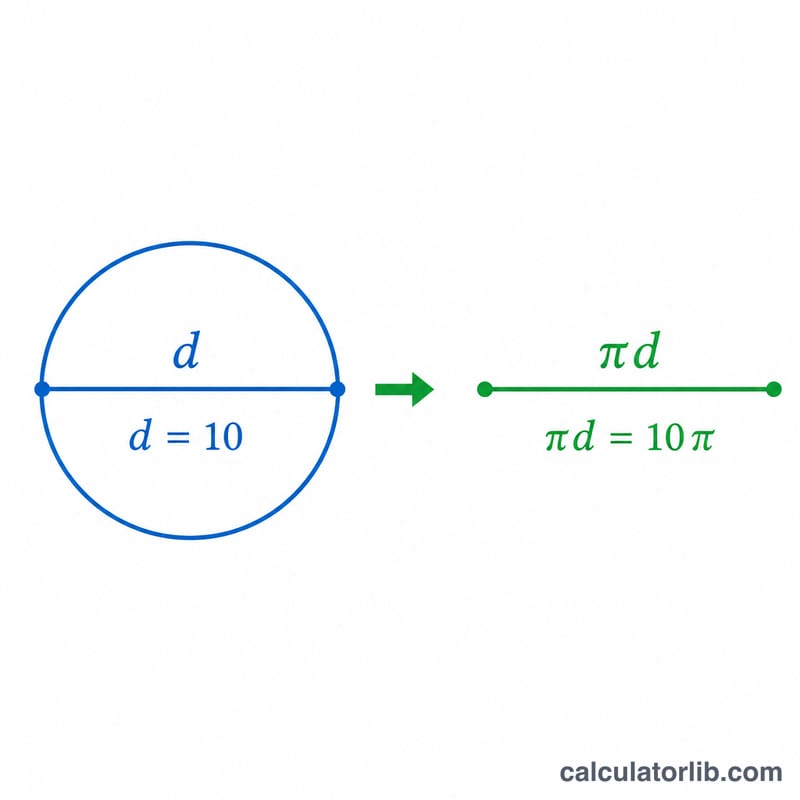
Suppose a circular tabletop has a diameter of 10 units. Then:
$$C = \pi \times 10 = 3.14159 \times 10 \approx \textbf{31.42 units}.$$
The radius is \(10 \div 2 = 5\) units, and the area is \(\pi \times 5^2 \approx 78.54\) square units.
FAQ
Is perimeter the same as circumference? Yes. "Perimeter" is the general term for the distance around any shape; for a circle that distance has the special name circumference.
What if I know the radius instead? Multiply the radius by 2 to get the diameter, then enter it — or use \(C = 2\pi r\), which gives the same answer.
What value of pi is used? The calculator uses the full-precision value of \(\pi\) built into the math library, so results are accurate to many decimal places.