
What Is the Dry Matter Basis Calculator?
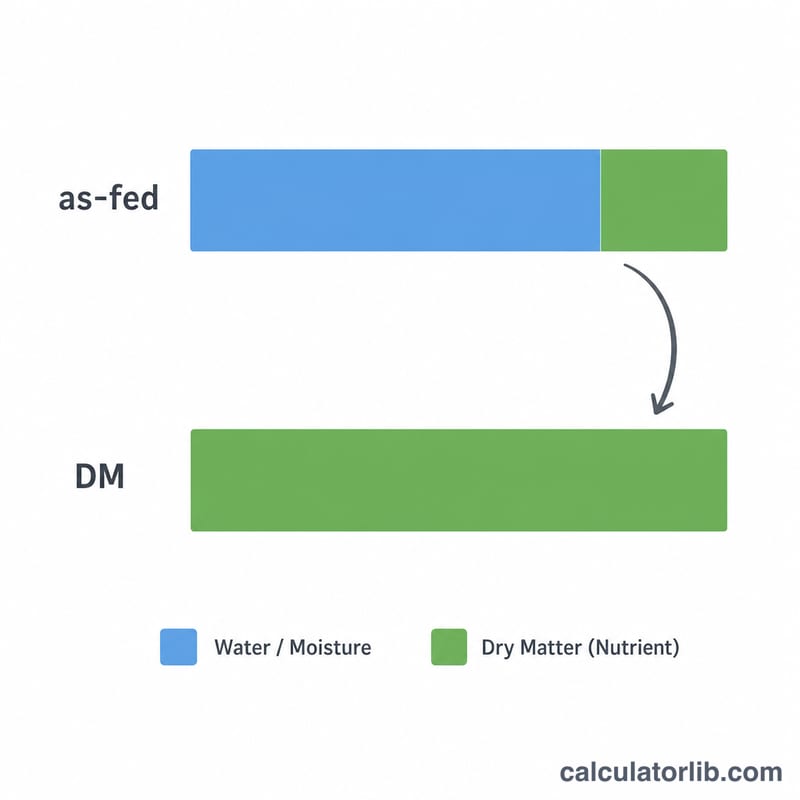
This tool converts a feed nutrient value reported on an as-fed basis (which includes water) into its equivalent on a dry matter (DM) basis (water removed). Because moisture dilutes the apparent concentration of nutrients, comparing two feeds on an as-fed basis can be misleading. Expressing nutrients on a dry matter basis lets you fairly compare feeds with very different moisture contents — for example, fresh pasture, silage, hay, or dry concentrate.
How to Use It
Enter the nutrient percentage as it appears on the as-fed (wet) feed analysis, then enter the feed's moisture percentage. The calculator returns the same nutrient expressed on a 100% dry matter basis, along with the feed's dry matter content.
The Formula Explained
The dry matter content of a feed equals \(100 - \text{moisture\%}\). To rescale a nutrient onto a fully dried basis you divide the as-fed nutrient by the dry matter fraction and multiply by 100:
$$\text{DM\%} = \dfrac{\text{Nutrient}_{\text{as-fed}}}{100 - \text{Moisture\%}} \times 100$$
The lower the moisture, the closer the dry matter value is to the as-fed value; very wet feeds show a large jump.
Worked Example
A silage tests at 9% crude protein as-fed with 65% moisture. Dry matter content = \(100 - 65 = 35\%\). Crude protein on a DM basis:
$$\frac{9}{35} \times 100 = 25.71\%$$
So although the silage looks low in protein when wet, it is actually a respectable 25.7% protein once the water is excluded.
FAQ
Why use a dry matter basis at all? It standardizes nutrient values so feeds with different water contents can be compared and rationed accurately.
What moisture should I enter? Use the moisture from your lab analysis or feed tag (\(\text{dry matter \%} = 100 - \text{moisture \%}\)).
Can moisture be 100%? No — that would mean the feed is entirely water with zero dry matter, making the conversion undefined. Enter a value below 100.