
What this calculator does
If you know just one trigonometric ratio for an angle θ — for example \(\sin\theta = 3/5\) — and you know which quadrant the angle lies in, every other trig function is fully determined. This tool takes that single ratio plus the quadrant and returns all six functions: sine, cosine, tangent, cosecant, secant, and cotangent, along with an approximate angle.
How to use it
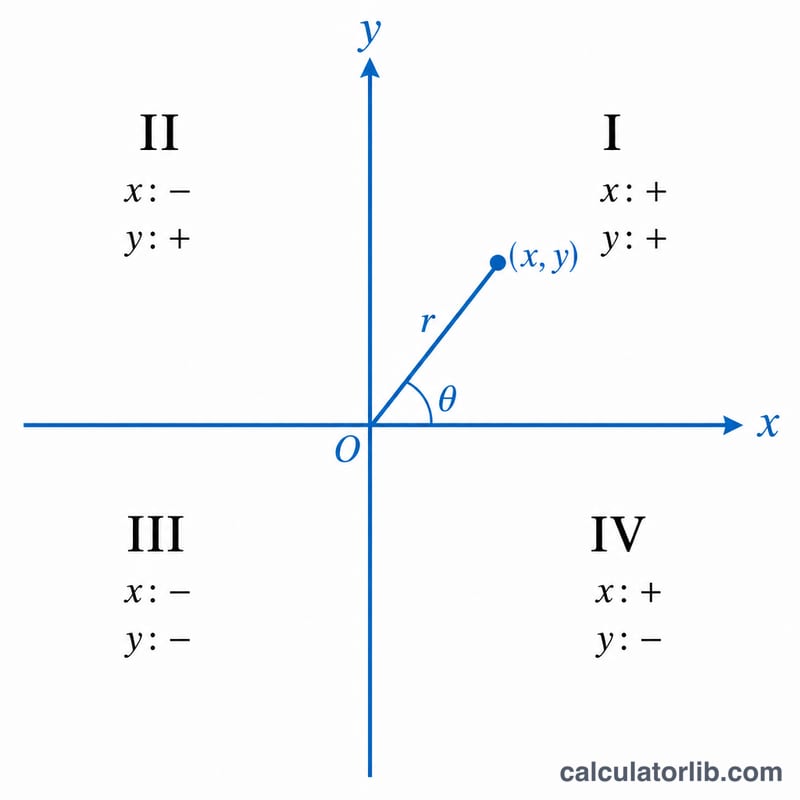
Pick the function you know from the dropdown, type its value, and choose the quadrant of θ (I, II, III or IV). The quadrant is essential because a ratio alone does not reveal sign: \(\sin\theta\) is positive in quadrants I and II, while \(\cos\theta\) is positive in quadrants I and IV. The calculator applies these sign rules automatically.
The formula explained
The engine first converts your input into sine and cosine. Reciprocal functions are inverted (e.g. if \(\csc\theta\) is given, \(\sin\theta = 1/\csc\theta\)). The missing primary ratio is found from the Pythagorean identity \(\sin^2\theta + \cos^2\theta = 1\), so $$\cos\theta = \pm\sqrt{1-\sin^2\theta}$$ the sign is chosen from the quadrant. For tangent and cotangent it uses \(1 + \tan^2\theta = \sec^2\theta\). Finally the other functions follow from the reciprocal and quotient relations.
Worked example
Suppose \(\sin\theta = 0.6\) and θ is in quadrant II. Then $$\cos\theta = -\sqrt{1 - 0.36} = -0.8 \quad (\text{negative in QII}).$$ So \(\tan\theta = 0.6 / {-0.8} = -0.75\), \(\csc\theta = 1/0.6 \approx 1.6667\), \(\sec\theta = 1/{-0.8} = -1.25\), and \(\cot\theta = -0.8/0.6 \approx -1.3333\). The angle is about \(143.13°\).
FAQ
Why do I need the quadrant? Because two different angles can share the same sine (or cosine) value. The quadrant fixes the signs of the remaining functions.
What if a value is undefined? Functions like \(\tan\theta\) at \(90°\) or \(\csc\theta\) at \(0°\) are undefined; those cells may show non-finite results.
Can I enter values greater than 1? Yes for tan, cot, sec, and csc, which are unbounded; but sin and cos must lie between \(-1\) and \(1\).