
What this calculator does
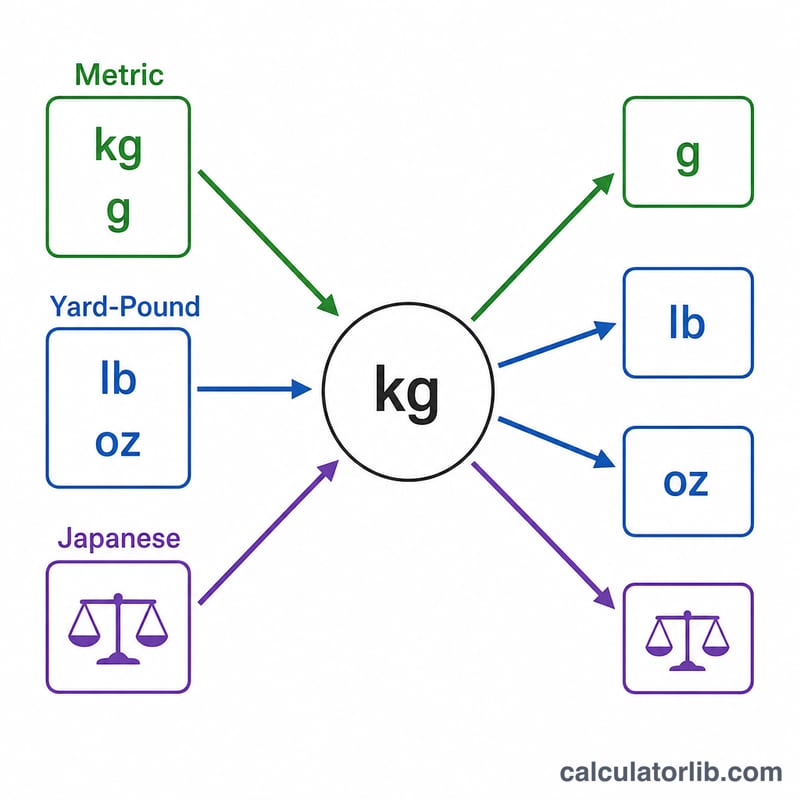
This tool converts any weight or mass value from one unit into 20 different units at once. It covers the metric system (microgram, milligram, carat, gram, kilogram, tonne), the yard-pound or avoirdupois system (grain, dram, ounce, pound, stone, long ton, short ton, long and short hundredweight) and the traditional Japanese (shakkanho) system (fun/bu, monme, hyakume, kin, kan). Mass conversion is physically universal, so the factors apply everywhere; the Japanese rows are simply labeled as traditional units for clarity.
How to use it
Enter a numeric value in the "Weight/Mass" box, pick the unit it is expressed in from the dropdown, and choose how many significant digits you want displayed (default 14). The results table then lists the equivalent value in every supported unit, grouped by system.
The formula explained
Every conversion pivots through the SI base unit, the kilogram. First the input is normalized to kilograms by multiplying by the source unit's exact kilograms-per-unit factor. Then each output is computed by dividing that kilogram value by the target unit's factor.
$$\text{Value}_{\text{unit}} = \frac{\text{Mass} \times f_{\text{From Unit}}}{f_{\text{unit}}}$$Because mass conversion is purely linear with no offset, an input of zero produces zero in every unit, and there is never any divide-by-zero risk since every factor is strictly positive.
Worked example
Take 1 kilogram. The kilograms-per-unit factor for kilogram is exactly 1, so the base mass is 1 kg. Dividing by each factor gives 1,000,000,000 micrograms, 1,000,000 milligrams, 5,000 carats, 1,000 grams, 0.001 tonnes, 15,432.358... grains, 35.273... ounces, 2.2046... pounds, and 0.15747... stones. In Japanese units, 1 kg equals about 266.67 monme and roughly 0.2667 kan.
FAQ
Which pound definition is used? The international avoirdupois pound, exactly \(0.45359237\) kg, so all derived imperial units are consistent.
What is a metric carat? Exactly 200 milligrams (\(0.0002\) kg), the standard used for gemstones.
How are the Japanese units defined? Using the modern legal definitions: 1 monme = 3.75 g, 1 kan = 1000 monme = 3.75 kg, and 1 kin = 160 monme = 600 g.