
What is the Domain and Range Calculator?
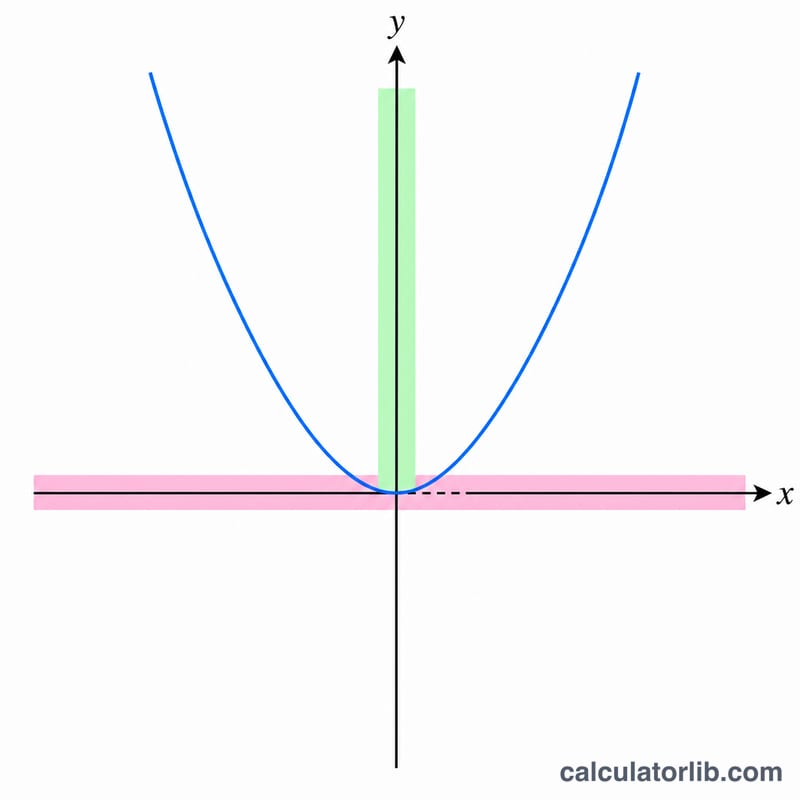
This tool determines the domain (all valid input x-values) and range (all possible output y-values) for four common function families: linear, quadratic, rational, and square root functions. It returns answers in standard interval and set notation.
How to use it
Pick a function type from the dropdown, then enter the relevant coefficients. For a quadratic \(a\cdot x^{2} + b\cdot x + c\) you supply a, b, and c. For a rational \(a/(x - h)\) or square root \(\sqrt{x - h}\) you supply h. Unused boxes can be left at zero.
The formulas explained
Linear functions (a \(\neq\) 0) span all real numbers in both domain and range. A quadratic has domain all reals; its range is bounded by the vertex y-value \(y_{v} = c - b^{2}/(4a)\), giving \([y_{v}, \infty)\) when a > 0 and \((-\infty, y_{v}]\) when a < 0. A rational \(a/(x - h)\) excludes x = h from the domain and y = 0 from the range. A square root \(\sqrt{x - h}\) requires x \(-\) h \(\geq\) 0, so the domain is \([h, \infty)\) and the range is \([0, \infty)\).
$$f(x) = a\,x^{2} + b\,x + c \;\Rightarrow\; \text{Domain} = (-\infty, \infty),\quad \text{Range} = \left[\,c - \frac{b^{2}}{4\,a},\; \infty\right)$$ $$f(x) = a\,x + b \;\Rightarrow\; \text{Domain} = (-\infty, \infty),\quad \text{Range} = (-\infty, \infty)$$ $$f(x) = \frac{a}{x - h} \;\Rightarrow\; \text{Domain} = \{\,x \neq h\,\},\quad \text{Range} = \{\,y \neq 0\,\}$$ $$f(x) = \sqrt{\,x - h\,} \;\Rightarrow\; \text{Domain} = \left[\,h,\; \infty\right),\quad \text{Range} = [\,0,\; \infty)$$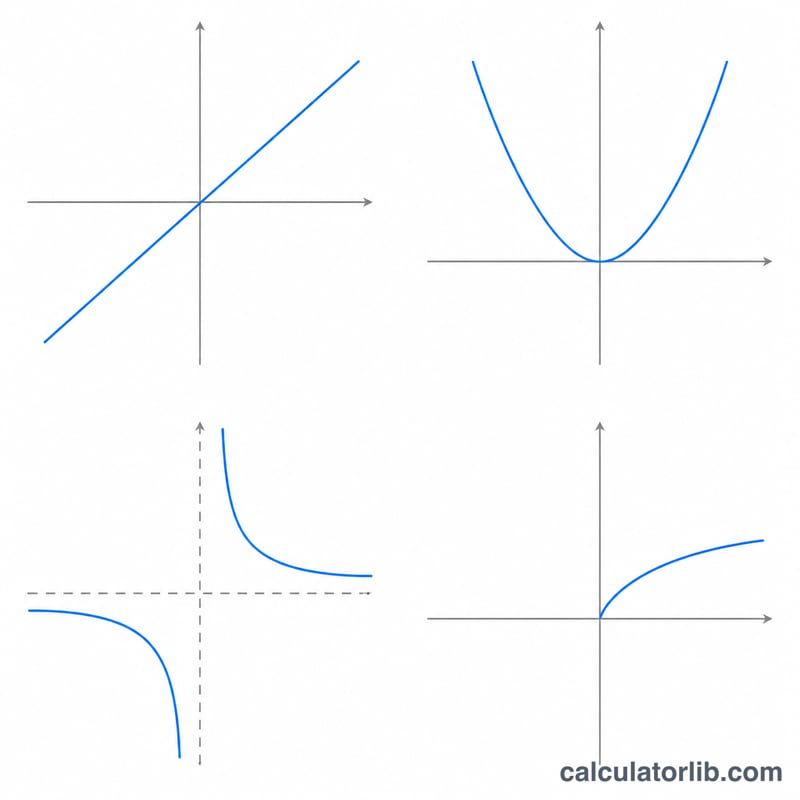
Worked example
For the quadratic \(x^{2} - 4x + 3\) we have a = 1, b = \(-4\), c = 3. The vertex y-value is $$3 - \frac{(-4)^{2}}{4\cdot 1} = 3 - \frac{16}{4} = 3 - 4 = -1.$$ Since a > 0 the range is \([-1, \infty)\) and the domain is all real numbers.
FAQ
Why is the domain of a quadratic always all real numbers? Polynomials are defined for every input, so there are no restrictions.
What restricts a rational function's domain? Any x that makes the denominator zero is excluded because division by zero is undefined.
Can the range of a square root be negative? No — the principal square root is always \(\geq\) 0, so the range starts at 0.