
What Is the Midpoint Calculator?
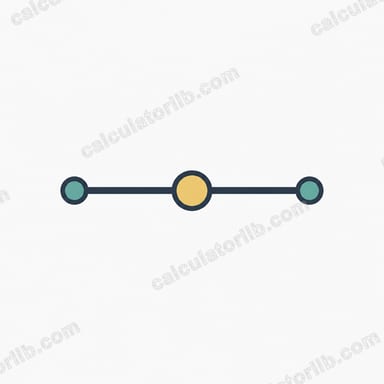
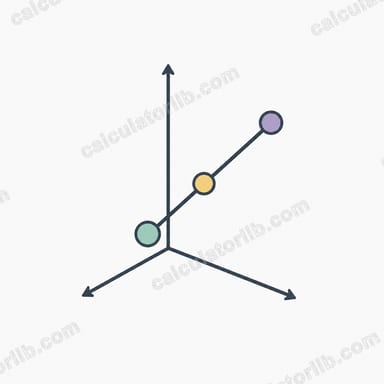
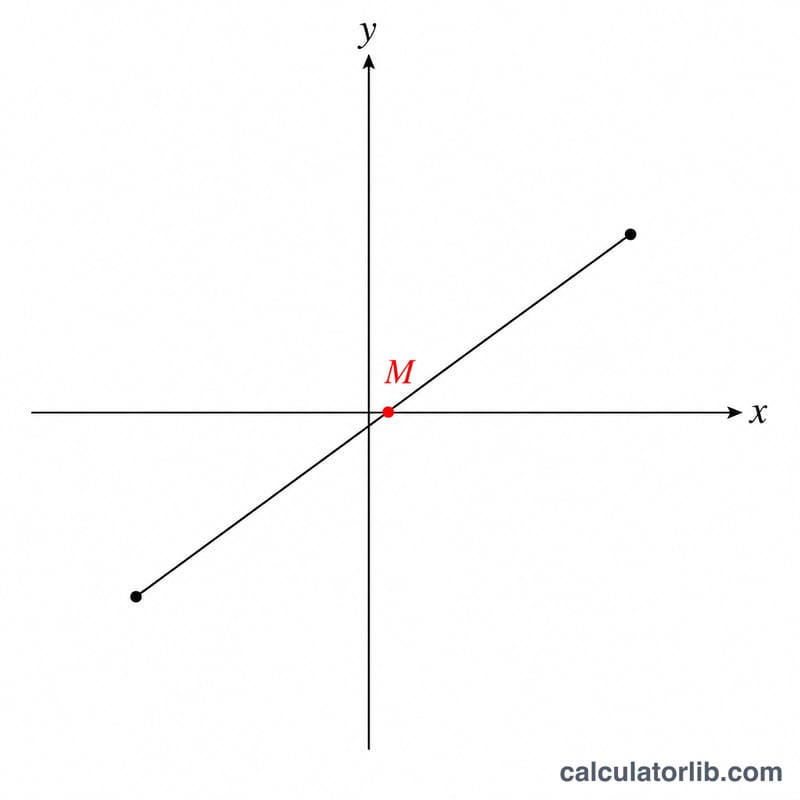
The midpoint of a line segment is the point that divides it into two equal halves — it sits exactly halfway between the two endpoints. This calculator takes the coordinates of two points, \((x_1, y_1)\) and \((x_2, y_2)\), and returns the coordinates of the point \(M\) that lies precisely between them. It works for any points on the Cartesian plane, including negative and decimal values.
How to Use It
Enter the x and y coordinates of your first point in the \(x_1\) and \(y_1\) fields, then enter the coordinates of your second point in \(x_2\) and \(y_2\). Click calculate and the tool returns the midpoint as an ordered pair \((x, y)\). No need to plot anything — the formula handles it instantly.
The Formula Explained
The midpoint formula is $$M = \left( \frac{x_1 + x_2}{2},\ \frac{y_1 + y_2}{2} \right)$$. The logic is simple: the midpoint's x-coordinate is the average of the two x-values, and its y-coordinate is the average of the two y-values. Averaging two numbers gives the value exactly in between them, which is why this produces the geometric center of the segment.
Worked Example
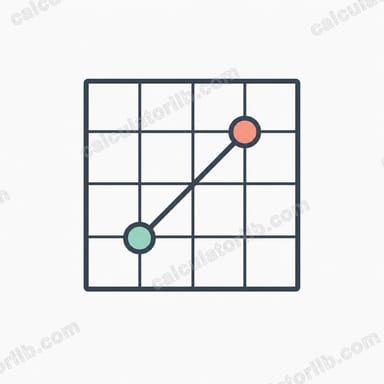
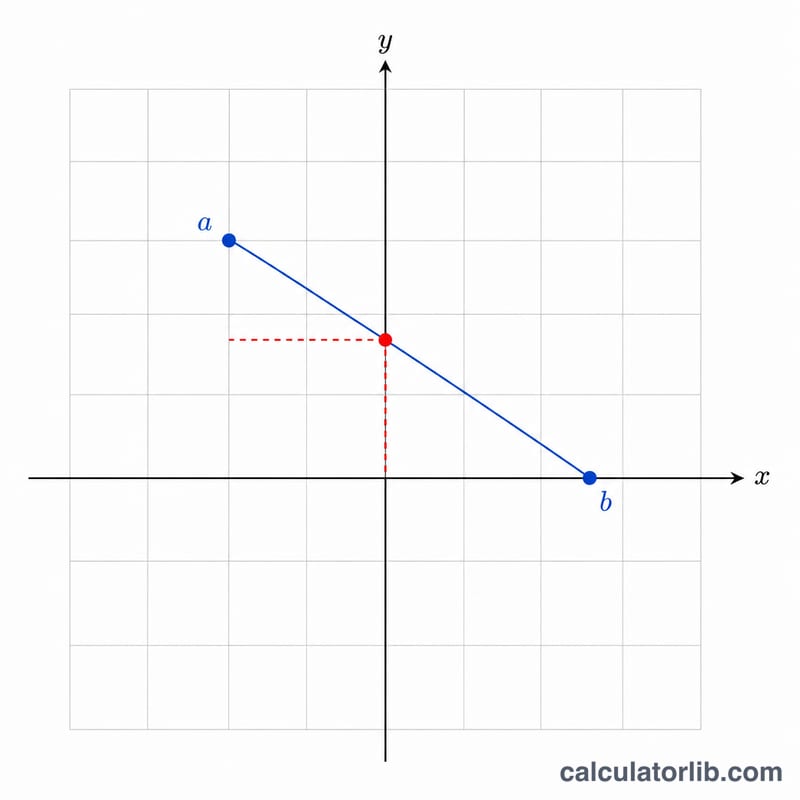
Suppose point \(A = (2, 3)\) and point \(B = (8, 11)\). The midpoint x-coordinate is $$\frac{2 + 8}{2} = \frac{10}{2} = 5.$$ The midpoint y-coordinate is $$\frac{3 + 11}{2} = \frac{14}{2} = 7.$$ So the midpoint \(M = (5, 7)\). You can verify this is halfway: it is 3 units right and 4 units up from \(A\), and the same distance again reaches \(B\).
FAQ
Does it work with negative coordinates? Yes. Averaging handles negatives correctly, so points like \((-4, -2)\) and \((2, 6)\) give a midpoint of \((-1, 2)\).
Can the midpoint formula be reversed? Yes — if you know the midpoint and one endpoint, you can find the other endpoint by solving \(x_2 = 2 \cdot M_x - x_1\) and \(y_2 = 2 \cdot M_y - y_1\).
Is the midpoint the same as the center of a circle? If the two points are endpoints of a diameter, then yes — the midpoint is the circle's center.