What Is the 30 Days From Today Calculator?
This calculator tells you exactly what date falls 30 days from today. Whether you are tracking a payment deadline, a return window, a notice period, or a project milestone, simply counting 30 days forward on a paper calendar is easy to get wrong — especially across month and year boundaries. This tool does the counting for you and even tells you which weekday the result lands on.
How to Use It
By default the calculator adds 30 days to the current date. You can change the "Number of days" field to any value from 1 to 3650 to find a different future date — for example 60, 90, or 180 days from today. Press calculate and the result shows the full date and weekday.
The Formula Explained
The math is simple addition on the calendar: $$\text{Result Date} = \text{Today} + n \text{ days}$$. The calculator starts from today's date, then advances the day count by \(n\), automatically rolling over into the next month or year when needed and accounting for the different lengths of each month.
Worked Example
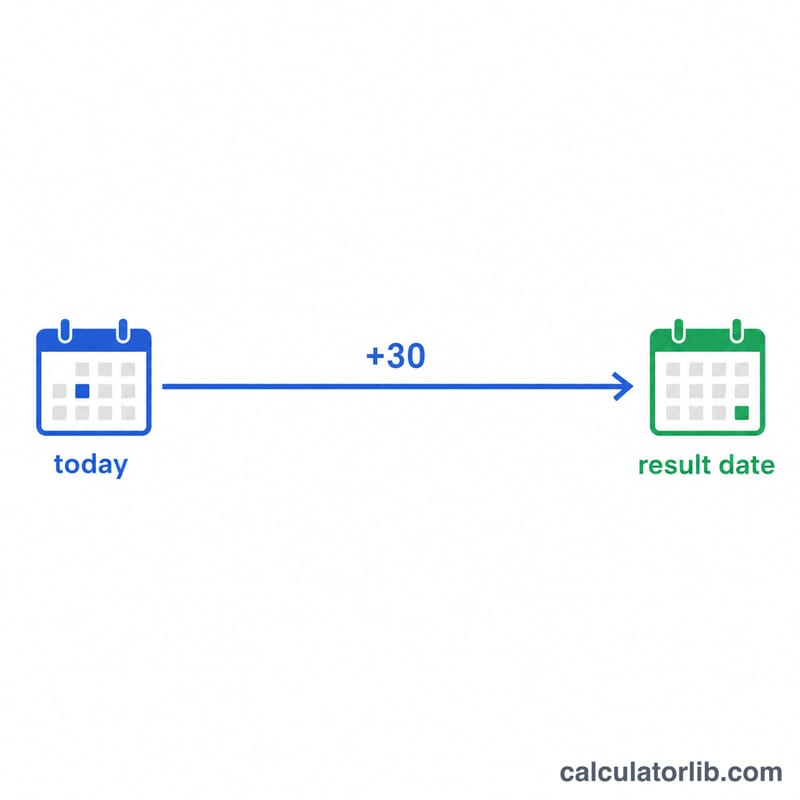
Suppose today is March 1, 2024. Adding 30 days takes us through the remaining 30 days of March (March has 31 days), landing on March 31, 2024. If today were instead June 15, 2024, then 30 days later would be July 15, 2024, because June has 30 days and we cross into July.
$$\text{Result Date} = \text{Today} + 30 \text{ days}$$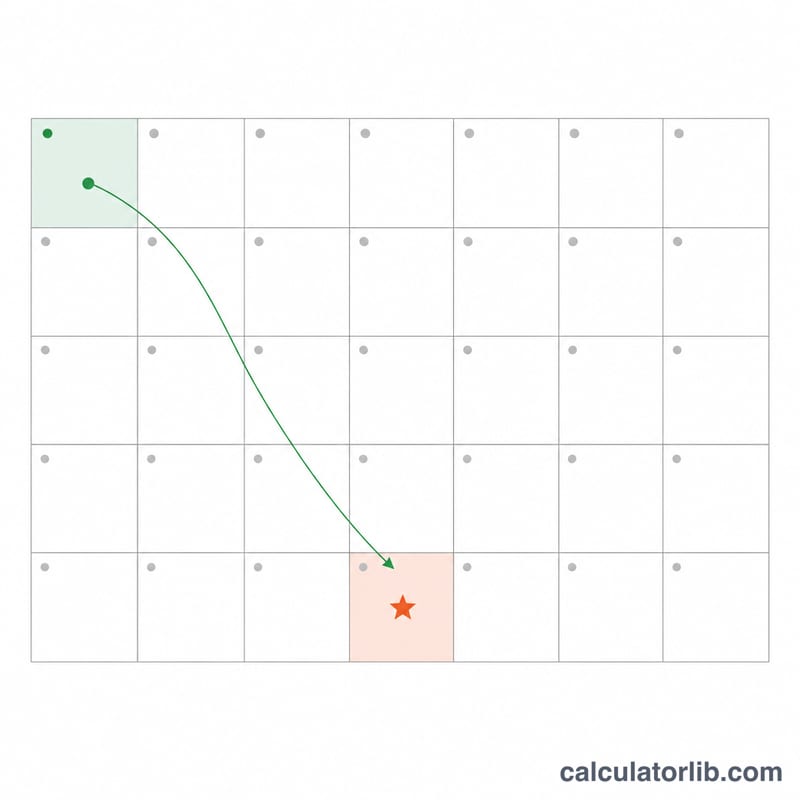
30, 60, 90 and 180 Days From Common Start Dates
The table below uses fixed, verifiable start dates chosen to cross the awkward boundaries: a mid-month date, a month-end, a leap-year February, a year rollover and a 30-day month. Each row assumes that exact start date — not today — and uses exclusive counting: the start day is day 0 and is not counted, so "+30 days" lands on the 30th day after the start date.
| Start Date | +30 Days | +60 Days | +90 Days | +180 Days |
|---|---|---|---|---|
| Wed 15 Jan 2025 | Fri 14 Feb 2025 | Sun 16 Mar 2025 | Tue 15 Apr 2025 | Mon 14 Jul 2025 |
| Fri 31 Jan 2025 (month-end) | Sun 2 Mar 2025 | Tue 1 Apr 2025 | Thu 1 May 2025 | Wed 30 Jul 2025 |
| Wed 28 Feb 2024 (leap year) | Fri 29 Mar 2024 | Sun 28 Apr 2024 | Tue 28 May 2024 | Mon 26 Aug 2024 |
| Sat 20 Dec 2025 (year rollover) | Mon 19 Jan 2026 | Wed 18 Feb 2026 | Fri 20 Mar 2026 | Thu 18 Jun 2026 |
| Sun 15 Jun 2025 | Tue 15 Jul 2025 | Thu 14 Aug 2025 | Sat 13 Sep 2025 | Fri 12 Dec 2025 |
Two patterns are worth noticing. First, "+30 days" is almost never "the same date next month": from 31 January it lands on 2 March 2025, because February has only 28 days that year, while the same jump from 28 February 2024 lands on 29 March 2024 because 2024 includes a 29 February. Second, the weekday shift is completely predictable: \(30 \bmod 7 = 2\), so +30 days is always two weekdays later; \(60 \bmod 7 = 4\), \(90 \bmod 7 = 6\) and \(180 \bmod 7 = 5\). All dates here are Gregorian calendar dates and count every calendar day, including weekends and any public holidays (which differ from country to country).
How to Count 30 Days Forward by Hand
You only need the length of each month and a little subtraction. The method generalises to any number of days \(n\); the example uses \(n = 30\).
- Write down the start date and fix the convention. The start day is day 0 — today is not counted. Tomorrow is day 1, so day \(n\) is \(n\) whole days after the start.
- Count the days left in the current month: \(R = L_{\text{month}} - d\), where \(L_{\text{month}}\) is the month's length and \(d\) is the current day number. Subtract that from \(n\): \(n_1 = n - R\).
- If \(n_1 \le 0\), you never leave the month. The answer is simply day \(d + n\) of the same month.
- Otherwise move to the next month. If \(n_1\) is still larger than that month's length, subtract the full length and move on again, repeating month by month (and rolling the year over after December).
- The leftover count is the day-of-month in the month where the remainder finally fits.
- Use the right February. February has 28 days, or 29 in a leap year: a year divisible by 4 is a leap year, except years divisible by 100, unless they are also divisible by 400. So 2024 and 2000 are leap years; 1900 and 2100 are not. The other months are 31, 30, 31, 30, 31, 31, 30, 31, 30, 31 for January and March through December.
- Get the weekday with remainders. Compute \(n \bmod 7\) and advance that many weekdays from the start weekday. Since \(30 \bmod 7 = 2\), a date 30 days ahead is always two weekdays later — Monday becomes Wednesday, Saturday becomes Monday.
Worked pass: 20 January 2025 + 30 days
January has 31 days and the start day number is 20, so the days remaining in January are
$$R = 31 - 20 = 11$$Subtract that from the 30-day span:
$$n_1 = 30 - 11 = 19$$Since \(n_1 = 19 > 0\), the result falls in the following month. February 2025 has 28 days (2025 is not divisible by 4, so it is not a leap year), and \(19 \le 28\), so no further month is needed. The leftover 19 is the day-of-month:
$$\text{20 Jan 2025} + 30\ \text{days} = \text{19 Feb 2025}$$For the weekday: 20 January 2025 was a Monday, and \(30 \bmod 7 = 2\), so the answer is Monday + 2 = Wednesday, 19 February 2025. A quick sanity check confirms it: 11 days finish January (to the 31st) and 19 more days reach 19 February, and \(11 + 19 = 30\).
Key Date Terms Explained
| Term | Meaning |
|---|---|
| Calendar day | Any day on the calendar, including Saturdays, Sundays and public holidays. This calculator adds calendar days. |
| Business (working) day | A day on which normal business is conducted — in most countries Monday to Friday, excluding public holidays. Which days count varies by country and industry (the working week is not Monday–Friday everywhere), so "30 business days" is always longer than 30 calendar days, typically around six weeks. |
| Exclusive counting (day 0) | The start date is not counted; tomorrow is day 1. "30 days from today" under this rule is the 30th day after today. This is the convention used here. |
| Inclusive counting (day 1) | The start date itself counts as day 1, so the span ends one day earlier than the exclusive result. Some legal, hospital and school rules use it — check which convention a deadline means before relying on it. |
| Month-end rollover | What happens when a day count runs past the last day of a month and continues into the next one. It is why 31 January + 30 days is 2 March in a 28-day February, and why "one month later" and "+30 days" are different operations. |
| Leap year | A 366-day year with a 29 February. In the Gregorian calendar a year is a leap year if it is divisible by 4, except centuries, which must also be divisible by 400: 2024 and 2000 qualify, 1900 and 2100 do not. This keeps the calendar aligned with the solar year. |
| Weekday | The named day of the week. Because a week is 7 days, the weekday of a future date depends only on \(n \bmod 7\): for \(n = 30\) the remainder is 2, so the result is always two weekdays later. |
| ISO 8601 (YYYY-MM-DD) | The international standard date format, e.g. 2025-02-19 for 19 February 2025. It is unambiguous worldwide — unlike 02/19/2025 (US style) versus 19/02/2025 (much of the rest of the world) — and sorts correctly as plain text. |
| "Net 30" and similar terms | A commercial payment term meaning the full invoice amount is due within 30 days, normally counted in calendar days from the invoice date unless the contract says otherwise. Related windows work the same way: a 30-day return policy, a 14-day cooling-off period, or a 90-day warranty. The exact start point (invoice date, delivery date, receipt date) and whether a due date falling on a weekend or holiday shifts to the next working day are set by the contract or by national law — read the terms rather than assuming. |
How this calculator counts: it adds whole calendar days to today's date, exclusive of today (today is day 0), and it does not skip weekends or public holidays — holidays differ by country and region, so none are built in. It applies the Gregorian leap-year rule automatically and ignores time of day and time zones, so if you are near midnight, confirm which date your device considers "today". For deadlines with legal or financial consequences, check the counting convention that actually governs your agreement.
FAQ
Does it include today in the count? No. The result is 30 full days after today, so if today is the 1st, the result is the 31st (or the equivalent date in the following month).
Does it account for leap years? Yes. The calendar logic correctly handles February 29 in leap years and all month-length differences.
Can I count more than 30 days? Yes. Enter any number of days up to 3650 (about 10 years) to find that future date.