
What This Calculator Does
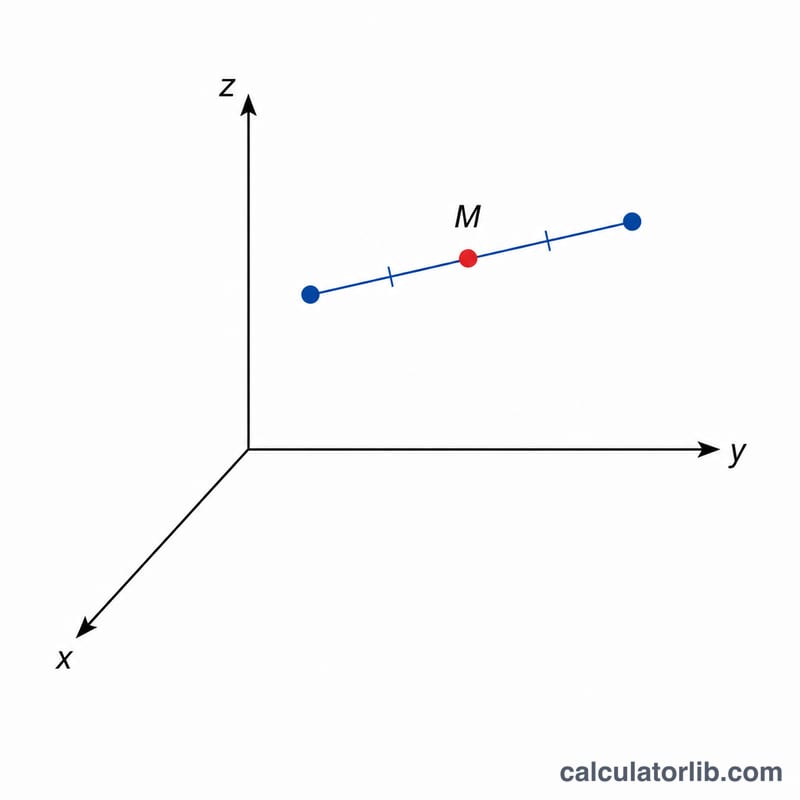
This tool computes two fundamental quantities for any two points in three-dimensional space: the straight-line (Euclidean) distance between them, and the midpoint that lies exactly halfway between them. Simply enter the coordinates of point 1 as (x₁, y₁, z₁) and point 2 as (x₂, y₂, z₂), and the calculator returns the distance and the (x, y, z) coordinates of the midpoint.
How to Use It
Type the three coordinates for each point. Coordinates can be positive, negative, or decimal values. The distance is always non-negative, and the midpoint will fall between the two points regardless of their order — swapping the points does not change either result.
The Formula Explained
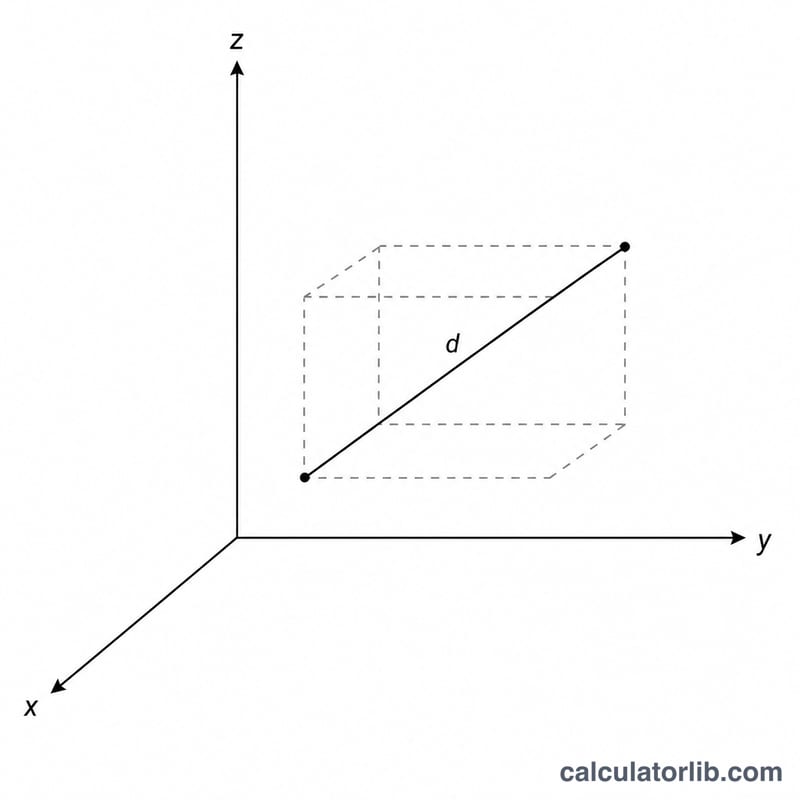
The distance formula is a direct extension of the Pythagorean theorem into three dimensions. You take the difference along each axis (\(\Delta x = x_2 - x_1\), \(\Delta y = y_2 - y_1\), \(\Delta z = z_2 - z_1\)), square each difference, add them, and take the square root: $$d = \sqrt{\Delta x^2 + \Delta y^2 + \Delta z^2}$$ The midpoint is just the average of the corresponding coordinates: $$M = \left( \dfrac{x_1 + x_2}{2},\; \dfrac{y_1 + y_2}{2},\; \dfrac{z_1 + z_2}{2} \right)$$
Worked Example
Take point 1 = (1, 2, 3) and point 2 = (4, 6, 3). The differences are \(\Delta x = 3\), \(\Delta y = 4\), \(\Delta z = 0\). Squaring and summing gives \(9 + 16 + 0 = 25\), so \(d = \sqrt{25} = 5\). The midpoint is $$\left( \dfrac{1+4}{2},\; \dfrac{2+6}{2},\; \dfrac{3+3}{2} \right) = (2.5,\; 4,\; 3)$$
FAQ
Does the order of the points matter? No. Distance uses squared differences, so sign does not matter, and the midpoint uses an average, which is symmetric.
What units are the results in? The same units as your inputs — if coordinates are in meters, the distance is in meters.
Can I use this for 2D problems? Yes — just set \(z_1 = z_2 = 0\) and the formula reduces to the standard 2D distance and midpoint.