
What this calculator does
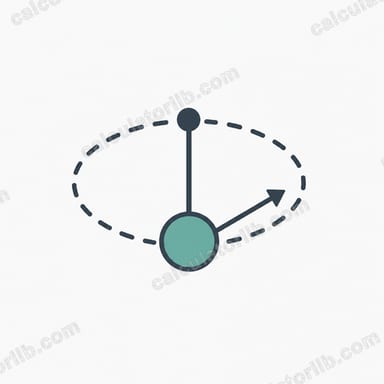
This tool determines how fast an object must rotate to produce a given centrifugal (centripetal) force. Provide the object's mass, its radius of rotation, and the centrifugal force, and it returns the rotational speed as both revolutions per second (rps) and angular velocity (rad/s), plus the tangential (linear) velocity in m/s and km/h. It is a universal physics tool valid in any location.
The physics and formula
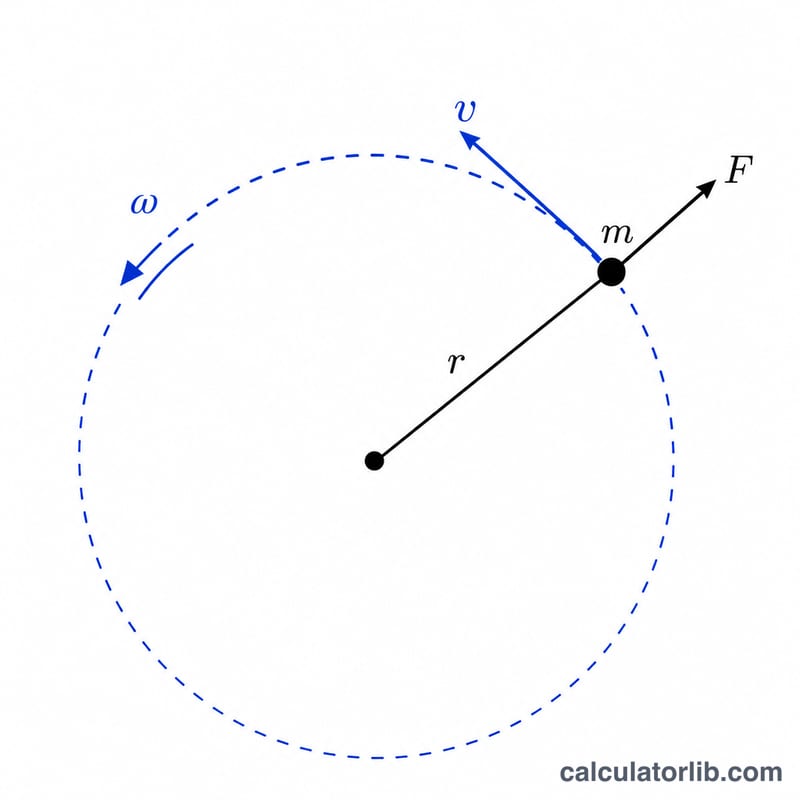
For an object of mass m moving in a circle of radius r, the centripetal force equals the centrifugal force in magnitude: $$F = m\cdot\omega^2\cdot r = \frac{m\cdot v^2}{r}$$, where \(\omega\) is angular velocity in rad/s and \(v = \omega\cdot r\) is the tangential velocity. Solving for \(\omega\) gives $$\omega = \sqrt{\frac{F}{m\cdot r}}.$$ The tangential speed is $$v = \omega\cdot r = \sqrt{\frac{F\cdot r}{m}}.$$ Convert \(\omega\) to revolutions per second by dividing by \(2\pi\), and convert m/s to km/h by multiplying by 3.6.
How to use it
Enter the mass and pick its unit (kg or g), enter the radius and its unit (m, cm, or mm), and enter the centrifugal force in newtons (N) or kilogram-force (kgf, where 1 kgf = 9.80665 N). All values are converted to SI before computing, so you can mix units freely. Mass and radius must be positive; force must be non-negative.
Worked example
With \(m = 1\) kg, \(r = 2\) m, and \(F = 8\) N: $$\omega = \sqrt{\frac{8}{1\cdot 2}} = \sqrt{4} = 2\ \text{rad/s}.$$ As revolutions, that is \(2 / (2\pi) \approx 0.31831\) rps. The tangential velocity is \(v = 2\cdot 2 = 4\) m/s, which equals \(4 \times 3.6 = 14.4\) km/h.
FAQ
What is the difference between rps and rad/s? One full revolution equals \(2\pi\) radians, so \(\text{rps} = (\text{rad/s}) / 2\pi\). They describe the same rotation in different units.
Why does mass appear in the denominator? A heavier object needs less speed to generate the same force, so for fixed \(F\) and \(r\), larger mass means smaller \(\omega\).
What is kgf? Kilogram-force is the force exerted by one kilogram under standard gravity, exactly 9.80665 N.