
What Is the Lowest Terms Calculator?
This tool reduces (simplifies) a fraction to its lowest terms — the form where the numerator and denominator share no common factor other than 1. For example, 18/24 simplifies to 3/4. The calculator works for any whole-number numerator and denominator, including negative values.
How to Use It
Enter the numerator (top number) and denominator (bottom number) of your fraction, then read the simplified result. The calculator also shows the greatest common divisor (GCD) it used, so you can see exactly how the fraction was reduced.
The Formula Explained
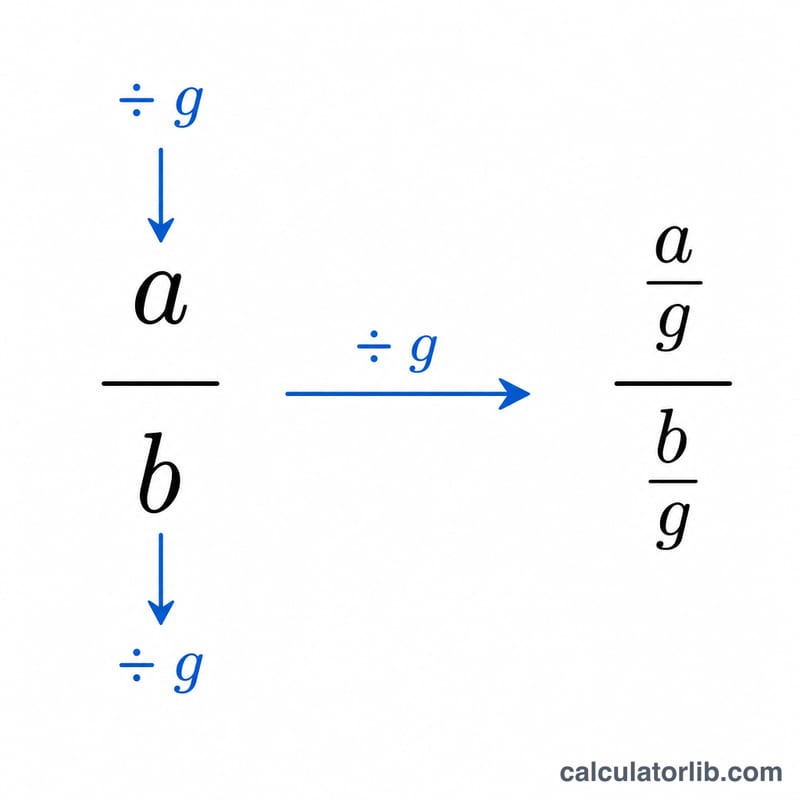
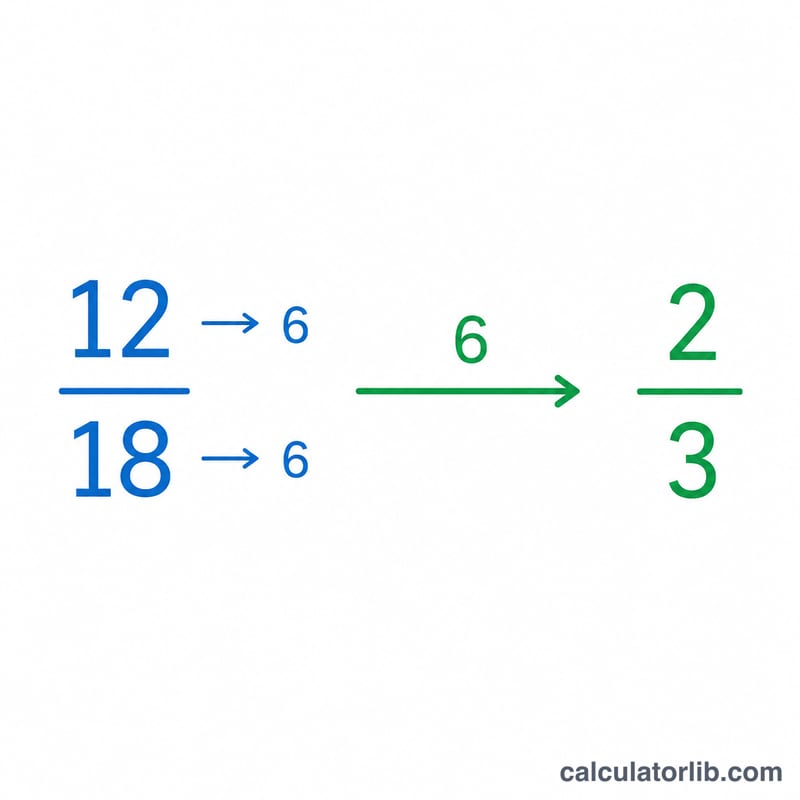
A fraction \(a/b\) is reduced by dividing both parts by their greatest common divisor \(g = \gcd(a, b)\):
$$\frac{a}{b} = \frac{a \div g}{b \div g}$$
The GCD is the largest integer that divides both numbers evenly. It is found quickly using the Euclidean algorithm, which repeatedly replaces the larger number with the remainder of dividing the two numbers until one becomes zero. The remaining nonzero value is the GCD.
Worked Example
Reduce 18/24. The divisors of 18 are 1, 2, 3, 6, 9, 18 and of 24 are 1, 2, 3, 4, 6, 8, 12, 24. The greatest shared divisor is 6, so \(g = 6\). Dividing gives \(18 \div 6 = 3\) and \(24 \div 6 = 4\). The fraction in lowest terms is 3/4.
FAQ
What if the numerator and denominator are already coprime? Then their GCD is 1 and the fraction is already in lowest terms — the result equals your input.
How are negative fractions handled? The sign is carried to the numerator, so -6/8 becomes -3/4.
Can the denominator be zero? A zero denominator makes the fraction undefined in mathematics; this calculator expects a nonzero denominator for a meaningful result.