What Is the Prescription Refill Date Calculator?
This tool estimates how long a medication supply will last and the date you will need a refill. Enter the total quantity dispensed (number of pills, tablets, or units), how many doses you take per day, and the date you started the prescription. The calculator works out your days supply and projects the date your supply runs out.
How to Use It
Provide three things: the total quantity you received, the doses per day you take, and the start date. Optionally set a reminder lead time so you know how many days ahead to request a refill. The result shows the run-out date plus a suggested reminder date.
The Formula Explained
Days supply is simply quantity divided by daily doses: \( \text{Days Supply} = \text{Quantity} \div \text{Doses per day} \). The refill (run-out) date adds the whole number of supply days to your start date. We use whole days because a partial day still leaves you needing the next dose. The reminder date subtracts your chosen lead time from the run-out date.
$$\begin{gathered} \text{Refill Date} = \text{Start Date} + \left\lfloor \text{Days Supply} \right\rfloor \\[1.5em] \text{where}\quad \left\{ \begin{aligned} \text{Days Supply} &= \dfrac{\text{Quantity}}{\text{Doses/Day}} \\ \text{Start Date} &= \text{Start Date} \\ \text{Reminder Date} &= \text{Refill Date} - \text{Lead Days} \end{aligned} \right. \end{gathered}$$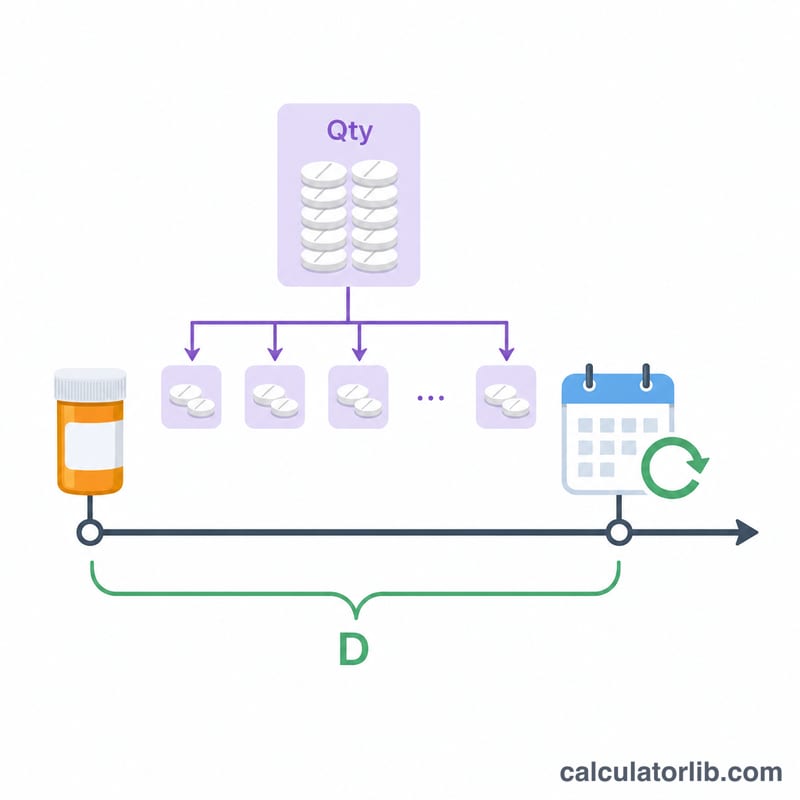
Worked Example
You receive 90 tablets and take 3 per day, starting on 2024-01-01. Days supply = \( 90 \div 3 = 30 \) days. Adding 30 days to January 1 gives a refill date of 2024-01-31. With a 5-day reminder lead, you would aim to refill by 2024-01-26.
Interpreting Your Refill Date
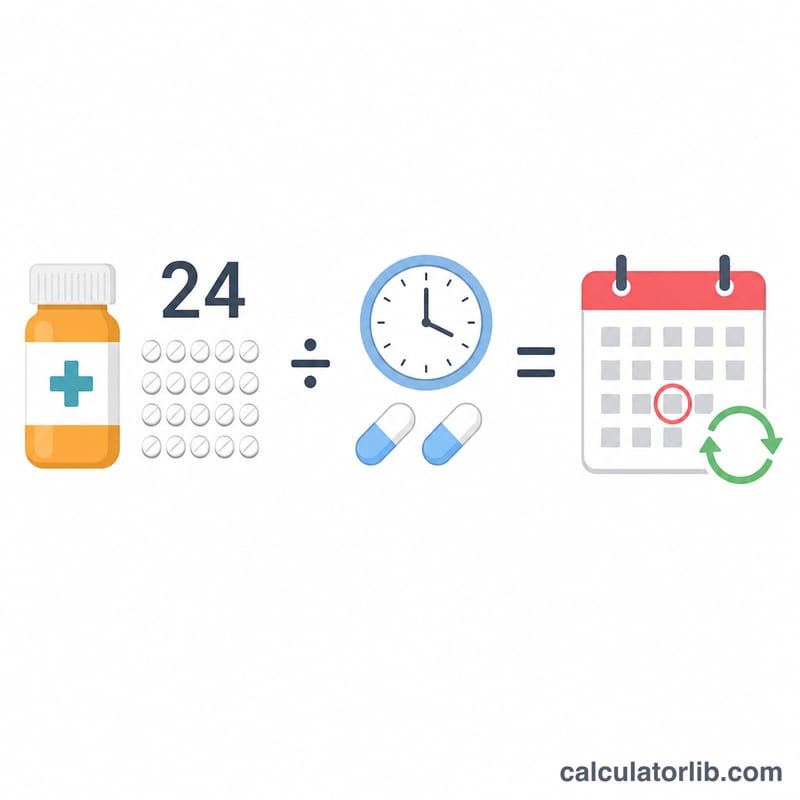
The date this tool returns is a supply-exhaustion date, not a pharmacy appointment. It answers one question: on the current dosing schedule, when does the quantity you were dispensed run out? The calculation is simply
$$\text{Days Supply} = \frac{\text{Quantity}}{\text{Doses per Day}}, \qquad \text{Run-Out Date} = \text{Start Date} + \left\lfloor \text{Days Supply} \right\rfloor$$Because whole days are added to the start date, a 30 day supply started on 2024-01-01 returns 2024-01-31. If you count the start date as day 1, your final dose falls on 2024-01-30 and 2024-01-31 is the first day you have nothing left — the boundary is the same, only the labelling differs. Check which convention you prefer and shift by one day if needed.
Days supply is the number the pharmacy and insurer use
Days supply is not just a convenience figure: it is the field on the dispensing record that determines when a refill is considered "on time." In the United States, most pharmacy benefit plans (commercial, Medicare Part D and Medicaid programs, each with its own rules) apply a refill-too-soon edit that releases a refill only after roughly 75–90% of the days supply has elapsed. In practice that means a 30-day supply can usually be filled about 2–7 days early, and a 90-day supply proportionally earlier (often around 10–22 days). Rules differ by plan, by drug class, and by country — controlled substances are typically much stricter, and some jurisdictions bar early fills of them entirely. Your run-out date is therefore the latest useful date, while the earliest fillable date is set by your plan and local law, not by this calculator.
Why the result is floored
A partial day still requires a full dose, so fractional days are discarded rather than rounded up. Twenty tablets at three per day gives \(20 \div 3 = 6.67\) days, but on day 7 you have only two tablets — not a complete day of therapy. Flooring to 6 days keeps the answer conservative: you will never be told you have a full day of medication that you cannot actually take.
When the date is only an upper bound
- PRN (as-needed) medication — inhalers, analgesics, anti-nausea and rescue medicines. If you enter the maximum permitted daily doses, the result is the soonest the supply could run out; actual use is usually slower.
- Tapers and titrations — the daily amount changes over time, so no single doses-per-day value describes the whole course. Calculate each phase separately and chain the dates.
- Split or partial units — half-tablet regimens work correctly as a fractional doses-per-day value (0.5), but only if the tablet is genuinely scored and safe to split.
- Missed, doubled or delayed doses, and liquids or inhalers with priming loss and measurement waste, all move the real date.
Use it for planning only
Treat the output as a reminder-setting tool: work backwards by a lead time that covers prescriber authorisation, pharmacy stock, shipping for mail-order, and holidays or travel. Five to seven days is a common lead for a local pharmacy and 10–14 days for mail-order or a medication that needs a new prescription. Nothing here overrides the directions on your label or the instructions of your pharmacist and prescriber — they govern actual use, and they are also the people who can tell you how many refills remain. This is general information, not medical advice; do not change a dose, split tablets, or stretch a supply to make it last without speaking to a healthcare professional.
Days Supply and Refill Date by Common Prescription Scenarios
All rows use a fixed start date of 2024-01-01 and a 5-day reminder lead, with \(\text{Days Supply} = \text{Quantity} \div \text{Doses per Day}\) and the run-out date obtained by adding the floored days supply to the start date.
| Quantity | Doses/Day | Days Supply | Start Date | Run-Out Date | Reminder Date (5-day lead) |
|---|---|---|---|---|---|
| 30 | 1 | 30 | 2024-01-01 | 2024-01-31 | 2024-01-26 |
| 60 | 2 | 30 | 2024-01-01 | 2024-01-31 | 2024-01-26 |
| 90 | 3 | 30 | 2024-01-01 | 2024-01-31 | 2024-01-26 |
| 90 | 1 | 90 | 2024-01-01 | 2024-03-31 | 2024-03-26 |
| 30 | 0.5 | 60 | 2024-01-01 | 2024-03-01 | 2024-02-25 |
| 20 | 3 | 6.67 → 6 | 2024-01-01 | 2024-01-07 | 2024-01-02 |
Notes on the rows:
- The first three rows show why quantity alone tells you nothing. 30, 60 and 90 tablets all represent the same 30-day supply once the daily dose is taken into account — which is exactly why pharmacies and insurers record days supply rather than tablet count.
- The 90-tablet, once-daily row is a standard 90-day maintenance fill; note that 2024 is a leap year, so February contributes 29 days to the span.
- The half-tablet row uses a fractional dose (0.5/day), stretching 30 tablets to 60 days.
- The last row demonstrates flooring: \(\left\lfloor 20 \div 3 \right\rfloor = \left\lfloor 6.67 \right\rfloor = 6\) days, because the two tablets left on day 7 are not a full day of therapy. Its reminder date falls only one day after the start — a signal that a short course leaves no meaningful lead time, so arrange any continuation at the same visit.
Key Terms and Definitions
- Quantity Dispensed
- The total number of units you actually received — tablets, capsules, millilitres of liquid, grams of cream, or actuations in an inhaler. It appears on the label and on the pharmacy receipt, and it is the numerator of the days-supply calculation. Enter the amount you hold now, not the amount originally prescribed, if a partial fill was given.
- Dose vs. Unit
- A unit is one physical item (one tablet, one millilitre). A dose is what you take at one time, which may be more than one unit — "take two tablets twice daily" is two doses of two units, or four units per day. Where the two differ, express your input in the units you counted.
- Doses per Day (daily units consumed)
- How much of the supply is used in 24 hours, measured in the same units as the quantity. Fractions are valid and common: 0.5 for half a tablet daily, 1.5 for one-and-a-half. For every-other-day dosing use 0.5; for weekly dosing use \(1 \div 7 \approx 0.143\).
- Days Supply
- Quantity divided by daily units consumed — how many complete days the dispensed amount covers. This is the standard measure used by pharmacies and insurers for refill timing, benefit limits and claims processing, and it is the figure fractional-day flooring is applied to.
- Run-Out Date
- The date on which the supply is exhausted, obtained by adding the whole days of supply to the start date. It marks the end of coverage, not the earliest date a refill can be dispensed.
- Reminder / Lead Time
- The number of days before the run-out date at which you want to be prompted to request the refill. It should cover prescriber authorisation, pharmacy stock, and delivery — short for a local pharmacy, longer for mail-order, and longer again before travel or a public holiday.
- Refill Authorization (refills remaining)
- The number of additional fills the prescriber authorised on the prescription, printed on the label (e.g. "Refills: 2"). Having days supply left is irrelevant if no refills remain or the prescription has expired — in that case you need a new prescription, which takes extra lead time. Expiry limits and rules for controlled substances vary by country and by state or region.
- PRN (pro re nata, "as needed")
- Medication taken only when symptoms occur rather than on a fixed schedule. Days supply for a PRN item is calculated from the maximum permitted daily amount, so the resulting date is the earliest the supply could run out, not a prediction.
- Taper
- A planned increase or decrease in the daily dose over time (for example reducing a steroid or an antidepressant week by week). A taper breaks this calculator's assumption of a constant daily amount — compute each dose level as its own segment and add the segments together.
General information only, not medical advice. Your label, pharmacist and prescriber determine how a medication should actually be taken.
FAQ
Does it account for missed doses? No — it assumes you take every scheduled dose exactly as entered. Skipped doses extend your supply.
What if I take half doses? Enter the actual number of units consumed per day, including fractions like 0.5.
Is this medical advice? No. This is an estimate for planning refills. Always follow your pharmacist's and doctor's instructions and the label.