
What Is the Flight Radiation Dose Calculator?
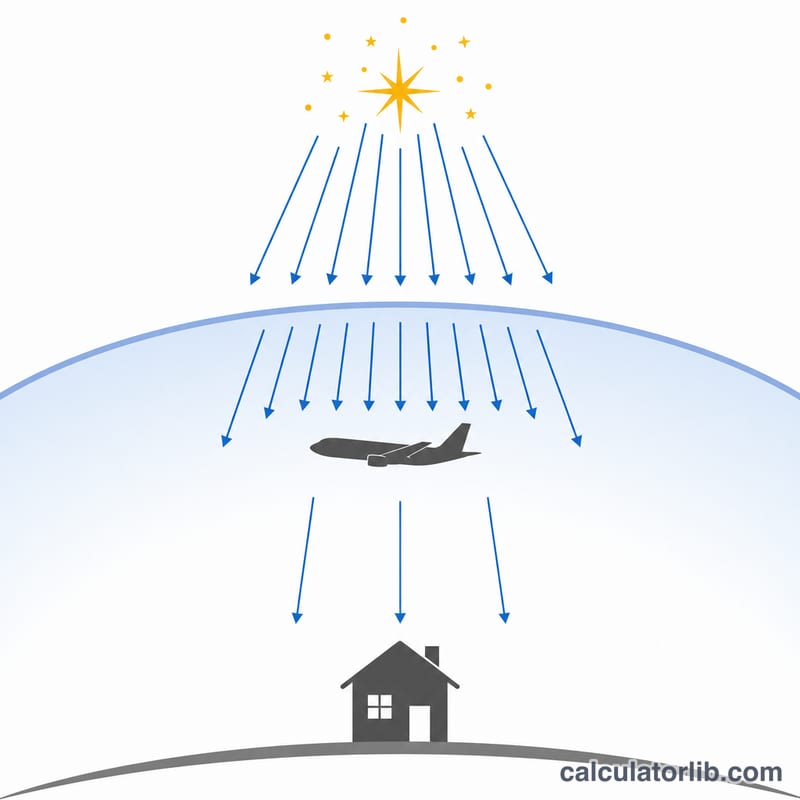
At cruising altitude the atmosphere is much thinner, so aircraft and passengers are exposed to more cosmic radiation than at sea level. This calculator gives a quick estimate of the effective dose you absorb on a flight, expressed in microsieverts (µSv) and millisieverts (mSv), based on how long you fly and the dose rate at cruise. It is a universal physics estimator and is not specific to any country.
How to Use It
Enter the flight duration in hours and the cruise dose rate in µSv per hour. If you do not know the exact rate, the default of 3 µSv/hr is a reasonable average for a typical jet flying near 35,000 ft on a mid-latitude route. Polar and very high-altitude routes can reach 5–8 µSv/hr, while short low-altitude hops are lower.
The Formula Explained
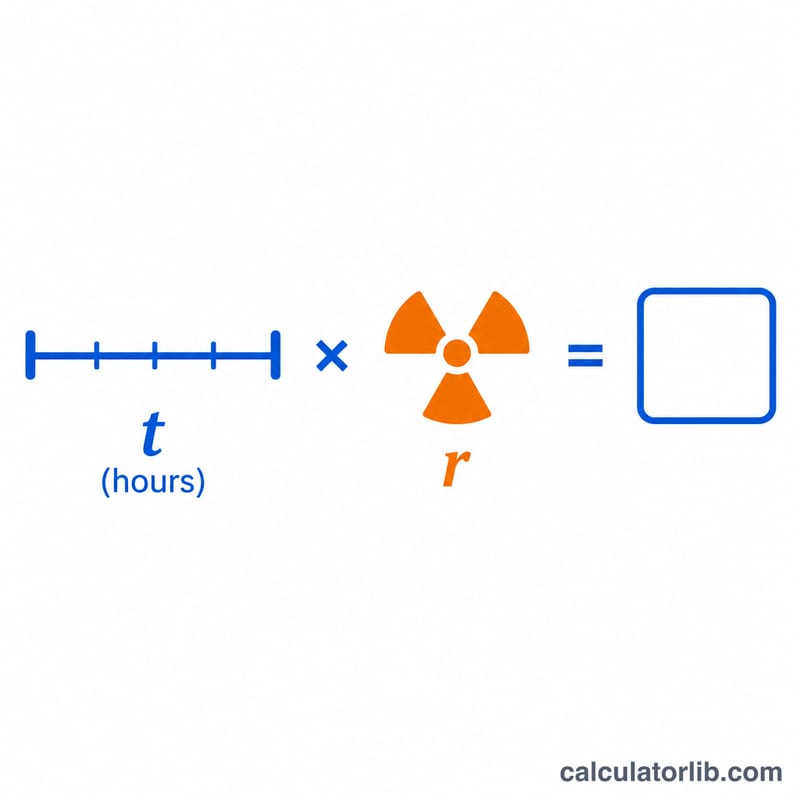
The model is simply
$$\text{Dose }(\mu Sv) = \text{Flight Hours} \times \text{Dose Rate }(\mu Sv/hr)$$Radiation dose accumulates roughly linearly with time spent at cruise altitude, so multiplying the time aloft by the per-hour rate gives a solid first-order estimate. The result is also divided by the average daily natural background dose (about 8.2 µSv, equivalent to roughly 3 mSv per year) so you can see how many "background days" your flight equals.
Worked Example
For a 10-hour transatlantic flight at a cruise dose rate of 3 µSv/hr:
$$\text{dose} = 10 \times 3 = 30 \ \mu Sv = 0.03 \ mSv$$That is about \(30 \div 8.2 \approx 3.7\) days of normal background radiation — a small fraction of what most people receive in a year.
FAQ
Is flying dangerous because of radiation? For occasional travelers, no. A single flight adds only a tiny amount compared with natural yearly background (~3 mSv). Frequent flyers and aircrew accumulate more.
Why does the dose rate vary? Cosmic radiation increases with altitude and latitude (it is highest near the poles) and changes with the solar cycle. Higher, more polar, longer flights mean more dose.
Is this medical advice? No. This is an educational estimate. For occupational monitoring, aircrew use dedicated dosimetry models and measurements.