
What is the MME Calculator?
This tool applies to the United States and uses the conversion factors published in the CDC opioid prescribing guidance. Morphine Milligram Equivalents (MME) express the potency of any opioid relative to oral morphine, allowing clinicians to compare doses across different drugs on a single scale. A higher total daily MME is associated with greater risk of overdose, so the metric is widely used for risk stratification.
How to use it
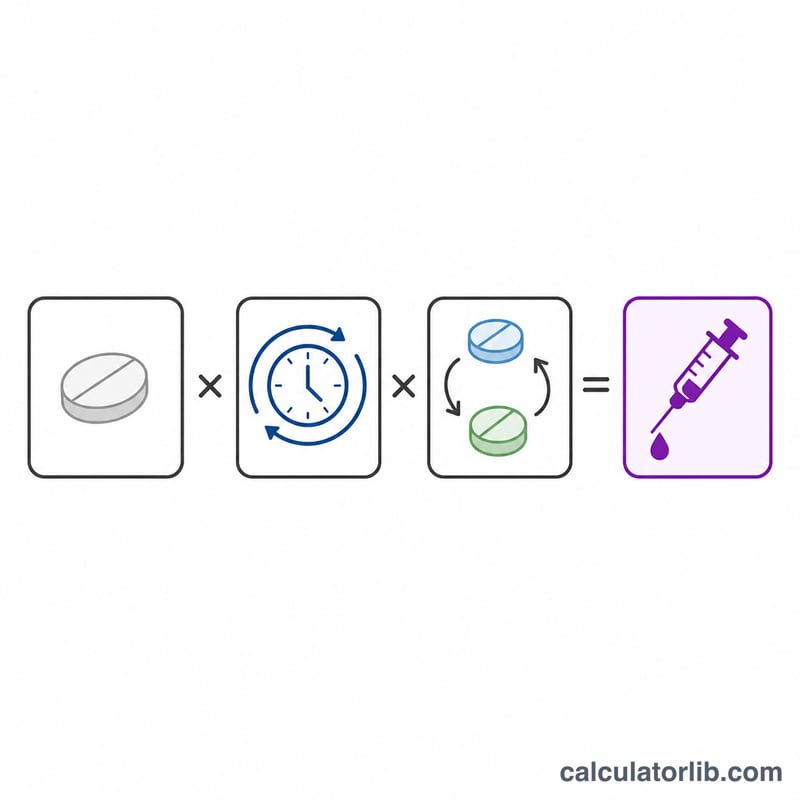
Select the opioid, enter the dose given each time (in mg, or mcg/hour for a fentanyl transdermal patch), and enter how many doses are taken per day. The calculator multiplies the dose by the frequency to get the total daily dose, then multiplies by the drug's conversion factor to produce MME/day. For a patient on multiple opioids, calculate each one separately and add the results.
The formula explained
$$\text{MME/day} = (\text{Dose} \times \text{Doses per day}) \times \text{Conversion Factor}$$ The conversion factor is a fixed per-drug multiplier: codeine \(0.15\), hydrocodone \(1\), morphine \(1\), oxycodone \(1.5\), oxymorphone \(3\), hydromorphone \(4\), tramadol \(0.1\), and transdermal fentanyl \(2.4\) (applied to mcg/hr).
Worked example
A patient takes 30 mg of oxycodone twice a day. Total dose per day = \(30 \times 2 = 60\) mg. Oxycodone's conversion factor is \(1.5\), so $$\text{MME/day} = 60 \times 1.5 = 90 \text{ MME}$$ The CDC flags reassessment of therapy at 50 MME/day and extra caution at 90 MME/day.
FAQ
Does fentanyl use the same units? No. For transdermal fentanyl patches, enter the patch strength in mcg/hour; the factor \(2.4\) converts that directly to MME/day, so set doses per day to 1.
How do I handle several opioids? Run the calculator once per drug and add the MME/day values for the patient's total.
Is this a clinical decision tool? No. It is an educational reference; always confirm conversions and use clinical judgment.